
Historical Bibliography Updated: July 14, 2026
A study of the structural unit of the liver.
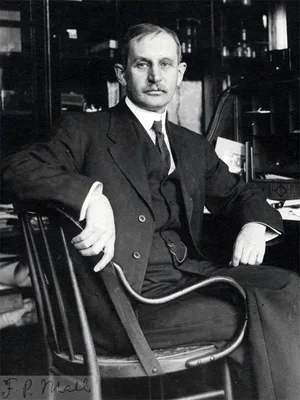
Amer. J. Anatomy 5, 227-308. 1906.
Mall defined the liver's structural unit as a tissue block centered on a portal vein, rather than the classic hepatic lobule centered on a central vein. He proposed that the structural unit of the liver is defined by its vascular and connective tissue, demonstrating how blood flows and mixes within the reticular framework. His name is still used today for the Space of Mall, which is the microscopic interstitial fluid space between the connective tissue of the portal canal and the outermost hepatocytes. Mall proved that the supporting framework (reticulum) of organs like the liver exists independently of the cells,
"Mall identified a microscopic fluid-filled space between the connective tissue of the portal triad and the hepatocytes (limiting plate). He demonstrated that this space serves as a pre-lymphatic conduit, where fluids from hepatic capillaries extravasate into the connective tissue before reaching the lymphatic vessels.
Reticular Network Discovery: Using "putrefaction" to digest cellular material, Mall revealed a three-dimensional reticular framework made of collagen and elastin that supports all organs. Modern research shows this framework defines the structure of the interstitium, acting as a scaffold for the fluid-filled "sinuses" that allow materials to flow throughout the body.
Structural Continuity: Mall was the first to propose that these fibroconnective layers (peri-arterial, peri-venous, and peri-biliary stroma) form an interconnected system rather than isolated compartments. This directly aligns with the modern definition of the interstitium as a continuous highway for fluid and cell movement across organ boundaries.
Functional Integration: His work integrated anatomy with physiology by showing how these interstitial spaces are critical for mixing materials from the hepatic artery and portal vein, facilitating the liver's role in lymphatic drainage and nutrient." (Google Gemini).
Facet Tags
| Catalog Metadata | Reference Information |
|---|---|
| Entry Number | #14351 |
| Permanent Link | https://historyofmedicine.com/id/16681 |
| Author Bio Link | Wikipedia ↗ |
| External URL | -a-study-of-the-structural-unit-of-the-liver |