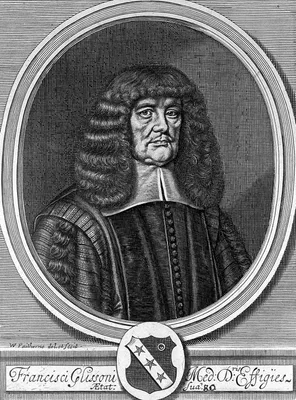
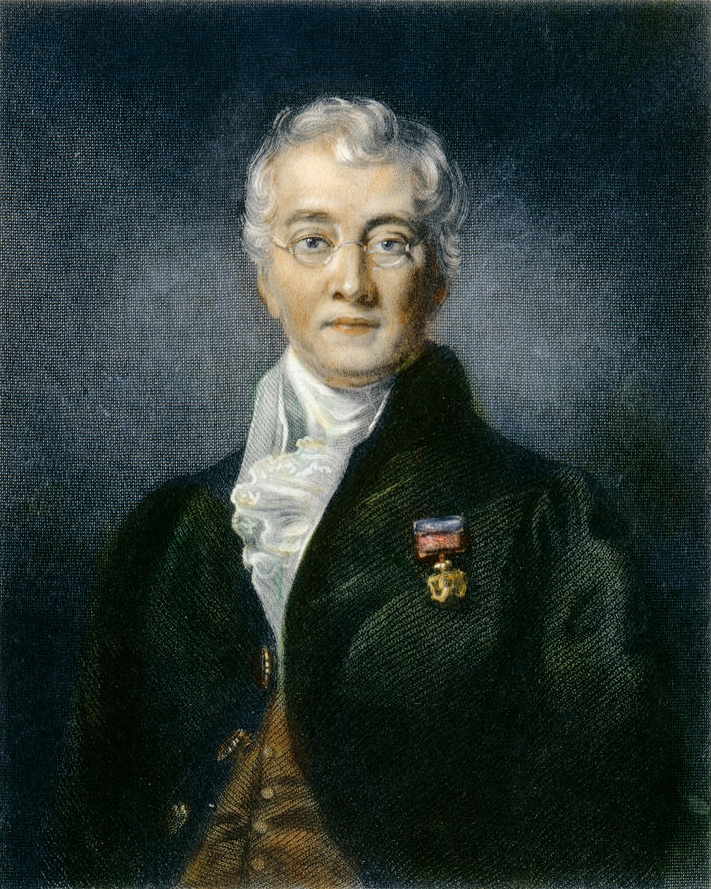
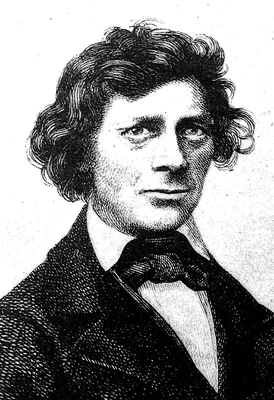
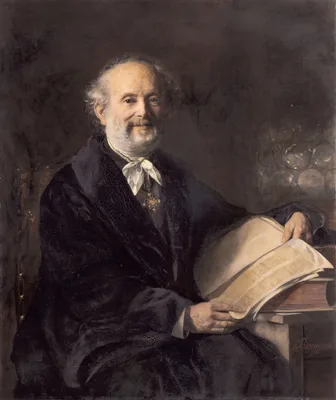
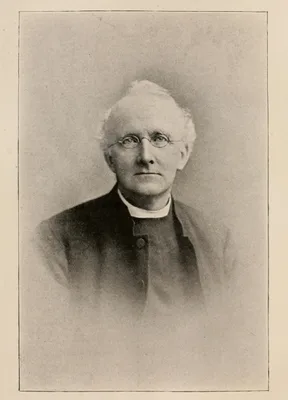
1650 GLISSON, Francis (1597 – 1677); BATE, George (1608 – 1668); REGEMORTER, Ahasuerus (Assuerus Regimorter) (1614 – 1650)
De rachitide sive morbo puerili, qui vulgo The Rickets dicitur tractatus.
Although anticipated by Whistler and others in the description of infantile rickets, Glisson’s account was the fullest that had till then appeared. He was first (Chap. 22) to describe infantile scurvy. Glisson’s book …
GMN 3729 · https://historyofmedicine.com/id/4509
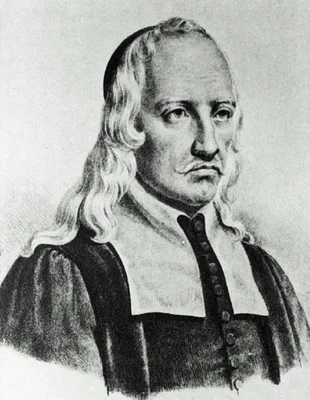
1667 BORELLI, Giovanni Alfonso (1608 – 1679)
De vi percussionis liber.
Building on the theory of mechanics as formulated by Aristotle and Galileo, and countering objections expressed by Stephani degli Angeli among others, Borelli presented a completely mechanical account of the action of…
GMN 9644 · https://historyofmedicine.com/id/11831
1680 –1681 BORELLI, Giovanni Alfonso (1608 – 1679)
De motu animalium. 2 pts.
Borelli originated the neurogenic theory of the heart’s action and first suggested that the circulation resembled a simple hydraulic system. He was the first to insist that the heart beat was a simple muscular contrac…
GMN 3669.3 · https://historyofmedicine.com/id/1749
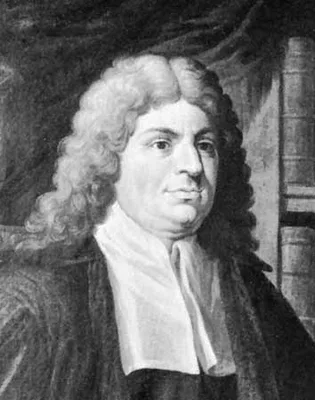
1683 BELLINI, Lorenzo (1643 – 1704)
De urinis et pulsibus de missione sanguinis de febribus de morbis capitis, et pectoris.
Bellini began to develop his hydraulic iatromechanics in this work, in which he considered the blood as a physical fluid with simple mechanical and mathematicizable properties. He realized the value of the urine as an…
GMN 4162 · https://historyofmedicine.com/id/1845
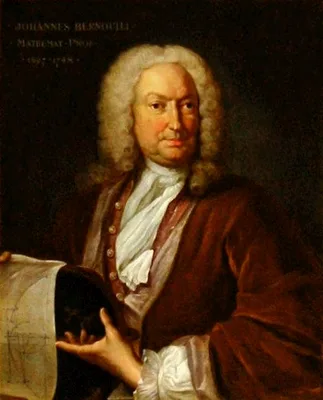
1694 BERNOULLI, Johann (1667 – 1740)
Dissertatio inauguralis physico-anatomica de motu musculorum.
Digital facsimile from e-rara.ch at this link. Facsimile edition translated into English, with a related thesis by Bernouilli, by Paul Macquet, assisted by August Zigellar, with an introduction by Troels Kardel as Dis…
GMN 10492 · https://historyofmedicine.com/id/12685
1738 STUART, Alexander (1673 – 1742)
Dissertatio de structura et motu musculari.
This was the text of the first Croonian Lecture at the Royal Society. In it Stuart promoted a strictly hydraulic iatromechanism as a theory of muscular motion. This work was translated into English in 1739. Digital fa…
GMN 11713 · https://historyofmedicine.com/id/13914
1833 BELL, Sir Charles (1774 – 1842)
The hand: Its mechanism and vital endowments as evincing design.
Classic work on the anatomy, physiology, bio-mechanics, comparative anatomy, and adaptive importance of the hand. Issued as a volume in a series entitled the "Bridgewater Treatises." The first edition has 288pp. An en…
GMN 411.1 · https://historyofmedicine.com/id/917
1836 WEBER, Eduard Friedrich Wilhelm (1806 – 1871); WEBER, Wilhelm Eduard (1804 – 1891)
Mechanik der menschlichen Gehwerkzeuge. 1 vol. and atlas.
A pioneering study of the physiology and biomechanics of motion and locomotion. The atlas contains four illustrations that were printed directly from actual bones embedded in plaster of Paris. This is one of the only …
GMN 604 · https://historyofmedicine.com/id/458
1873 HAUGHTON, Samuel (1821 – 1897)
Principles of animal mechanics.
Haughton stated that the muscular mechanism is so arranged that its work is carried out with the minimum of muscular contraction. This he called the “principle of least action”. His opposition to Darwinism is especial…
GMN 628 · https://historyofmedicine.com/id/510
1889 BRAUNE, Christian Wilhelm (1831 – 1892); FISCHER, Otto (1861 – 1917)
Über den Schwerpunkt des menschlichen Körpers mit Rücksicht auf die Ausrüstung des deutschen Infanteristen.
Translated into English by P.G.J. Maquet and R. Furlong as On the centre of gravity of the human body as related to the equipment of the German infantry soldier. Berlin: Springer-Verlag, 1985.
GMN 12646 · https://historyofmedicine.com/id/14887
1891 BRAUNE, Christian Wilhelm (1831 – 1892); FISCHER, Otto (1861 – 1917)
Die Bewegungen des Kniegelenkes.
Investigation of the mechanics of motion of the knee joint on mathematical lines. See also No. 645.
GMN 637 · https://historyofmedicine.com/id/517
1891 CHAUVEAU, Jean Baptiste Auguste (1827 – 1917)
Le travail musculaire et l’énergie qu’il représente.
Important studies on thermodynamics of muscular work.
GMN 638 · https://historyofmedicine.com/id/518
1892 WOLFF, Julius (1836 – 1902)
Das Gesetz der Transformation der Knochen.
“Wolff’s law” stated that every change in form and function of a bone, or in its function alone, is followed by certain definite changes in its internal architecture and equally definite secondary alterations in its m…
GMN 641 · https://historyofmedicine.com/id/520
1892 BRAUNE, Christian Wilhelm (1831 – 1892); FISCHER, Otto (1861 – 1917)
Bestimmung der Trägheitsmomente des menschlichen Körpers und seiner Glieder.
Translated into English by P. Maquet and R. Furlong as Determination of the moments of intertia of the human body and its limbs. Berlin: Springer-Verlag, 1988.
GMN 12647 · https://historyofmedicine.com/id/14888
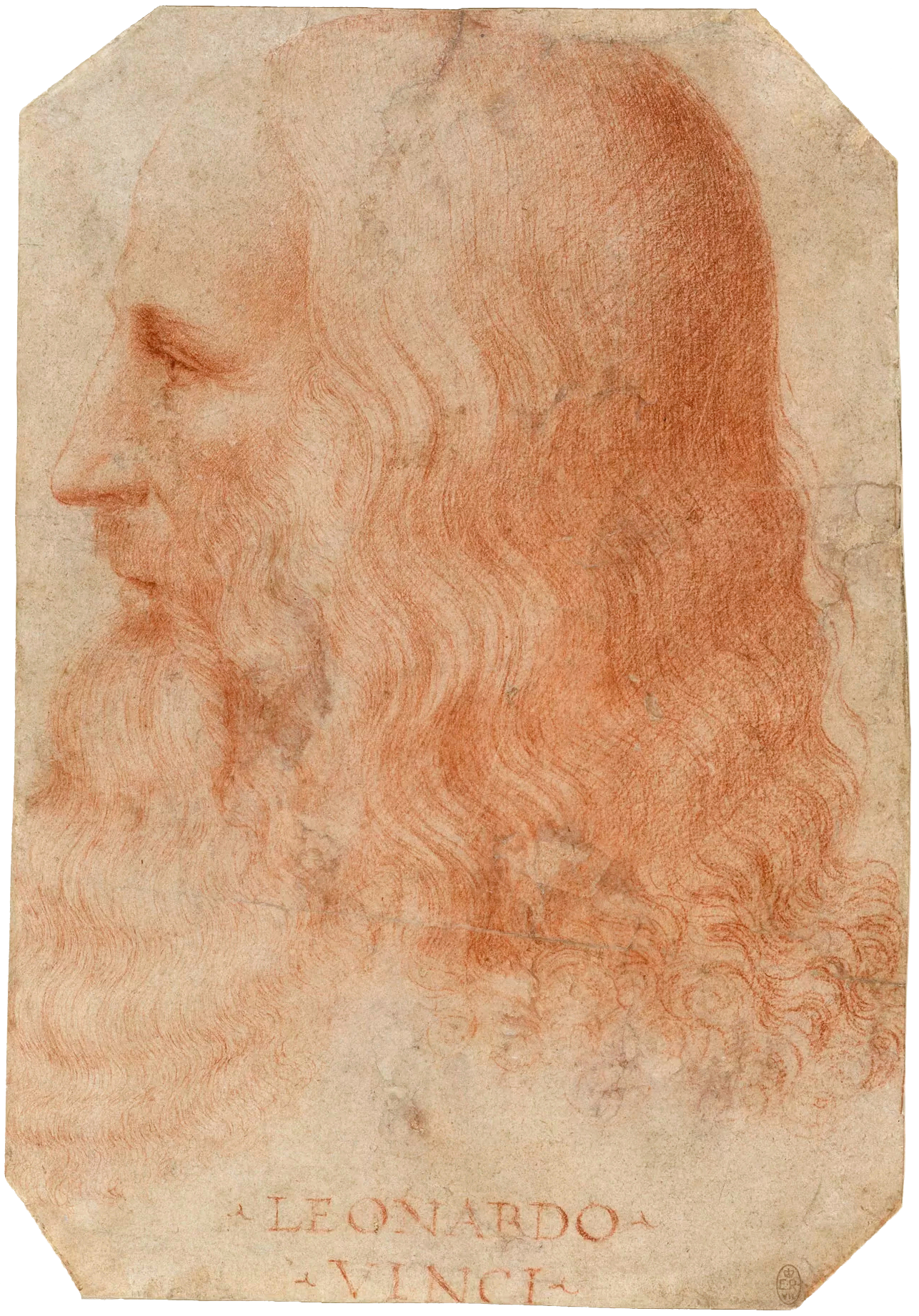
1893 LEONARDO DA VINCI (1452 – 1519); SABACHNIKOFF, Theodore (Fyodor Vasilyevich Sabašnikov) (1869 – 1927); PIUMATI, Giovanni (1850 – 1915); RAVAISSON-MOLLIEN, Charles Lacher (1849 – 1919)
Leonardo da Vinci: Codice sul volo degli uccelli e varie altre materie. Pubblicato da Teodoro Sabachnikoff. Transcrizione e note di Giovanni Piumati; traduzione francese di Carlo Ravaisson-Mollien.
The scientific study of the mechanics of flight begins with Leonardo’s investigations on birds, undertaken during his attempts to build a flying machine. At the time of publication Sabachnikoff owned the manuscript. A…
GMN 93 · https://historyofmedicine.com/id/53
1894 MAREY, Étienne Jules (1830 – 1904)
Le mouvement.
Marey, like Muybridge (No. 650-51), was a pioneer in the use of serial pictures as a method of studying the mechanics of locomotion. English translation, 1895.
GMN 643 · https://historyofmedicine.com/id/522
1895 –1904 BRAUNE, Christian Wilhelm (1831 – 1892); FISCHER, Otto (1861 – 1917)
Der Gang des Menschen. 1-6 Abt. (All published.)
Classic study of the human gait. The authors calculated the external and internal forces involved in walking and described the kinematics and kinetics of the movement. Because of Braune's death in 1892 he could only c…
GMN 645 · https://historyofmedicine.com/id/524
1899 MUYBRIDGE, Eadweard [JAMES EDWARD MUGGERIDGE] (1830 – 1904)
Animals in motion.
GMN 650 · https://historyofmedicine.com/id/528
1935 PAUWELS, Friedrich (1885 – 1980)
Der Schenkelhalsbruch, Ein mechanische Problem.
Pioneering study of the biomechanics of the hip joint.
GMN 4400.5 · https://historyofmedicine.com/id/6031
1961 ROBINETTE, Joan C.
Bionics Symposium. Living prototypes-the key to new technology. Wadd Technical Report 60-600. Edited by Joan C. Robinette.
GMN 13057 · https://historyofmedicine.com/id/15309
1973 PAUWELS, Friedrich (1885 – 1980)
Atlas zur Biomechanik der Gesunden und kranken Hüfte,
Translated into English by Ronald J. Furlong and Paul Maquet as Biomechanics of the normal and diseased hip. Theoretical foundation, technique and results of treatment: An atlas. Berlin: Springer-Verlag, 1976.
GMN 12648 · https://historyofmedicine.com/id/14889
1992 NIKLAS, Karl Joseph (1948 – )
Plant biomechanics: An engineering approach to plant form and function.
The first comprehensive treatment of plant biomechanics. "Niklas analyzes plant form and provides a far deeper understanding of how form is a response to basic physical laws. He examines the ways in which these laws c…
GMN 9186 · https://historyofmedicine.com/id/11367
2001 LATASH, Mark L.; ZATSIORSKY, Vladimir M. (1932 – )
Classics in movement science. Edited by Mark L. Latash and Vladimir M. Zatsiorsky.
GMN 12645 · https://historyofmedicine.com/id/14886