1907 WILSON, Henry Van Peters (1863 – 1939)
A new method by which sponges may be artificially reared.
In one of the first dissociation-reaggregation experiments Wilson demonstrated that mechanically dissociated sponge cells can reaggregate and self-organize to generate a whole organism. Digital facsimile from zenodo.o…
GMN 13333 · https://historyofmedicine.com/id/15601
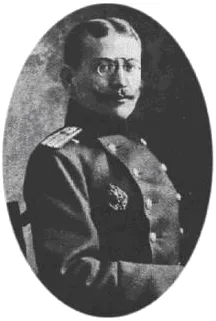
1909 MAXIMOW, Alexander Alexandrowitsch (1874 – 1928)
Der Lymphozyt als gemeinsame Stammzelle der verschiedenen Blutelemente in der embryonalen Entwicklung und im postfetalen Leben der Säugetiere.
Maximow developed and introduced a unitarian theory of hematopoiesis, a theory upon which the modern concept of blood cells' origin and differentiation is based. He introduced the term "stem cell." Translated into Eng…
GMN 12426 · https://historyofmedicine.com/id/14657
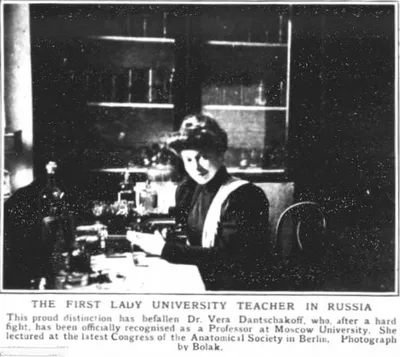
1916 DANCHAKOFF, Vera Mikhailovna (1879 – 1950)
The differentiation of cells as a criterion for cell identification, considered in relation to the small cortical cells of the thymus.
First use of the term "stem cells" in English. Digital facsimile from rupress.org at this link.
GMN 14094 · https://historyofmedicine.com/id/16405
1959 MATHÉ, Georges (1922 – 2010); JAMMET, H.; PENDIC, B.; ET AL
Transfusions et greffes de moelle osseuse homologue chez des humains irradiés a haute dos accidentellement.
Order of authorship in the original publication: Mathé, Jammet, Pendic et al. Mathé performed the first bone marrow graft between unrelated donors and hosts in order to save six Yugoslavian nuclear researchers who had…
GMN 13334 · https://historyofmedicine.com/id/15602
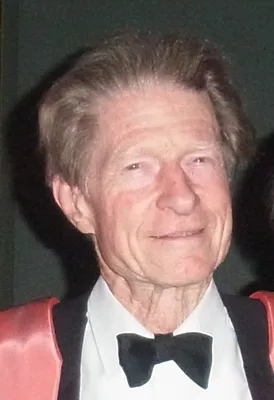
1962 GURDON, Sir John Bertrand (1933 – )
Adult frogs derived from the nuclei of single somatic cells.
Demonstration that somatic and germinal nuclei are genetically equivalent. Using somatic cell nuclear transfer (SCNT), Gurdon (Nobel Prize 2012) transplanted cell nuclei from mature intestinal tadpole cells into enucl…
GMN 256.12 · https://historyofmedicine.com/id/8709
1963 MCCULLOCH, Ernest Armstrong (1926 – 2011); TILL, James Edgar (1931 – ); BECKER, Andrew John (1935 – 2015)
Cytological demonstration of the clonal nature of spleen colonies derived from transplanted mouse marrow cells.
McCulloch and Till discovered the blood-forming stem cell, the hematopoietic stem cell (HSC), through their pioneering work in mice. McCulloch and Till began a series of experiments in which bone marrow cells were inj…
GMN 12427 · https://historyofmedicine.com/id/14658
1963 MCCULLOCH, Ernest Armstrong (1926 – 2011); TILL, James Edgar (1931 – ); SIMINOVITCH, Louis "Lou" (1920 – )
The distribution of colony-forming cells among spleen colonies.
Evidence that stem cells are capable of self-renewal. (Order of authorship in the original publication: Siminovitch, McCullch, Till). Digital facsimile from tspace.library.utoronto.ca at this link.
GMN 12428 · https://historyofmedicine.com/id/14659
1966 GURDON, Sir John Bertrand (1933 – ); UEHLINGER, V.
"Fertile" intestine nuclei.
Gurdon and Uehlinger replaced the cell nucleus of frog ova with frog intestinal nuclei to generate tadpoles, some of which became fertile adult male and female frogs. In 2012 the Nobel Prize in Physiology or Medicine …
GMN 14064 · https://historyofmedicine.com/id/16375
1981 EVANS, Sir Martin John (1941 – ); KAUFFMAN, Matthew H. (1942 – 2013)
Establishment in culture of pluripotential cells from mouse embryos.
Evans and Kauffman were the first to identify, isolate and successfully culture embryonic stem cells using mouse blastocysts. This discovery opened the doors to the creation of “murine genetic models” -- mice that hav…
GMN 13285 · https://historyofmedicine.com/id/15551
1981 MARTIN, Gail Roberta (1944 – )
Isolation of a pluripotent cell line from early mouse embryos cultured in medium conditioned by teratocarcinoma stem cells (embryonic stem cells/inner cell masses/differentiation in vitro/embryonal carcinoma cells/growth factors) .
Martin used a different approach that avoided in vivo alteration. She reasoned that an ES cell line might be obtained by culturing cells isolated from blastocysts in a medium that had previously been conditioned by an…
GMN 13961 · https://historyofmedicine.com/id/16263
1997 WILMUT, Sir Ian (1944 – ); CAMPBELL, Keith Henry Stockman (1954 – 2012)
Viable offspring derived from fetal and adult mammalian cells.
Cloning of the lamb Dolly, the first mammal to be cloned from an adult cell. Her birth established that the nuclei of at least some adult cells can be used to produce sheep or other animals that are genetically identi…
GMN 7457 · https://historyofmedicine.com/id/9629
1998 THOMSON, James Alexander (1958 – ); ITSKOVITZ-ELDOR, Joseph; SHAPIRO, Sander S.; ET AL
Embryonic stem cell lines derived from human blastocysts.
Thomson and collaborators first isolated embryonic stem cells from human blastocysts. Order of authorship in original publication: Thomson, Itskovitz-Eldor, Shapiro et al. Available online from science.sciencemag.org …
GMN 13286 · https://historyofmedicine.com/id/15552
1998 GEARHEART, John D. (1943 – 2020); SHAMBLOTT, Michael J.; AXELMAN, Joyce; ET AL
Derivation of pluripotent stem cells from cultured human primordial germ cells.
Order of authorship in the original publication: Shamblott, Axelman,... Gearheart. Gearheart led the team that successfully developed human embryonic germ cells, pluripotent stem cells derived from primordial germ cel…
GMN 13977 · https://historyofmedicine.com/id/16280
2002 COMMITTEE ON THE BIOLOGICAL AND MEDICAL APPLICATIONS OF STEM CELL RESEARCH
Stem cells and the future of regenerative medicine.
In 2001 this report cited the following diseases with high prevalence in the United States as likely candidates for stem cell research: Cardiovascular Disease: 58 million U.S. patients Automimmune Disease: 30 million …
GMN 13598 · https://historyofmedicine.com/id/15877
2006 YAMANAKA, Shinya (1962 – ); TAKAHASHI, Kazutoshi
Induction of pluripotent stem cells from mouse embryonic and adult fibroblast cultures by defined factors.
Takahashi and Yamanaka reprogrammed mice fibroblast cells, which can produce only other fibroblast cells, to become pluripotent stem cells, which have the capacity to produce many different types of cells. This they a…
GMN 13287 · https://historyofmedicine.com/id/15553
2007 YAMANAKA, Shinya (1962 – ); TAKAHASHI, Kazutoshi; TANABE, Koji; OHNUKI, Mari
Induction of pluripotent stem cells from adult human fibroblasts by defined factors.
Yamanaka (Nobel Prize 2012) and colleagues demonstrated the generation of Induced Pluripotent Stems Cells (iPS) from adult human dermal fibroblasts with the same 4 mice factors they used in GM 13287. By overexpressing…
GMN 14063 · https://historyofmedicine.com/id/16374
2009 HÜTTER, Gero (1968 – ); ET AL
Long-term control of HIV by CCR5 Delta32/Delta32 stem-cell transplantation.
Gero Hütter and co-authors reported the first long-term remission or "cure" of HIV/AIDS in a human. The patient, Timothy Ray Brown also known as "The Berlin Patient" also suffered from myeloid leukemia and underwent s…
GMN 10775 · https://historyofmedicine.com/id/12971
2009 CLEVERS, Johannes Carolus "Hans" (1957 – ); SATO, Toshiro; DE VRIES, Robert P.; ET AL
Single Lgr5 stem cells build crypt-villus structures in vitro without a mesenchymal niche.
Order of authorship in the original publication: Sato, de Vries, .... Clevers. Clevers and postdoc Toshiro Sato took adult stem cells from the mouse intestine and created the first mini-guts they called organoids—thre…
GMN 13335 · https://historyofmedicine.com/id/15603
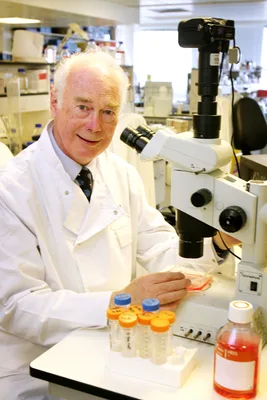
2011 PRESCOTT, Catherine D.; POLAK, Dame Julia Margaret (1939 – 2014)
The delivery of regenerative medicines and their impact on healthcare. Edited by Catherine D. Prescott and Dame Julia Polak.
GMN 13319 · https://historyofmedicine.com/id/15586
2013 INSTITUTE OF MEDICINE OF THE NATIONAL ACADEMIES
The California Institute for Regenerative Medicine. Science, governance, and the pursuit of cures
The California Institute for Regenerative medicine was the first state-fund institution that provided stable, in-state funding on a very large scale for biomedical research. "The California Institute for Regenerative …
GMN 13284 · https://historyofmedicine.com/id/15550
2018 LIU, Zhen; CAI, Yijun; SUN, Qiang; ET AL
Cloning of Macaque monkeys by somatic cell nuclear transfer.
The authors at the Chinese Academy of Sciences in Shanghai reported the first cloning of a non-human primate. Full text available from cell.com at this link. Order of authorship in the original publication: Liu, Cai..…
GMN 14146 · https://historyofmedicine.com/id/16460
2020 REED, Don C.
Revolutionary therapies: How the California Stem Cell Program saved lives, eased suffering - and changed the face of medicine forever.
GMN 13332 · https://historyofmedicine.com/id/15600