1598 PÉREZ DE HERRERA, Cristóbal (1558 – 1620)
Discvrsos del amparo de los legitimos pobres.
A plan for a state-funded public health system and poor relief program. An emblem introduces each of the ten essays, which treat hospital sanitation and kitchen gardens, care of disabled veterans, prisoners and the in…
GMN 10727 · https://historyofmedicine.com/id/12921
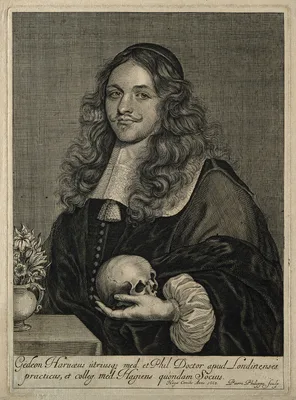
1676 HARVEY, Gideon (1640 – 1700)
The family physician, and the house apothecary: Containing I. Medicines against all such diseases people usually advise with apothecaries to be cured of, II. Instructions, whereby to prepare at your own houses all kinds of necessary medicines that are prepared by apothecaries, or prescribed by physicians, III. The exact prices of all drugs, herbs, seeds, simple and compound medicines, as they are sold at the druggists, or may be sold by the apothecaries, IV. That it's plainly made to appear, that in preparing medicines thus at your own houses, that it's not onely a far safer way, but you shall also save nineteen shillings in twenty, comparing it with the extravagant rates of many apothecaries.
The text of the second edition (1678) is available from Early English Books Online at this link.
GMN 9511 · https://historyofmedicine.com/id/11696
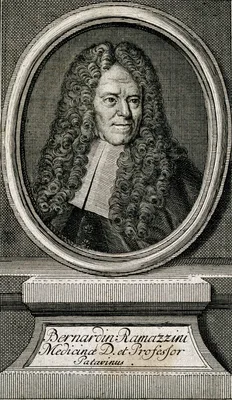
1700 RAMAZZINI, Bernardino (1633 – 1714)
De morbis artificum diatriba.
Ramazzini's study of the diseases of workers, De morbis artificium diatriba, was the first comprehensive and systematic treatise on occupational medicine; it was also the foundation work in ergonomics. It deals with p…
GMN 2121 · https://historyofmedicine.com/id/79
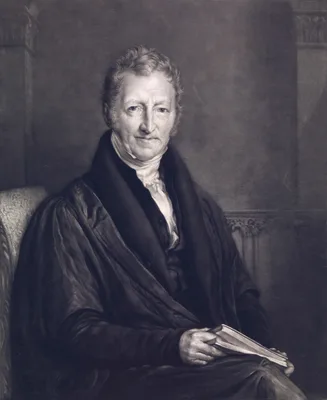
1798 MALTHUS, Thomas Robert (1766 – 1834)
An essay on the principle of population, as it affects the future improvement of society.
Malthus laid down the principle that populations increase in geometrical ratio, but that subsistence increases only in arithmetical ratio. He argued that a stage is reached where increase of populations must be limite…
GMN 1693 · https://historyofmedicine.com/id/8809
1822 RAMAZZINI, Bernardino (1633 – 1714); PATISSIER, Philibert (1791 – 1863)
Traité des maladies des artisans, et de celles qui résultent des diverse professions, d'après Ramazzini; Ouvrage dans lequel on indique les précautions que doivent prendre, sous le rapport de la salubrité publique et particulière, les fabricans, les manufacturiers, les chefs d'ateliers, les artistes, et toutes les personnes qui exercent des professions insalubres.
This second French edition of Ramazzini's De morbis artificum diabriba by Philibert Patissier provides so much new material on the diseases of workers in France as to virtually double the length of Ramazzini’s text. D…
GMN 9326 · https://historyofmedicine.com/id/11508
1830 SMITH, Thomas Southwood (1788 – 1861)
A treatise on fever.
Both a doctor and a minister, Smith, physician to the London Fever Hospital, called himself, “physician to body and soul.” He argued that the poor are impoverished by fever and that fever was preventable. This book in…
GMN 2211 · https://historyofmedicine.com/id/1689
1831 THACKRAH, Charles Turner (1795 – 1833)
The effects of the principal arts, trades and professions, and of civic states and habits of living on health and longevity.
The first systematic publication in Great Britain on industrial disease and its prevention. For comprehensiveness, first-hand clinical experience and constructive proposals for improvements, Thackrah’s monograph is su…
GMN 2123 · https://historyofmedicine.com/id/2637
1836 –1837 MCCREADY, Benjamin William (1813 – 1892)
On the influence of trades, professions, and occupations, in the United States in the production of disease.
The first American work devoted entirely to occupational diseases. Reprinted with introduction, Baltimore, Johns Hopkins Press, 1943.
GMN 2123.1 · https://historyofmedicine.com/id/2639
1837 MCCULLOCH, John Ramsay (1789 – 1864)
A descriptive and statistical account of the British Empire, exhibiting its extent, physical capacities, population, industry and civil and religious institutions. 2 vols.
McCulloch indicated on the title page that he was "assisted by numerous contributors." Digital facsimile from the Hathi Trust at this link. Fourth edition, revised with an appendix of tables (2 vols., 1854). Digital f…
GMN 9651 · https://historyofmedicine.com/id/11838
1850 SAN FRANCISCO MEDICAL SOCIETY
Constitution, by-laws and fee bill of the San Francisco Medical Society: Organized June 22, 1850.
This 8-page pamphlet is one of the earliest separate publications relating to medicine printed in the State of California. The "Society" disbanded shortly after this was published, perhaps over disputes concerning the…
GMN 11306 · https://historyofmedicine.com/id/13504
1902 OLIVER, Sir Thomas (1853 – 1942)
Dangerous trades: the historical, social, and legal aspects of industrial occupations as affecting health, by a number of experts.
A collective work edited by Oliver. Digital fascimile from the Internet Archive at this link.
GMN 2129 · https://historyofmedicine.com/id/2663
1905 MATHEWS, Joseph McDowell (1847 – 1928)
How to succeed in the practice of medicine.
Digital facsimile from the Internet Archive at this link.
GMN 8713 · https://historyofmedicine.com/id/10891
1926 BUER, M. C.
Health, wealth and population in the early days of the industrial revolution.
Chapters on water supply, 18th physicians and pioneers of public health, the hospital and dispensary movement, general hygiene and midwifery, rickets and scurvy, antiseptics, smallpox, anti-typhus campaign, malaria, etc.
GMN 10467 · https://historyofmedicine.com/id/12660
1926 GRIFFITH, Grosvenor Talbot (1899 – 1981)
Population problems of the age of Malthus.
Includes chapters on birth and marriage rates relating to conditions of employment, also the influence of the Poor Laws on these rates. Other chapters concern agriculture and food and health of towns and factores, and…
GMN 10468 · https://historyofmedicine.com/id/12661
1931 NEWSHOLME, Sir Arthur (1857 – 1943)
International studies of the relation between the private & official practice of medicine with special reference to the prevention of disease. Vol. 1: The Netherlands, Scandinavia, Germany, Austria, Switzerland. Vol. 2: Belgium, France, Italy, Jugo-Slavia, Hungary, Poland, Czecho-Slovakia. Vol. 3: England and Wales, Scotland, Ireland.(3 vols.)
Contains almost no references to prior literature.
GMN 8887 · https://historyofmedicine.com/id/11065
1932 COMMITTEE ON THE COSTS OF MEDICAL CARE
Medical care for the American people. The final report of the Committee on the Costs of Medical Care.
See Gore, "A forgotten landmark medical study from 2932 by the Committee on the Cost of Medical Care," Proc (Bayl Univ Med Cent). 2013 Apr; 26 (2): 142–143. Available from PubMedCentral at this link. See also, Ross, "…
GMN 8074 · https://historyofmedicine.com/id/10250
1933 FALK, Isidore Sydney (1899 – 1984); ROREM, Clarence Rufus (1894 – 1988); RING, Martha D.
The costs of medical care: A summary of investigations on the economic aspects of the prevention and care of illness.
GMN 8075 · https://historyofmedicine.com/id/10251
1933 FALK, Isidore Sydney (1899 – 1984); SINAI, Nathan (1894 – ); KLEM, Margaret C.
The incidence of illness and the receipt and costs of medical care among representative families. Experiences in twelve consecutive months during 1928-1931. Publications of the Committee on the Costs of Medical Care : No. 26.
Digital facsimile from Hathi Trust at this link.
GMN 8079 · https://historyofmedicine.com/id/10255
1935 CABOT, Hugh (1872 – 1945)
The doctor's bill. With an introduction by A. Lawrence Powell.
Digital facsimile from the Hathi Trust at this link.
GMN 8619 · https://historyofmedicine.com/id/10796
1940 CABOT, Hugh (1872 – 1945)
The patient’s dilemma: The quest for medical security in America.
Cabot advocated the group practice of medicine and for budgeted prepayment systems for healthcare.
GMN 13352 · https://historyofmedicine.com/id/15623
1943 KRUIF, Paul Henry de (1890 – 1971)
Kaiser wakes the doctors.
The first book on what became the Kaiser Permanente health plan, initially set up by Henry J. Kaiser to provide health care for his 200,000 workers.
GMN 8180 · https://historyofmedicine.com/id/10356
1949 ROTHENBERG, Robert Edward (1909 – 2002); PICKARD, Karl
Group medicine & health insurance in action.
"The Health Insurance Plan of Greater New York was established in March, 1947 for the specific purpose of accumulating the required experience under carefully controlled conditions. In order to assemble measurable dat…
GMN 8885 · https://historyofmedicine.com/id/11063
1951 WINSLOW, Charles-Edward Amory (1877 – 1957)
The cost of sickness and the price of health. WHO Monograph Series 7.
Digital facsimile from WHO.int at this link.
GMN 9266 · https://historyofmedicine.com/id/11448
1956 COHN-HAFT, Louis (1920 – 2012)
The public physicians of ancient Greece. (Smith College Studies in History, Vol. XLII.)
Re-examination of the question of whether the public physicians employed by the Greek city-states derived their entire income from their salaried positions and thus provided free medical care or whether they received …
GMN 6485 · https://historyofmedicine.com/id/7952
1961 SOMERS, Herman Miles (1911 – 1991); SOMERS, Anne
Doctors, patients, and health insurance: The organization and financing of medical care.
GMN 8764 · https://historyofmedicine.com/id/10942
1968 ANDERSON, Odin Waldemar (1914 – 2003)
An uneasy equilibrium: Private and public financing of health service in the United States 1875-1965.
The central theme of this book is that health policy in the Unitesd States is the product of a deep ambivalence in public attitudes that on the one hand support a private, market-oriented health provision system, whil…
GMN 9134 · https://historyofmedicine.com/id/11313
1970 BEAMISH, Robert Earl (1916 – 2001)
New horizons in health care. Proceedings First International Congress on Group Medicine. Edited by Robert Beamish.
Addresses the goal of "the provision of adequate health care for every citizen."
GMN 8605 · https://historyofmedicine.com/id/10782
1971 ELWOOD, Paul M. Jr. (1926 – ); ET AL
Health maintenance strategy.
Elwood is often referred to as the "father of the health maintenance organization. He not only coined the term, he also played a role in bringing about structural changes to the American health care system to simultan…
GMN 8327 · https://historyofmedicine.com/id/10503
1974 STEVENS, Robert; STEVENS, Rosemary A.
Welfare medicine in America: A case study of Medicaid.
The first study of Medicaid. Revised edition, 2003.
GMN 8769 · https://historyofmedicine.com/id/10947
1982 STARR, Paul (1949 – )
The social transformation of American medicine: The rise of a sovereign profession and the making of a vast industry.
GMN 6596.6 · https://historyofmedicine.com/id/8509
1985 GRITZER, Glenn; ARLUKE, Arnold (1947 – )
The making rehabilitation: A political economy of medical specialization, 1890-1980.
GMN 10094 · https://historyofmedicine.com/id/12283
1989 RUTKOW, Ira Michael (1948 – 2026)
Socioeconomics of surgery.
Probably the first book-form study of these issues.
GMN 7763 · https://historyofmedicine.com/id/9935
1989 STEVENS, Rosemary A.
In sickness and in wealth: American hospitals in the twentieth century.
GMN 9138 · https://historyofmedicine.com/id/11317
1993 HENDRICKS, Ricky
A model for national health care: The history of Kaiser Permanente.
GMN 8179 · https://historyofmedicine.com/id/10355
1995 SLOAN, Frank Allen (1942 – )
Valuing health care: Costs, benefits, and effectiveness of pharmaceuticals and other medical technologies. Edited by Frank A. Sloan.
GMN 13317 · https://historyofmedicine.com/id/15584
1999 KOOIJMAN, Jaap W.
... And the pursuit of national health: The incremental strategy toward national health insurance in the United States of America.
GMN 8078 · https://historyofmedicine.com/id/10254
2000 MACK, Connie III (1940 – )
The benefits of medical research and the role of the NIH.
According to Senator Mack's report, the economic costs of illness in the U.S. were approximately $3 trillion annually, representing 31% of the nation’s GDP. This included “direct” costs of public and private health ca…
GMN 13318 · https://historyofmedicine.com/id/15585
2002 COMMITTEE ON THE BIOLOGICAL AND MEDICAL APPLICATIONS OF STEM CELL RESEARCH
Stem cells and the future of regenerative medicine.
In 2001 this report cited the following diseases with high prevalence in the United States as likely candidates for stem cell research: Cardiovascular Disease: 58 million U.S. patients Automimmune Disease: 30 million …
GMN 13598 · https://historyofmedicine.com/id/15877
2004 PERKINS, Barbara Bridgman
The medical delivery business: Health reform, childbirth, and the economic order.
GMN 10553 · https://historyofmedicine.com/id/12746
2005 COOMBS, Jan Gregoire
The rise and fall of HMOs: An American health care revolution.
A broad historical overview of HMOs with a close analysis of one institution, the Marshfield Clinic in northern Wisconsin.
GMN 8328 · https://historyofmedicine.com/id/10504
2007 ILARDI, Vincent (1926 – 2009)
Renaissance vision from spectacles to telescopes.
Through an examination of original economic documents, as well as scientific documents, Ilardi discovered that Florence rather than Venice was the 15th-century center for making eye glasses and that lenses for farsigh…
GMN 7775 · https://historyofmedicine.com/id/9947
2007 MURRAY, John E. (1959 – )
Origins of American health insurance: A history of industrial sickness funds.
GMN 8077 · https://historyofmedicine.com/id/10253
2007 DUTTON, Paul V.
Differential diagnoses: A comparative history of health care problems and solutions in the United States and France.
GMN 11575 · https://historyofmedicine.com/id/13774
2008 BOYCHUK, Gerald William (1967 – )
National health insurance in the United States and Canada: Race, territory, and the roots of difference.
Explores why two countries that were very similar in many ways, struck out on radically divergent paths to public health insurance. Canada developed a universal single-payer system of national health care, while the U…
GMN 8080 · https://historyofmedicine.com/id/10256
2009 FISHER, Jill A.
Medical research for hire: The political economy of pharmaceutical clinical trials.
GMN 8645 · https://historyofmedicine.com/id/10822
2009 JACOBS, Philip; RAPOPORT, John; JONSSON, Egon
Cost containment and efficiency in national health systems: A global comparison. Edited by John Rapoport, Philip Jacobs, and Egon Jonsson.
Comparison of systems in Canada, England, Finland, Germany, The Netherlands, Japan, New Zealand, Sweden.
GMN 8708 · https://historyofmedicine.com/id/10886
2010 BARONA VILAR, Josep Lluís (1955 – )
The problem of nutrition: Experimental science, public health and economy in Europe 1914-1945.
GMN 8060 · https://historyofmedicine.com/id/10236
2011 PRESCOTT, Catherine D.; POLAK, Dame Julia Margaret (1939 – 2014)
The delivery of regenerative medicines and their impact on healthcare. Edited by Catherine D. Prescott and Dame Julia Polak.
GMN 13319 · https://historyofmedicine.com/id/15586
2012 MARCHILDON, Gregory P. (1956 – )
Making Medicare: New perspectives on the history of Medicare in Canada.
GMN 8093 · https://historyofmedicine.com/id/10269
2013 REINARZ, Jonathan; SCHWARZ, Leonard
Medicine and the workhouse. Edited by Jonathan Reinarz and Leonard Schwarz.
The first in depth study of the history of the medical services provided by workhouses, both in Britain and its former colonies, during the eighteenth and nineteenth centuries. Throughout this period workhouses were a…
GMN 10541 · https://historyofmedicine.com/id/12734