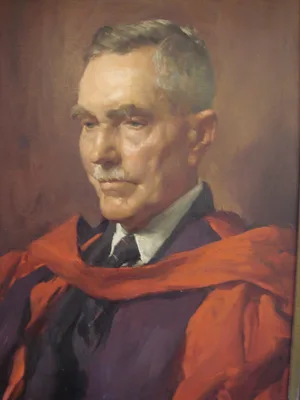
1846 DUBINI, Angelo (1813 – 1902)
Primi cenni sulla corea elettrica.
First description of electric chorea, “Dubini’s chorea”, the myoclonic form of epidemic encephalitis.
GMN 4637 · https://historyofmedicine.com/id/702
1847 GRUNER, Christian Gottfried (1744 – 1815)
Scriptores de sudore anglico superstites. Colliget C. G. Gruner. Post mortem auctoris adomavit et edidit H. Haeser.
A collection of all the important earlier writings on sweating sickness.
GMN 5524 · https://historyofmedicine.com/id/6614
1847 PANUM, Peter Ludvig (1820 – 1885)
Iagttagelser, anstillede under Maeslinge-Epidemien paa Faerøerne i Aaret 1846.
When only 26 years of age, Panum was sent by the Danish Government to investigate the epidemic of measles then raging in the Faroe Islands. His report on the subject was a valuable contribution to medical literature. …
GMN 5443 · https://historyofmedicine.com/id/7478
1848 VIRCHOW, Rudolf Ludwig Karl (1821 – 1902)
Mittheilungen über die in Oberschlesien herrschende Typhus-Epidemie.
Virchow was one of the first to identify medicine as a social science. He developed a theory of epidemics that emphasized the social circumstances permitting spread of illness. This approach has been called sociologic…
GMN 12083 · https://historyofmedicine.com/id/14292
1849 SNOW, John (1813 – 1858)
On the pathology and mode of communication of the cholera.
Snow first became interested in cholera at Newcastle-on-Tyne during the epidemic of 1831-1832, and recurrent outbreaks of the disease gave him the opportunity to investigate it in detail. His paper on cholera, publish…
GMN 5106 · https://historyofmedicine.com/id/6042
1849 MITCHELL, John Kearsley (1793 – 1858)
On the cryptogamous origin of malarious and epidemic fevers.
Although Hensinger in 1844 had suggested a parasite as the cause of malaria, Mitchell was the first to approach this theory in a scientific spirit. He was Professor of Medicine at Jefferson College, and the father of …
GMN 5234 · https://historyofmedicine.com/id/7880
1849 SNOW, John (1813 – 1858)
On the mode of communication of cholera.
Publication of Snow's 31-page pamphlet on cholera preceded his paper in the London Medical Gazette by about one month.
GMN 9981 · https://historyofmedicine.com/id/12170
1852 THOMPSON, Theophilus (1807 – 1860)
Annals of influenza or epidemic catarrhal fever in Great Britain from 1510-1837.
GMN 5489 · https://historyofmedicine.com/id/6432
1855 PETTENKOFER, Max Josef von (1818 – 1901)
Unterschungen und Beobachtungen über die Verbreitungsart der Cholera.
Pettenkofer gave much attention to the etiology of cholera. He postulated the theory that a specific germ, certain local conditions, certain seasonal conditions, and certain individual conditions are all necessary for…
GMN 5107 · https://historyofmedicine.com/id/6046
1855 LA ROCHE, René (1795 – 1872)
Yellow fever, considered in its historical, pathological, etiological, and therapeutical relations: including a sketch of the disease as it has occurred in Philadelphia from 1699 to 1854, with an examination of the connections between it and the fevers known under the same name in other parts of temperate, as well as in tropical, regions. 2 vols.
The most important 19th century American monograph on yellow fever. La Roche’s work sketched the disease in its appearances from 1699 to 1854 at Philadelphia, which saw some of the worst yellow fever epidemics, and pr…
GMN 5454.2 · https://historyofmedicine.com/id/7545
1855 SNOW, John (1813 – 1858)
On the mode of communication of the cholera. Second edition, much enlarged.
The second edition of Snow's book on cholera, with 162pp. compared to 31pp. in the first edition, incorporated the results of five more years of research, and contained so much additional material that it was essentia…
GMN 9982 · https://historyofmedicine.com/id/12171
1858 FOURGEAUD, Victor Jean (1817 – 1875)
Diphtheritis: A concise historical and critical essay on the late epidemic pseudo-membranous sore throat of California (1856-7), with a few remarks illustrating the diagnosis, pathology, and treatment of the disease.
For publishing this 46-page pamphlet Fourgeaud has been called "California's first medical historian." Digital facsimile from U.S. National Library of Medicine at this link.
GMN 12152 · https://historyofmedicine.com/id/14362
1859 LOGAN, Thomas Muldrup (1808 – 1876)
Report on the medical topography and epidemics of California.
Logan provided an updated report with the same title in 1865. Digital facsimile of the 1865 report from U.S. National Library of Medicine at this link.
GMN 11304 · https://historyofmedicine.com/id/13502
1865 HIRSCH, August (1817 – 1894); HECKER, Justus Friedrich Karl (1795 – 1850)
Die grossen Volkskrankheiten des Mittelalters. Historischpathologische Untersuchungen. Von J. F. K. Hecker. Gesammelt und in erweiteter Bearbeitung hrsg. von A. Hirsch.
A collection of essays on the Black Death, the dancing mania, and the English sweat, published 1832-34 and later in a collective English edition, The epidemics of the Middle Ages, 2 pts., London, 1833-35; reprinted 18…
GMN 1678 · https://historyofmedicine.com/id/2353
1866 HIRSCH, August (1817 – 1894)
Die Meningitis cerebro-spinalis epidemica vom historisch-geographischen und pathologisch-therapeutischen Standpunkte.
Digital facsimile from the Hathi Trust at this link.
GMN 12347 · https://historyofmedicine.com/id/14571
1868 VIRCHOW, Rudolf Ludwig Karl (1821 – 1902)
Ueber den Hungertyphus und einige verwandte Krankheitsformen.
Virchow was instrumental in introducing into Germany an epidemiology based on the study of multiple factors – sociological as well as bacteriological. In the above report on the reappearance of typhus in Berlin and Ea…
GMN 5376 · https://historyofmedicine.com/id/7033
1869 SILLIAU, Pierre Marie (1813 – 1871)
Fièvre à rechutes. (Thesis.)
Silliau gave a good account of the epidemic of relapsing fever at Réunion, 1865. He showed the contagious nature of the disease.
GMN 5312 · https://historyofmedicine.com/id/6585
1869 LOGAN, Thomas Muldrup (1808 – 1876)
Medical history of the year 1868, in California. A paper read before the "Sacramento Society for Medical Improvement," February 16th, 1869. And published by order of the society.
Digital facsimile from the U.S. National Library of Medicine at this link.
GMN 11305 · https://historyofmedicine.com/id/13503
1872 MACPHERSON, John (1817 – 1890)
Annals of cholera: from the earliest periods to the year 1817.
GMN 5111.2 · https://historyofmedicine.com/id/6064
1875 LAVERAN, Charles Louis Alphonse (1845 – 1922)
Traité des maladies et épidémies des armées.
GMN 2175 · https://historyofmedicine.com/id/1211
1875 HAVILAND, Alfred Joseph (1824 – 1903)
The geographical distribution of heart disease and dropsy, cancer in females & phthisis in females, in England and Wales. Illustrated by six small and three large coloured maps.
Haviland used the national mortality statistics for England and Wales to develop an elaborate geographical explanation based on map analysis for the cause of heart, cancer, and tuberculosis deaths. He found that femal…
GMN 10451 · https://historyofmedicine.com/id/12644
1876 MACNAMARA, Nottidge Charles (1832 – 1918)
A history of Asiatic cholera.
GMN 5111.3 · https://historyofmedicine.com/id/6068
1876 CHRISTIE, James
Cholera epidemics in East Africa. An account of the several diffusions of the disease in the country from 1821 till 1872, with an outline of the geography, ethnology, and trade connections of the regions through which the epidemics passed.
Digital facsimile from the Internet Archive at this link.
GMN 10681 · https://historyofmedicine.com/id/12874
1879 BAKER, Sir George Edward Dunstan Sherston (1846 – 1923)
The laws relating to quarantine of Her Majesty's dominions at home and abroad, and of the principal foreign states, including the sections of the Public health act, 1875, which bear upon measures of prevention
Digital facsimile from the Internet Archive at this link.
GMN 9028 · https://historyofmedicine.com/id/11207
1879 POWER, John Logan (1834 – 1901)
The epidemic of 1878 in Mississippi: Report of the yellow fever relief work.
Digital facsimile from the U.S. National Library of Medicine at this link.
GMN 10524 · https://historyofmedicine.com/id/12717
1879 VIRCHOW, Rudolf Ludwig Karl (1821 – 1902)
Gesammelte Abhandlungen aus dem Gebiete der öffentlichen Medicin und der Seuchenlehre. 2 vols.
Virchow "articulated that the moral goal of the political role of medicine was to become an active agent in eliminating social inequality" (Dorothy Porter, Doctors, the state and the ethics of political medical practi…
GMN 12084 · https://historyofmedicine.com/id/14293
1882 HAESER, Heinrich (1811 – 1884)
Geschichte der epidemischen Krankheiten.
Forms vol. 3 of his Lehrbuch der Geschichte der Medizin und der epidemischen Krankheiten, 3te. Aufl.
GMN 1679 · https://historyofmedicine.com/id/2358
1882 PFEIFFER, Ludwig (1842 – 1921); RULAND, C
Pestilentia in nummis.
A study of medals and tokens relating to epidemics of plague and other infectious diseases.
GMN 5132 · https://historyofmedicine.com/id/6140
1883 –1886 HIRSCH, August (1817 – 1894); CREIGHTON, Charles (1847 – 1927)
Handbook of geographical and historical pathology. Translated from the second German edition by Charles Creighton. Vol. 1.-Acute infective diseases. Vol. 2.-Chronic infective, toxic, parasitic, septic and constitutional diseases. Vol. 3.-Diseases of organs and parts.
This is the best edition of Hirsch's Handbuch. Digital facsimiles of all 3 vols. from the Internet Archive at this link.
GMN 8378 · https://historyofmedicine.com/id/10555
1884 GORDON, Sir Charles Alexander (1821 – 1899)
An epitome of the reports of the medical officers to the Chinese Imperial Maritime Customs Office from 1871 to 1882. With chapters on the history of medicine in China: Materia medica: Epidemics: Famine: Ethnology: And chronology in relation to medicine and public health.
Apart from studies of common diseases, public health issues, and epizootics, this work contains a chapter on opium smoking and a chapter on the castration of Chinese eunuchs, of which there were around a thousand work…
GMN 9422 · https://historyofmedicine.com/id/11605
1885 FARR, William (1807 – 1883)
Vital statistics. A memorial volume of selections from the reports and writings of William Farr.
Farr applied statistical methods to epidemiology and was the first mathematically to express the rise and fall of epidemic diseases, thus making possible the more accurate prediction of the occurrence of epidemics.
GMN 1704 · https://historyofmedicine.com/id/2507
1886 SMITH, Theobald (1859 – 1934); SALMON, Daniel Elmer (1850 – 1914)
The bacterium of swine-plague.
Discovery of Salmonella choleraesuis. The Salmonellae tribe was named after Salmon, even though the discovery was made by Smith. See Bibel, Milestones in immunology (1988) 31-32.
GMN 2505 · https://historyofmedicine.com/id/3214
1888 LA HAYE, Olivier de
Poëme sur la grande peste de 1348. Publié d'après le manuscrit de la Bibliothèque du Palais Saint-Pierre par Georges Geigue.
The book indicates that 175 copies were printed "sur papier de Hollande." The editor describes himself as the archivist of the city of Lyon. Digital facsimile from Google Books at this link.
GMN 13059 · https://historyofmedicine.com/id/15311
1889 FUCHS, Ernst (1851 – 1930)
Keratitis punctata superficialis.
Epidemic keratoconjunctivitis first described.
GMN 5934 · https://historyofmedicine.com/id/6875
1890 MEDIN, Karl Oskar (1847 – 1927)
En epidemi af infantil paralysi.
The epidemic character of poliomyelitis was first noted by Medin. The disease is also known as “Heine–Medin disease” from the descriptions given by these two writers (see also No. 4664). German version in Verh. X. Int…
GMN 4667 · https://historyofmedicine.com/id/822
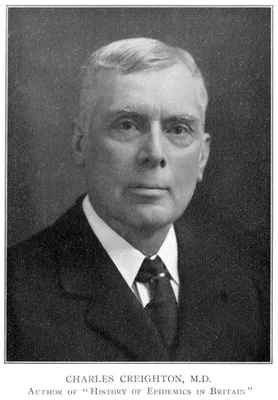
1891 –1894 CREIGHTON, Charles (1847 – 1927)
A history of epidemics in Britain. Vol. 1: From A. D. 664 to the extinction of plague. Vol. 2: From the extinction of plague to the present time.
A classical contribution to modern epidemiology, of which Creighton may be said to have been the founder. Reprinted with new introductory material, 1965. Digital facsimile from the Internet Archive at this link.
GMN 1680 · https://historyofmedicine.com/id/2363
1893 SMITH, Theobald (1859 – 1934); KILBORNE, Frederick Lucius (1858 – 1936)
Investigations into the nature, causation and prevention of Texas or Southern cattle fever.
U.S. Bureau of Animal Industry, Bulletin No. 1. Discovery of the parasite of Texas cattle fever, Pyrosoma bigeminum, and proof that its transmission is due to the cattle tick, Boöphilus bovis. This was the first demon…
GMN 5529 · https://historyofmedicine.com/id/6646
1897 OGATA, Masanori (1852 – 1919)
Ueber die Pestepidemie in Formosa.
Ogata considered the flea (principally Xenopsylla cheopis) to be the principal, if not the sole, vector of bubonic plague infection.
GMN 5128 · https://historyofmedicine.com/id/6130
1897 ROSS, Sir Ronald (1857 – 1932)
On some peculiar pigmented cells found in two mosquitoes fed on malarial blood.
Ross proved that the mosquito was responsible for the transmission of malaria. On 20 August 1897, he found Laveran’s Plasmodium in the stomach of the Anopheles mosquito after it had fed on the blood of malaria patient…
GMN 5247 · https://historyofmedicine.com/id/7904
1900 REED, Walter (1851 – 1902); CARROLL, James (1854 – 1907); AGRAMONTE Y SIMONI, Aristides (1868 – 1931); LAZEAR, Jesse William (1866 – 1900)
The etiology of yellow fever. A preliminary note.
First definite proof that the organism causing yellow fever is transmitted to man by the mosquito Aëdes aegypti. During the period spent by these workers in the investigation of the disease in Cuba Lazear and Carroll …
GMN 5457 · https://historyofmedicine.com/id/7559
1907 MACKIE, Frederick Percival (1875 – 1944)
The part played by Pediculus corporis in the transmission of relapsing fever.
Proof that relapsing fever is conveyed by the body louse, Pediculus corporis.
GMN 5321 · https://historyofmedicine.com/id/6617
1907 HAM, Bertie Burnett (1865 – )
Plague in Queensland, 1900-1907.
Ham was Queensland's first Commissioner of Public Health. Extensively illustrated. Digital facsimile from the Internet Archive at this link.
GMN 12138 · https://historyofmedicine.com/id/14347
1908 –1912 STICKER, Georg (1860 – 1960)
Abhandlungen aus der Seuchengeschichte und Seuchenlehre. Pt. 1: Die Pest. Pt. 2: Die Cholera. 2 vols. in 3.
GMN 1681 · https://historyofmedicine.com/id/2368
1908 DOERR, Robert (1871 – 1952)
Ueber ein neues invisibles Virus.
Doerr showed the relation of phlebotomus fever to the sandfly, Phlebotomus.
GMN 5477 · https://historyofmedicine.com/id/6363
1911 FRANCO, Roberto; TORO, Gabriel; MARTINEZ, Jorge
Fiebre amarilla y fiebre espiroquetal; endemias y epidemias en Muzo, de 1907 a 1910.
Franco, J. Martínez-Santamaria, and G. Toro-Villa described epidemics of yellow fever spread by mosquitoes other than Ae. aegypti. Later F. L. Soper, et al., Amer. J. Hyg., 1933, 18, 555-87, substantiated this.
GMN 5460.1 · https://historyofmedicine.com/id/7567
1911 PETERS, O. H.
Observations upon the natural history of epidemic diarrhoea.
Diarrhoea was one of the chief causes of child mortality in Great Britain at the turn of the century. Peters begins with a statistical study of age incidence, prevalence, and fatality of the condition and then in succ…
GMN 7762 · https://historyofmedicine.com/id/9934
1912 BERTILLON, Jacques (1851 – 1922)
On mortality and the causes of death according to occupations. IN: Transactions of the 15th International Congress on Hygiene Demography, pp. 336-339.
Bertillon, brother of Alphonse Bertillon, was Chief of Statistical Services for the city of Paris. His classification of diseases was based on the principle, adopted by Farr, of distinguishing between general diseases…
GMN 8407 · https://historyofmedicine.com/id/10584
1916 PRINZING, Friedrich (1859 – 1938); WESTERGAARD, Harald Ludvig (1853 – 1936)
Epidemics resulting from wars. Edited by Harald Westergaard.
Digital facsimile from the Internet Archive at this link.
GMN 1682 · https://historyofmedicine.com/id/2374
1917 CAMPBELL, Alfred Walter (1868 – 1937); CLELAND, Sir John Burton (1878 – 1971)
The Australian epidemics of an acute polio-encephalomyelitis (X disease).
Campbell was Australia's first neurologist. This paper described Murray Valley encephalitis (Australian X disease). Cleland and Campbell isolated a virus from the cerebral tissue of three patients.
GMN 4648 · https://historyofmedicine.com/id/738
1917 CRUCHET, Jean René (1875 – 1959); CALMETTE, Léon Charles Albert (1863 – 1933); ET AL
Quarante cas d’encéphalo-myélite subaiguë.
Cruchet’s account of epidemic encephalitis was given on 27 April 1917, preceding that of Economo by 13 days. With F. Moutier
GMN 4649 · https://historyofmedicine.com/id/743