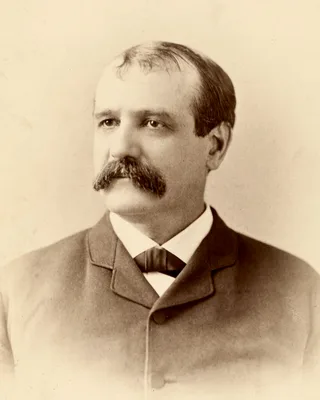
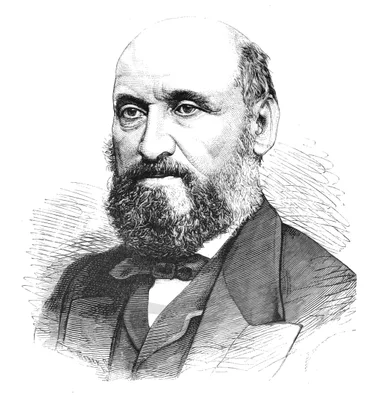
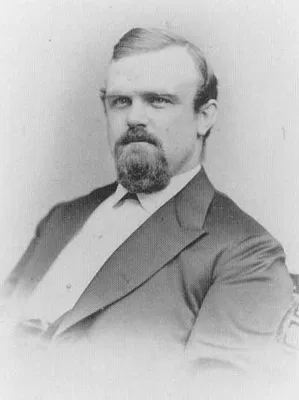
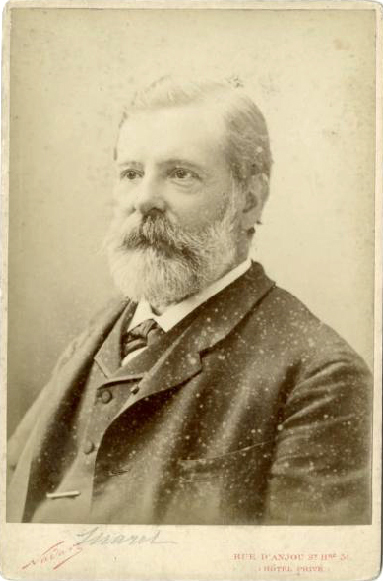
1874 WALKER, Francis Amasa (1840 – 1897)
Statistical atlas of the United States based on the results of the ninth census 1870, with contributions from many eminent men of science and several departments of the government.
This oversized compendium of maps, graphs, statistical tables, and essays was the first comprehensive thematic atlas produced by any nation. It was hailed both at home and abroad for its innovative use of graphic elem…
GMN 7479 · https://historyofmedicine.com/id/9651
1875 RUMSEY, Henry Wyldbore (1809 – 1876)
Essays and papers on some fallacies of statistics concerning life and death, health and disease.
GMN 1702 · https://historyofmedicine.com/id/2493
1875 FARR, William (1807 – 1883)
Supplement to the thirty-fifth annual report of the Registrar-General of Births and Marriages in England.
Includes statistical calculations of the effect on life expectation if certain preventable diseases were eliminated.
GMN 1703 · https://historyofmedicine.com/id/2502
1875 BAXTER, Jedediah Hyde (1837 – 1890)
Statistics, medical and anthropological, of the Provost-Marshal-General's Bureau, derived from records of the examination for military service in the armies of the United States during the late War of the Rebellion, of over a million recruits.... 2 vols.
Digital facsimile from the Internet Archive at this link.
GMN 7818 · https://historyofmedicine.com/id/9990
1878 MAREY, Étienne Jules (1830 – 1904)
La méthode graphique dans les sciences expérimentales et particulièrement en physiologie et en médecine.
Marey pioneered the use of graphical recording in the experimental sciences, using instruments (many of his own invention) to capture and display data impossible to observe with the senses alone, and to record the pro…
GMN 7294 · https://historyofmedicine.com/id/9464
1885 FARR, William (1807 – 1883)
Vital statistics. A memorial volume of selections from the reports and writings of William Farr.
Farr applied statistical methods to epidemiology and was the first mathematically to express the rise and fall of epidemic diseases, thus making possible the more accurate prediction of the occurrence of epidemics.
GMN 1704 · https://historyofmedicine.com/id/2507
1886 BELOCH, Karl Julius (1854 – 1929)
Die Bevölkerung der griechisch-römischen Welt.
Digital facsimile from the Internet Archive at this link.
GMN 9111 · https://historyofmedicine.com/id/11290
1889 BILLINGS, John Shaw (1838 – 1913)
On vital and medical statistics.
GMN 1705 · https://historyofmedicine.com/id/2510
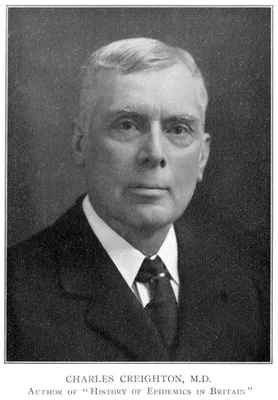
1891 –1894 CREIGHTON, Charles (1847 – 1927)
A history of epidemics in Britain. Vol. 1: From A. D. 664 to the extinction of plague. Vol. 2: From the extinction of plague to the present time.
A classical contribution to modern epidemiology, of which Creighton may be said to have been the founder. Reprinted with new introductory material, 1965. Digital facsimile from the Internet Archive at this link.
GMN 1680 · https://historyofmedicine.com/id/2363
1892 OGLE, John William (1824 – 1905)
"A copy of the earliest known Weekly Bill of Mortality. British Museum. Egerton MSS. 2603, f.4." IN: An inquiry into the trustworthiness of the old bills of mortality.
On p. 452 of his paper Ogle reproduces in type "A copy of the earliest known Weekly Bill of Mortality. British Museum. Egerton MSS. 2603, f.4." Ogle states that Creighton attributed this manuscript bill of mortality t…
GMN 8377 · https://historyofmedicine.com/id/10554
1896 HOFFMAN, Frederick Ludwig (1865 – 1946)
Race traits and tendencies of the American Negro.
Hoffman was statistician for the Prudential Insurance Company of America. This work, "Hoffman's first, characterized African Americans as exceptionally disease-prone. The work was motivated by a concern about issues o…
GMN 11823 · https://historyofmedicine.com/id/14025
1899 GRAUNT, John (1620 – 1674); PETTY, Sir William (1623 – 1687); HULL, Charles Henry (1864 – 1936)
The economic writings of Sir William Petty together with Observations upon the bills of mortality, more probably by Captain John Graunt. Edited by Charles Henry Hull. 2 vols.
Full text available from en.wikisource.org at this link.
GMN 11824 · https://historyofmedicine.com/id/14026
1900 BRADFORD, Thomas Lindsley (1847 – 1898)
The logic of figures, or comparative results of homoeopathic and other treatments.
A comparison of mortality rates in institutions and private practice between homeopathic and other modes of treatment. Digital facsimile from The Medical Heritage Library at the Internet Archive at this link.
GMN 6881 · https://historyofmedicine.com/id/9045
1911 BERTILLON, Jacques (1851 – 1922)
La dépopulation de la France: Ses conséquences, ses causes, mésures à prendre pour la combattre.
Digital facsimile from the Internet Archive at this link.
GMN 1710 · https://historyofmedicine.com/id/2526
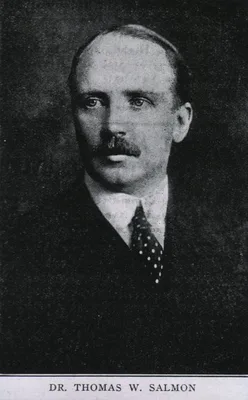
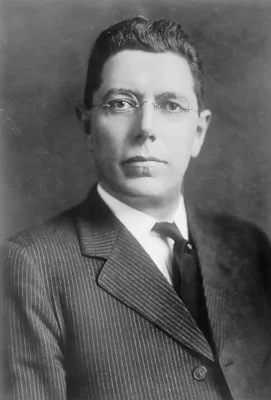
1913 ROSENAU, Milton Joseph (1869 – 1946); WHIPPLE, George Chandler (1866 – 1924); WILBUR, Cressy Livingstone (1865 – 1928); SALMON, Thomas William (1876 – 1927)
Preventive medicine and hygiene by Milton J. Rosenau. With chapters on sewage and garbage by George C. Whipple...Vital statistics by Cressy L. Wilbur...The prevention of mental diseases by Thomas W. Salmon.
Digital facsimile of the 1913 edition from the Internet Archive at this link. There were numerous later revised editions.
GMN 1641 · https://historyofmedicine.com/id/2085
1915 HOFFMAN, Frederick Ludwig (1865 – 1946)
The mortality from cancer throughout the world.
GMN 2641 · https://historyofmedicine.com/id/3262
1920 PEARL, Raymond (1879 – 1940); REED, Lowell Jacob (1886 – 1966)
On the rate of growth of the population of the United States since 1790 and its mathematical representation.
GMN 1712 · https://historyofmedicine.com/id/2537
1920 U.S. BUREAU OF THE CENSUS
Special tables of mortality from influenza and pneumonia in Indiana, Kansas, and Philadelphia, Pa., September 1 to December 31, 1918.
Digital facsimile from the Hathi Trust at this link.
GMN 11921 · https://historyofmedicine.com/id/14126
1920 U.S. BUREAU OF THE CENSUS
Mortality Statistics 1918. Nineteenth Annual Report.
From Causes of Death, p. 27: "Influenza and pneumonia (All forms). "In 1918 the registration area (exclusive of Hawaii) 477,467 deaths wee assigned to influenza and pneumonia (all forms). In the latter part of that ye…
GMN 12068 · https://historyofmedicine.com/id/14277
1921 U.S. BUREAU OF THE CENSUS
Mortality statistics 1919. Twentieth annual report.
From "Influenza and pneumonia (All forms)" p. 28: "In the later part of 1918 a pandemic of influenza swept over the country and did not fully spend its force until well into 1919.... "In the registration area (exclusi…
GMN 12069 · https://historyofmedicine.com/id/14278
1922 PEARL, Raymond (1879 – 1940)
The biology of death.
Raymond Pearl did important work on the subject of vital statistics.
GMN 137 · https://historyofmedicine.com/id/2250
1922 CARR-SAUNDERS, Sir Alexander Morris (1886 – 1966)
The population problem: A study in human evolution.
GMN 1713 · https://historyofmedicine.com/id/2540
1923 ISSERLIS, Leon (1881 – 1966); WOOD, Frances Chick (1883 – 1919)
The relation between home conditions and the intelligence of school children. From data collected by the late Mrs. Frances Wood. Privy Council. Medical Report Council. Special reports series No. 74.
GMN 12588 · https://historyofmedicine.com/id/14827
1926 GRIFFITH, Grosvenor Talbot (1899 – 1981)
Population problems of the age of Malthus.
Includes chapters on birth and marriage rates relating to conditions of employment, also the influence of the Poor Laws on these rates. Other chapters concern agriculture and food and health of towns and factores, and…
GMN 10468 · https://historyofmedicine.com/id/12661
1939 PEARL, Raymond (1879 – 1940)
The natural history of population.
GMN 1714 · https://historyofmedicine.com/id/2550
1945 LESLIE, Patrick Holt (1900 – 1972)
On the use of matrices in certain population mathematics.
"... the Leslie matrix is a discrete, age-structured model of population growth that is very popular in population ecology.... The Leslie matrix (also called the Leslie model) is one of the most well known ways to des…
GMN 9891 · https://historyofmedicine.com/id/12079
1948 GREENWOOD, Major (1880 – 1949)
Medical statistics from Graunt to Farr.
FitzPatrick Lectures, 1941 and 1943.
GMN 1716 · https://historyofmedicine.com/id/2945
1958 RUSSELL, J. C.
Late ancient and medieval population.
Digital facsimile from JSTOR at this link.
GMN 9110 · https://historyofmedicine.com/id/11289
1967 BERTIN, Jacques (1918 – 2010)
Sémiologie graphique: Les diagrammes. Les reseaux. Les cartes.
Foundational work in design and cartography concerning the graphic display of quantitative information. Includes display of medical or statistical information. Translated into English by William J. Berg as Semiology o…
GMN 7699 · https://historyofmedicine.com/id/9871
1969 CASSEDY, James H. (1919 – 2007)
Demography in early America: Beginnings of the statistical mind 1600-1800.
Covering the period 1600–1800, the author deals with demography in its economic, political, and social aspects. The work is particularly concerned with the development of health-related and scientific aspects of demog…
GMN 11322 · https://historyofmedicine.com/id/13520
1970 SACHER, George A. (1917 – 1981); FINCH, Caleb Ellicott (1939 – ); HAYFLICK, Leonard (1928 – 2024)
George A Sacher, Life table modification and life prolongation. IN: Handbook of the biology of aging, edited by Caleb E. Finch and Leonard Hayflick, pp. 582–638.
"The building of a connection between the Gompertz equation and the biology of ageing owes much to the work of biophysicist George Sacher [10] of the Argonne National Laboratory, whose introduction to ageing stemmed f…
GMN 8380 · https://historyofmedicine.com/id/10557
1970 ACSÁDI, Györggyei; NEMESKÉRI, Janos (1914 – 1989)
History of human life span and mortality. Translated by K. Balás.
A particularly valuable collection of reviews ot his work published in Current Anthropology, I5 (1974) 495-507 is available from JSTOR at this link.
GMN 9099 · https://historyofmedicine.com/id/11278
1971 GRAUNT, John (1620 – 1674); PETTY, Sir William (1623 – 1687); KEYNES, Sir Geoffrey Langdon (1887 – 1982)
A bibliography of Sir William Petty F.R.S. and of Observations on the bills of mortality by John Graunt F.R.S
GMN 11818 · https://historyofmedicine.com/id/14020
1975 U.S. BUREAU OF THE CENSUS
Historical statistics of the United States: Colonial times to 1970. Bicentennial edition. 2 vols.
Chapter B, "Vital statistics and health and medical care." Digital facsimile from the Internet Archive at this link; from the U. S. Census Bureau at this link.
GMN 7982 · https://historyofmedicine.com/id/10158
1977 DENEVAN, William Maxfield (1931 – )
The native population of the Americas in 1492. Edited by William M. Devevan.
"The discovery of America was followed by possibly the greatest demographic disaster in the history of the world." Research by some scholars provides population estimates of the pre-contact Americas to be as high as 1…
GMN 7977 · https://historyofmedicine.com/id/10153
1978 U.S. BUREAU OF THE CENSUS
Graphic presentation of statistical information: Papers presented at the 136th annual meeting of the American Statistical Association, Social Statistics Section: Session of Graphical Methods for Presenting Statistical Data: Boston, Massachusetts, August 23-26, 1976, Vol. 3.
Digital facsimile from Google Books at this link.
GMN 8122 · https://historyofmedicine.com/id/10298
1979 –1984 SÜSSMILCH, Johann Peter (1707 – 1767); HECHT, Jacqueline
Johann Peter Süssmilch. L'Ordre divin aux origines de la démographie. Traduction originale avec des études et commentaires rassemblés par Jacqueline Hecht. Vol. I: Études critiques, biographie, correspondance, bibliographie. Vol. 2: L' Oeuvre de J.P. Süssmilch, L'Ordre divin. Traduction de M. Kriegel. Vol. 3: Index des auteurs, des lieux et des matières. 3 vols.
A three-volume critical edition including the first edition in French.
GMN 11817 · https://historyofmedicine.com/id/14019
1982 COOK, Noble David (1941 – )
Demographic collapse: Indian Peru, 1520-1620.
The first in depth study of the demographic effects of the Spanish conquest. Cook estimated population size on the basis of archaeology, carrying capacity of the agricultural systems, disease mortality, depopulation r…
GMN 10572 · https://historyofmedicine.com/id/12765
1983 RIGGAN, Wilson B. (1915 – 2007); ET AL
U.S. cancer mortality rates and trends, 1950-1979. 4 vols.
Riggan supervised this long-term project of calculating and publishing cancer mortality rates and trends for every county in the United States over several decades. The last 30 of the 40 years of the underlying data b…
GMN 11814 · https://historyofmedicine.com/id/14016
1984 CASSEDY, James H. (1919 – 2007)
American medicine and statistical thinking, 1800-1860.
GMN 8622 · https://historyofmedicine.com/id/10799
1985 SHERIDAN, Richard B. (1918 – )
Doctors and slaves: A medical and demographic history of slavery in the British West Indies.
GMN 8820 · https://historyofmedicine.com/id/10998
1985 DUPÂQUIER, Jacques (1922 – 2010); DUPÂQUIER, Michel
Histoire de la démographie: La statique de la population des origines à 1914.
Digital facsimile from BnF Gallica at this link.
GMN 9104 · https://historyofmedicine.com/id/11283
1986 CASSEDY, James H. (1919 – 2007)
Medicine and American growth, 1800-1860.
"The interconnections between population increase, migration and immigration on the one hand, and disease and the development of medicine on the other in antebellum America are brilliantly presented" (publisher)
GMN 11323 · https://historyofmedicine.com/id/13521
1990 LANCASTER, Henry Oliver (1913 – 2001)
Expectations of life: A study in the demography, statistics, and history of world mortality.
GMN 8759 · https://historyofmedicine.com/id/10937
1993 KIPLE, Kenneth F. (1939 – 2016)
The Cambridge world history of human disease. Edited by Kenneth F. Kiple [and 12 co-editors].
An encyclopedic world history of disease, incorporating a geographic approach.
GMN 6963 · https://historyofmedicine.com/id/9128
1995 MATTHEWS, J. Rosser
Quantification and the quest for medical certainty.
GMN 8714 · https://historyofmedicine.com/id/10892
1995 PORTER, Theodore M. (1953 – )
Trust in numbers: The pursuit of objectivity in science and public life.
GMN 8715 · https://historyofmedicine.com/id/10893
1997 CORSINI, Carlo Alberto (1935 – 2017); VIAZZO, Pier Paolo (1950 – )
The decline of infant and child mortality: The European experience, 1750-1990.
GMN 11822 · https://historyofmedicine.com/id/14024
1997 CENTERS FOR DISEASE CONTROL AND PREVENTION (CDC); HETZEL, Alice M. (1922 – )
U.S. Vital Statistics System: Major activities and developments, 1950-95. From the Center for Disease Control and Prevention/ National Center for Health Statistics. Includes reprint of "History and organization of the Vital Statistics system" to 1950.
Appendix two is a reprint of "History and organization of the Vital Statistics System" by A. M. Hetzel, that first appeared in Vital Statistics of the United States I (1950) 1-19. Digital facsimile from cdc.gov at thi…
GMN 12128 · https://historyofmedicine.com/id/14337
1998 COOK, Noble David (1941 – )
Born to die: Disease and New World conquest, 1492-1650.
"The biological mingling of the previously separated Old and New Worlds began with the first voyage of Columbus. The exchange was a mixed blessing: It led to the disappearance of entire peoples in the Americas, but it…
GMN 10574 · https://historyofmedicine.com/id/12767