1677 HASEIAH, Laurentius [HASEIAC]
De postrema Melitensi lue praxis historica.
This work, recording the epidemic of plague in Malta in 1675-76, was the first medical work published by a Maltese.
GMN 5122 · https://historyofmedicine.com/id/8856
1821 TULLY, James D.
The history of plague, as it has lately appeared in the islands of Malta, Gozo, Corfu, Cephalonia, &c. detailing specific contagion of that disease, with particulars of the means adeopted for its eradication.
Concerns the Maltese plague,. 1813-1814. Digital facsimile from the Internet Archive at this link.
GMN 12757 · https://historyofmedicine.com/id/15003
1830 HENNEN, John (1779 – 1828)
Sketches of the medical topography of the Mediterranean; comprising an account of Gibraltar, the Ionian Islands, and Malta. To which is prefixed a sketch of a plan for memoirs on medical topography
Digital facsimile from Google Books at this link.
GMN 9713 · https://historyofmedicine.com/id/11900
1842 DAVY, John (1790 – 1868)
Notes and observations on the Ionian Islands and Malta: With some remarks on Constantinople and Turkey, and on the system of quarantine as at present conducted. 2 vols.
Digital facsimile from Google Books at this link.
GMN 13843 · https://historyofmedicine.com/id/16133
1863 MARSTON, Jeffery Allen (1831 – 1911)
Report on fever (Malta).
Marston wrote the first description of Malta fever as a distinct disease. He contracted the disease while serving in the Mediterranean area and described his own case. Marston was apparently the first to describe “Wei…
GMN 5097 · https://historyofmedicine.com/id/6018
1887 BRUCE, Sir David (1855 – 1931)
Note on the discovery of a micro-organism in Malta fever.
Malta fever was shown by Bruce to be due to Micrococcus (Brucella) melitensis. The disease was later named Brucellosis.
GMN 5098 · https://historyofmedicine.com/id/6020
1897 HUGHES, Matthew Louis (1867 – 1899)
Mediterranean, Malta, or undulant fever.
An authoritative summary of current knowledge of Malta fever.
GMN 5100 · https://historyofmedicine.com/id/6025
1905 –1907
REPORTS of the Commission appointed by the Admiralty, the War Office, and the Civil Government of Malta, for the investigation of Mediterranean fever, under the supervision of an advisory committee of the Royal Society. 7 pts.
The important findings of the Mediterranean Fever Commission are summarized in Topley & Wilson’s Bacteriology,1975, p. 2173; probably the most valuable was that of T. Zammit, who showed goat’s milk to be the main sour…
GMN 5102 · https://historyofmedicine.com/id/6032
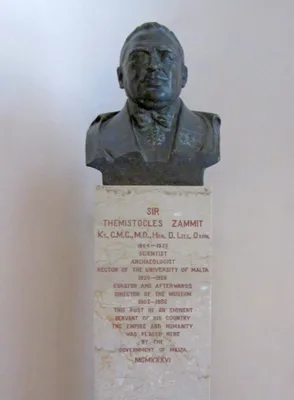
1905 ZAMMIT, Themistocles (1864 – 1935)
A preliminary note on the susceptibility of goats to Malta fever.
Zammit discovered that contaminated goat milk was the vector for transmission to humans of the Malta fever bacterium, Brucellosis melitensis. At the time goat milk was a primary source of milk in Malta and other parts…
GMN 10780 · https://historyofmedicine.com/id/12976
1964 CASSAR, Paul (1914 – 2006)
Medical history of Malta.
GMN 6565.1 · https://historyofmedicine.com/id/8265