1947 LORENTE DE NÓ, Rafael (1902 – 1990)
A study of nerve physiology. 2 vols.
See, Jorge A. Larriva-Sahd, "Some predictions of Rafael Lorente de Nó 80 years later," Frontiers in neuoranatomy, 8 (2014) 147.
GMN 10692 · https://historyofmedicine.com/id/12885
1948 AHLQUIST, Raymond Perry (1914 – 1983)
A study of the adrenotropic receptors.
Described the concept of α and β adrenergic receptors in the sympathetic nervous system, and placed specific receptors into pharmacologic mechanisms.
GMN 1929.4 · https://historyofmedicine.com/id/2745
1949 PATON, Sir William Drummond Macdonald (1917 – 1993); ZAIMIS, Eleanor (1915 – 1982)
The pharmacological actions of polymethylene bistrimethyl-ammonium salts.
Introduction of hexamethonium bromide.
GMN 5727 · https://historyofmedicine.com/id/6468
1952 KATZ, Sir Bernard (1911 – 2003)
Different forms of signalling employed by the nervous system.
In 1970 Katz shared the Nobel Prize in Physiology or Medicine with Ulf von Euler and J. Axelrod "for their discoveries concerning the humoral transmitters in the nerve terminals and the mechanism for their storage, re…
GMN 1354.2 · https://historyofmedicine.com/id/1619
1958 POYNTER, Frederick Noel Lawrence (1908 – 1979)
The history and philosophy of knowledge of the brain and its functions: an Anglo-American symposium.
GMN 1586 · https://historyofmedicine.com/id/1382
1958 AXELROD, Julius (1912 – 2004); TOMCHICK, R.
Enzymatic O-methylation of epinephrine and other catechols.
The authors discovered the enzyme "COMT" or cathecol-O-methyltransferase, and determined that it was crucial in the methylation and inactivation of adrenergic and other catecholamine type neurotransmitters. (Thanks to…
GMN 1931.6 · https://historyofmedicine.com/id/2761
1961 SPERRY, Roger Wolcott (1913 – 1994)
Cerebral organization and behavior: The split brain behaves in many respects like two separate brains, providing new research possibilities.
Sperry and colleagues, including Michael Gazzaniga, conducted extensive experiments on an epileptic patient who had had his corpus collosum, the "bridge" between the left and right hemispheres of the brain, split so t…
GMN 9648 · https://historyofmedicine.com/id/11835
1963 SPERRY, Roger Wolcott (1913 – 1994)
Chemoaffinity in the orderly growth of nerve fiber patterns and connections.
Sperry's chemoaffinity hypothesis, which states that neurons make connections with their targets based on interactions with specific molecular markers[1] and, therefore, that the initial wiring diagram of an organism …
GMN 9647 · https://historyofmedicine.com/id/11834
1976 NEHER, Erwin (1944 – ); SAKMANN, Bert (1942 – )
Single-channel currents recorded from membrane of denervated frog muscle fibres.
In 1991 Neher and Sakmann were awarded the 1991 Nobel Prize in Physiology or Medicine for "their discoveries concerning the function of single ion channels in cells." They were also awarded the prize for the invention…
GMN 7454 · https://historyofmedicine.com/id/9626
2001 ROBINSON, Joseph D.
Mechanisms of synaptic transmission: Bridging the gaps (1890-1990).
"Synaptic transmission plays a central role in the nervous system as the mechanism that allows for chemical and electrical communication between cells and thus connects discrete elements into the functioning whole. Th…
GMN 8748 · https://historyofmedicine.com/id/10926
2002 FINGER, Stanley
Origins of neuroscience: A history of explorations into brain function.
GMN 13461 · https://historyofmedicine.com/id/15735
2011 FINGER, Stanley; PICCOLINO, Marco (1946 – )
The shocking history of electric fishes: From ancient epochs to the birth of modern neurophysiology.
The first comprehensive history of this subject.
GMN 6843 · https://historyofmedicine.com/id/9007
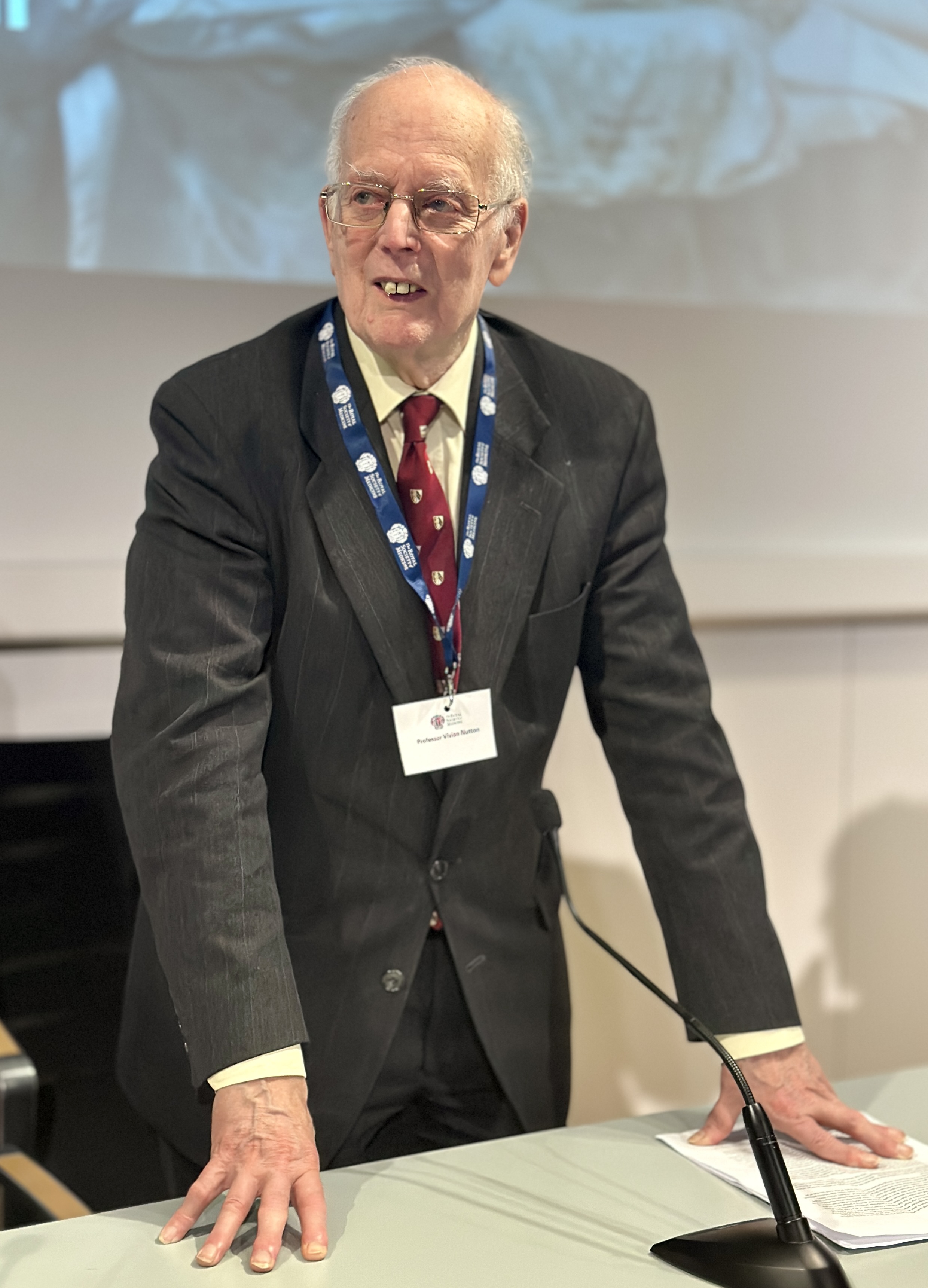
2012 GALEN, [Κλαύδιος Γαληνός; Galen of Pergamon] (129 – 216); NUTTON, Vivian (1943 – ); BOS, Gerrit
Galen: On problematical movements. Edited with introduction and commentary by Vivian Nutton, with an edition of the Arabic version by Gerrit Bos.
GMN 8257 · https://historyofmedicine.com/id/10433

![GALEN, [Κλαύδιος Γαληνός; Galen of Pergamon] (129 – 216)](/media/portraits/21)