1496 BENEDETTI, Alessandro (Alexander Benedictus) (1450 – 1512)
Diaria de bello Carolino, with a dedication letter from the author to the Doge Augustinus Barbadicus, Venice 21.3.1496, to the Venetian Councilors Sebastianus Baduarius and Hieronymus Bernardus, Venice 27.8.1496, and two poems on the Gauls and on the work of Quintius Aemilianus Cimbriacus.
An eyewitness account of the retreat from Italy of Charles VIII of France in 1495, written by a physician of Verona, who was chief surgeon of the Venetian troops in the campaign. Although the book is not written prima…
GMN 12846 · https://historyofmedicine.com/id/15093
1545 PARÉ, Ambroise (1510 – 1590)
La méthode de traicter les playes faictes par hacquebutes et aultres bastons à feu: & de celles qui sont faictes par fleches, dardz & semblables: assy des combustions specialement faictes par la pouldre à canon.
Paré’s first book was his treatise on gunshot wounds. He is one of the greatest of the military surgeons, and is particularly remembered for his abandonment of the practice of cauterization of gunshot wounds with boil…
GMN 2139 · https://historyofmedicine.com/id/2710
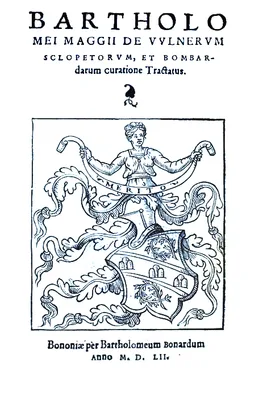
1552 MAGGI, Bartolomeo (1477 – 1552)
De vulnerum sclopetorum et bombardarum curatione tractatus.
In this very early work on gunshot wounds Maggi, Professor of Surgery at Bologna, showed that not all gunshot wounds suppurated and he discarded cauterization, treating such wounds with white of egg and salt water.
GMN 2139.1 · https://historyofmedicine.com/id/2714
1557 PICTORIUS, Georg (1500 – 1569)
Raiss Büchlein…mit güten Mitteln der Artzney Begegnen Soll.
The first pocket reference for travelers by land or sea, dealing with topics such as infected genitalia, frostbite, fouled drinking water, shipboard stench, the best boots and shoes. The recipes in this work comprised…
GMN 10726 · https://historyofmedicine.com/id/12920
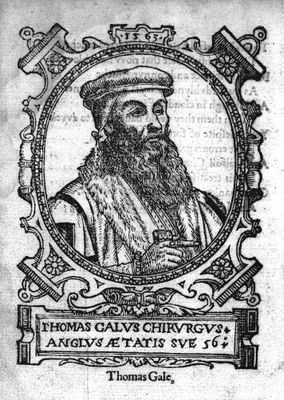
1563 GALE, Thomas (1507 – 1587)
An excellent treatise of wounds made with gonneshot.
Gale, a contemporary of Paré, was surgeon in Henry VIII’s army at Montreuil. His book supported the views of Paré regarding the treatment of gunshot wounds, denying the poisonous effect of bullets; Gale, however, appl…
GMN 2140 · https://historyofmedicine.com/id/2716
1564 PARÉ, Ambroise (1510 – 1590)
Dix livres de la chirurgie avec le magasin des instruments necessaires à icelle.
Paré’s first general treatise on surgery, and the most comprehensive of his treatises before his collected works (1575). Dix livres included Paré's first description of the use of the ligature in amputations, one of h…
GMN 3668.1 · https://historyofmedicine.com/id/6937
1573 CROCE, Giovanni Andrea Della (1514 – 1575)
Chirurgiae Ioannis Andrea a Cruce, Veneti medici libri septem, Quamplurimis instrumentorum imaginibus arti chirurgicae opportunis suis locis exornati, theoricam, practicam ac verissimam experientiam continentes....
Croce improved the instruments for trephination, and published classic woodcuts depicting the operation, including the first illustration of a neurological surgery operation actually taking place. The work is also imp…
GMN 4850.4 · https://historyofmedicine.com/id/5586
1575 PARÉ, Ambroise (1510 – 1590)
Les oeuvres de M. Ambroise Paré.
Paré was the greatest of the army surgeons before Larrey. Born in poor circumstances, he became the most famous surgeon in France. He is particularly remembered for his abandonment of boiling oil and the cautery (No. …
GMN 5565 · https://historyofmedicine.com/id/6944
1606 –1641 FABRY VON HILDEN, Wilhelm (Fabricius Hildanus) (1560 – 1624)
Observationum et curationum chirurgicarum centuriae. 6 vols.
Fabricius’s most important work; it was the best collection of case-records available for many years. Among other things, Fabricius used a magnet to extract an iron splinter from the eye – an idea suggested to him by …
GMN 5570 · https://historyofmedicine.com/id/6969
1615 FABRY VON HILDEN, Wilhelm (Fabricius Hildanus) (1560 – 1624)
New Feldt Arztny Buch von Kranckheiten und Schäden, so in Kriegen den Wundartzten gemeinlich fürfallen.
Fabry’s book includes an early description of a field drug chest for army use. He was one of the most eminent surgeons of his time, although not prepared to adopt all the teachings of Paré. He had considerable mechani…
GMN 2142 · https://historyofmedicine.com/id/2721
1616 MAGATI, Cesare (1579 – 1647)
De rara medicatione vulnerum.
Like Paré, Magati believed that gunshot wounds were not in themselves poisonous. He suggested a bandage moistened with plain water in place of the various salves then in vogue.
GMN 2143 · https://historyofmedicine.com/id/2724
1620 MINDERER, Raymund (1570 – 1621)
Medicina militaris, seu libellus castrensis.
Minderer’s book gives a good idea of the position of military surgery during the Thirty Years’ War. He published a pharmacopoeia in 1621; he also discovered ammonium acetate. An English edition appeared in 1674.
GMN 2145 · https://historyofmedicine.com/id/2728
1679 YONGE, James (1646 – 1721)
Currus triumphalis, è terebinthô. Or an account of the many admirable vertues of oleum terebinthinae. More particularly, of the good effects produced by its application to recent wounds, especially with respect to the hemorrhagies of the veins, and arteries, and the no less pernicious weepings of the nerves, and lymphaducts. Where also, the common methods, and medicaments, used to restrain hemorrhagies, are examined, and divers of them censured. And lastly, A new way of amputation, and a speedier convenient method of curing stumps, than that commonly practised, is with divers other useful matters recommended to the military surgeon.…
Describes how Yonge used turpentine to arrest hemorrhage, and presents the first account of a flap amputation. It also shows that Yonge was familiar with tourniquets. Digital facsimile from Google Books at this link.
GMN 4436 · https://historyofmedicine.com/id/6326
1690 PURMANN, Matthäus Gottfried (1649 – 1711)
Der rechte und warhafftige Feldscher.
Purmann was a skilful army surgeon – one of the most famous of the period. Despite this he believed in the efficacy of the weapon-salve and the sympathetic powder.
GMN 2146 · https://historyofmedicine.com/id/2730
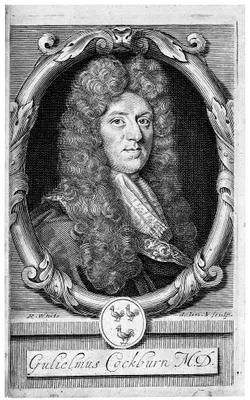
1696 COCKBURN, William (1669 – 1739)
An account of the nature, causes, symptoms, and cure of the distempers that are incident in seafaring people. With observations on the diet of the sea-men in his Majesty’s navy.
Cockburn studied medicine at Leiden; he became famous on account of his secret remedy for dysentery. The book is a record of two years spent as a ship’s doctor.
GMN 2147 · https://historyofmedicine.com/id/2734
1734 ATKINS, John (1685 – 1757)
The navy-surgeon, or a practical system of surgery.
Atkins was an English naval surgeon. His book includes some useful case reports and contains the first English description of African trypanosomiasis.
GMN 2148 · https://historyofmedicine.com/id/2737
1737 LE DRAN, Henri François (1685 – 1770)
Traité ou reflexions tirées de la pratique sur les playes d’armes à feu.
English translation, 1743.
GMN 2149 · https://historyofmedicine.com/id/2740
1744 RANBY, John (1703 – 1773)
The method of treating gunshot wounds.
Describes surgical cases that Ranby treated under Lord Stair in the German campaign up to the Battle of Dettingen. While the Earl of Stair exercised operational control, the Allied army was nominally commanded by Geor…
GMN 11991 · https://historyofmedicine.com/id/14199
1752 PRINGLE, Sir John (1707 – 1782)
Observations on the diseases of the army, in camp and garrison.
Pringle, founder of modern military medicine, was Physician-General of the British Army from 1744 to 1752. His books lay down the principles of military sanitation and the ventilation of barracks, gaols, hospital ship…
GMN 2150 · https://historyofmedicine.com/id/2743
1757 LIND, James (1716 – 1794)
An essay on the most effectual means, of preserving the health of seamen, in the Royal Navy.
Lind is regarded as the founder of naval hygiene in England. Besides his work on scurvy (see No.3713), he is notable for the above book, which deals not only with the men but also with the appalling conditions in whic…
GMN 2151 · https://historyofmedicine.com/id/2746
1758 SWIETEN, Gerard L. B. van (1700 – 1772)
Kurze Beschreibung und Heilungsart der Krankheiten, welche am öftesten in dem Feldlager beobachtet werden.
An essay on diseases of military camps. Digital facsimile from Google Books at this link. English translation as A short account of the most comon diseases incident to armies. With the method of cure (London, 1762). D…
GMN 2152 · https://historyofmedicine.com/id/2749
1764 BROCKLESBY, Richard (1722 – 1797)
Oeconomical and medical observations … tending to the improvement of military hospitals, and to the cure of camp diseases, incident to soldiers.
The best book of the century regarding military sanitation.
GMN 2153 · https://historyofmedicine.com/id/2751
1764 MONRO, Donald (1727 – 1802)
An account of the diseases which were most frequent in the British military hospitals in Germany, from January 1761 to the return of the troops to England in March 1763. To which is added an essay on the means of preserving the health of soldiers, and conducting military hospitals.
Donald Monro was the second son of Alexander Monro (primus). Digital facsimile from the Internet Archive at this link.
GMN 9205 · https://historyofmedicine.com/id/11386
1768 RAVATON, Hugues
Chirurgie d’armée.
One of the most important works on military surgery during the 18th century. Ravaton, a skilful army surgeon, was the first to employ a tin boot, suspended on four rings, for the “hanging” position of broken bones. He…
GMN 2154 · https://historyofmedicine.com/id/2753
1774 FALCK, Nicolai Detlef (1736 – 1783)
The seaman's medical instructor, in a course of lectures on accidents and diseases incident to seamen, in the various climates of the world. Calculated for ships that carry no surgeon. The whole delivered in a plain language and founded upon a long and successful experience.
Digital facsimile from the Hathi Trust at this link.
GMN 9519 · https://historyofmedicine.com/id/11704
1775 JONES, John [American] (1729 – 1791)
Plain, concise, practical remarks, on the treatment of wounds and fractures; to which is added an appendix, on camp and military hospitals; principally designed for the use of young military surgeons in North America.
The first surgical work written by an American and printed in North America. Jones’s work was the accepted guide to surgical practice during the American Revolutionary War.
GMN 2155 · https://historyofmedicine.com/id/2755
1776 PRINGLE, Sir John (1707 – 1782)
A discourse upon some late improvements of the means for preserving the health of mariners.
Besides his pioneer work in military medicine, Pringle did much to improve the conditions of sailors afloat. See also Nos. 2150 & 3714.
GMN 2156 · https://historyofmedicine.com/id/2758
1776 STÖRCK, Anton von (1731 – 1803)
Medicinisch-praktischer Unterricht für die Feld- und Landwundärzte der österreichischen Staaten. 2 vols. [& Supplement:] Die in dem medicinisch-praktischen Unterrichte für die Feld-und Landwundärzte vorkommende Arzneymittel.
This work on "Practical medical lessons for field and land surgeons of the Austrian states," includes a 91-page appendix containing 319 recommended pharmaceuticals for the treatments described in the text. The formula…
GMN 13549 · https://historyofmedicine.com/id/15826
1778 RUSH, Benjamin (1745 – 1813)
Directions for preserving the health of soldiers: recommended to the consideration of the officers of the Army of the United States. Published by order of the Board of War.
A reprint from the Philadelphia Packet, No. 284. The pamphlet was reprinted by the Massachusetts Temperance Alliance in Boston, 1865, for distribution to the Union soldiers.
GMN 2157 · https://historyofmedicine.com/id/2760
1779 MILLAR, John (1733 – 1805)
Observations on the management of the prevailing diseases particularly in the Army and Navy; together with a review of that in other countries, and arithmetical calculations of the comparative success of different methods of cure.
Millar promoted mathematical methods for computing the comparative success of different methods of cure. Digital facsimile from Google Books at this link.
GMN 9467 · https://historyofmedicine.com/id/11650
1779 ROBERTSON, Robert (1742 – 1829)
A physical journal kept on board H. M. Ship Rainbow during three voyages to the coast of Africa and the West Indies, in the years 1772, 1773, and 1774: To which is prefixed, a particular account of the remitting fever which happened on board of His Majesty's Sloop Weasel, on that coast, in 1769.
GMN 9501 · https://historyofmedicine.com/id/11686
1780 ROLLO, John ( – 1809)
Observations on the diseases which appeared in the army on St. Lucia....To which are prefixed remarks calculated to assist in ascertaining the causes, and in explaining the treatment of those diseases.
Digital facsimile from Google Books at this link. Revised and expanded edition, 1781; digital facsimile of the 1781 edition from Google Books at this link.
GMN 9466 · https://historyofmedicine.com/id/11649
1785 BLANE, Sir Gilbert (1749 – 1834)
Observations on the diseases incident to seamen.
William Hunter recommended Blane as private physician to Admiral Rodney; Blane sailed with him to the W. Indies and became physician to the British Fleet. He was held in great esteem in the navy and was instrumental i…
GMN 2158 · https://historyofmedicine.com/id/842
1789 CANIVELL, Francisco (1721 – 1797)
Tratado de las heridas de armas de fuego, dispuesto para uso de los alumnos del Real Colegio de Chirugia de Cadiz.
Probably the first significant work on military medicine by a Spanish physician. Canivell’s work, prepared for the use of students at Cadiz’s Royal College of Surgery, deals with contusions, wounds and fractures cause…
GMN 13134 · https://historyofmedicine.com/id/15392
1791 JACKSON, Robert (1750 – 1827)
A treatise on the fevers of Jamaica, with some observations on the intermitting fever of America, and an appendix containing some hints on the means of preserving the health of soldiers in hot climates.
Digital facsimile from the Internet Archive at this link.
GMN 10111 · https://historyofmedicine.com/id/12300
1792 PERCY, Pierre François (1754 – 1825)
Manuel du chirurgien-d’armée.
One of Napoleon’s leading surgeons, Percy laid down his principles of the practice of military surgery in the same year he was appointed médecin consultant of the Army of the North. He devised his own instrument for b…
GMN 2158.1 · https://historyofmedicine.com/id/848
1793 WADE, John Peter (1762 – 1802)
A paper on the prevention and treatment of the disorders of the seamen and soldiers in Bengal. Presented to the Honourable Court of East-India Directors, in the year 1791.
Murray was in the Bengal Medical Service from 1782 to 1802. This was his report to the Directors of the East-India Company. Digital facsimile from the Internet Archive at this link.
GMN 13619 · https://historyofmedicine.com/id/15899
1794 HUNTER, John (1728 – 1793)
A treatise on the blood, inflammation, and gun-shot wounds.
It was while serving with the army at Belle Isle during the Seven Years’ War that Hunter collected the material for his epoch-making book on inflammation and gunshot wounds. His studies on inflammation in particular a…
GMN 2283 · https://historyofmedicine.com/id/2900
1797 –1803 TROTTER, Thomas (1760 – 1832)
Medicina nautica; an essay on the diseases of seamen. 3 vols.
Trotter has left an excellent account of the conditions of seamen at the beginning of the 19th century. His book includes an interesting theory of the causation of fevers. He worked hard to improve the conditions of t…
GMN 2159 · https://historyofmedicine.com/id/858
1798 –1801 DESGENETTES, René-Nicolas Dufriche (1762 – 1837)
Opuscules du C[itoy]en Desgenettes, Médecin en chef de l'Armée d'Orient.
A collection of nine separately printed pamphlets issued by Napoleon's press in Cairo during his Egyptian campaign. See J.-F. Hutin, "La littérature médicale de la campagne d'Égypte", Histoire des sciences medicales, …
GMN 10577 · https://historyofmedicine.com/id/12770
1800 –1801 LARREY, Dominique Jean (1766 – 1842)
Mémoire sur l’ophtalmie régnante en Egypte.
The great military surgeon Larrey served during the Napoleonic campaign in Egypt, where he was the first to observe the contagiousness of trachoma shortly after the successful invasion in 1798. The disease spread to E…
GMN 5837 · https://historyofmedicine.com/id/7120
1801 ASSALINI, Paolo (1759 – 1846)
Observations sur la maladies appelée peste, le flux dissentérique, l'ophtalmie d'Égypte, et les moyens de s'en préserver. Avec des notions sur la fièvre jaune de Cadix, et les projet et plan d'un hôpital, pour le traitement maladies épidémiques et contagieuses.
At the time of publication Assalini, a military surgeon with Napoleon, characterized himself on the title page as "Docteur en Médecine et Chirugien de 1re classe de la Garde des Consuls..." Digital facsimile from well…
GMN 12053 · https://historyofmedicine.com/id/14261
1802 DESGENETTES, René-Nicolas Dufriche (1762 – 1837)
Histoire médicale de l'Armée d'Orient.
Napoleon appointed Desgenettes physician-in-chief for his expedition into Egypt. Desgenette's Histoire contained 19 separate chapters written by expedition personel. Digital facsimile of the 1802 from the Internet Arc…
GMN 8188 · https://historyofmedicine.com/id/10364
1802 FRANK, Louis (1761 – 1825)
Mémoire sur le commerce des nègres au Kaire et sur les maladies auxquelles ils sont sujets en y arrivant.
Digital facsimile from BnF Gallica at this link. Also published in Mémoires sur l'Egypte: ... Publiés dans les années VII, VIII et IX, Volume 4, (An X) pp. 125-156.
GMN 8204 · https://historyofmedicine.com/id/10380
1803 WITTMAN, William
Travels in Turkey, Asia-Minor, Syria, and across the desert into Egypt during the years 1799, 1800, and 1801, in company with the Turkish Army, and the British Military Mission.To which are annexed, observations on the plague, and on the diseases prevalent in Turkey, and a meteorological journal.
Wittman described the plague and other epidemics that afflicted both the Ottoman and British armies. In the Appendix he provided medical suggestions for treatment, together with a history of the plague. Digital facsim…
GMN 7367 · https://historyofmedicine.com/id/9539
1803 GILBERT, Nicolas-Pierre (1751 – 1814)
Histoire médicale de l'Armée Française, a Saint-Domingue, en l'an dix; ou mémoire sur la fièvre jaune, avec un apperçu de la topographie médicale de cette colonie.
Digital facsimile from Google Books at this link.
GMN 9657 · https://historyofmedicine.com/id/11844
1803 LARREY, Dominique Jean (1766 – 1842)
Rélation historique et chirurgicale de I’expedition de l'Armée d’Orient, en Egypte et en Syrie.
Larrey's history of his experiences with Napoleon and Napoleon's armies during the Egypt campaign. Includes a reprint of Larrey's treatise on trachoma, which was first published at Napoleon's press in Cairo. Digital f…
GMN 12942 · https://historyofmedicine.com/id/15189
1803 BALME, Claude (1766 – 1850)
Observations et réflexions sur le scorbut, d'après celui qui a régné parmi les troupes françaises formant la garnison d'Alexandrie (en Egypte), pendant le Blocus et le Siége de cette ville, en l'an IX (1801), par les Armées combinées des Turcs et des Anglais.
The author was a military surgeon on Napoleon's Egyptian campaign. Digital facsimile from BnF Gallica at this link. (32pp.)
GMN 13611 · https://historyofmedicine.com/id/15891
1805 –1806 ROBERTSON, James (1742 – 1814)
Remarks on the management of the scalped-head.
Treatment for the quintessential American war injury suffered by troops and settlers alike on the American frontier.
GMN 2159.1 · https://historyofmedicine.com/id/863
1806 VINCENT, DE MARCIAC, J.
Dissertation sur la fièvre-jaune qui a régné épidémiquement à Saint-Domingue, et qui a fait tant de ravages dans l'Armée expéditionnaire, en l'an X et en l'an XI, et sur les causes qui l'ont rendue si funeste.
Describes the yellow fever epidemic that swept through French troops on the island of Saint Domingue (Haiti) in 1802. In the midst of the slave uprising that led to the island’s independence, Napoleon sent an expediti…
GMN 13161 · https://historyofmedicine.com/id/15420