1502 –1503 BONACCIOLI, Ludovico [Lodovico; Bonaciolus] (1475 – 1536)
Enneas muliebris.
This work was prepared for and dedicated to Lucrezia Borgia by her physician, Bonaccioli, who guided her through 14 pregnancies, the last of which was fatal to both mother and child. The first three chapters concern f…
GMN 9325 · https://historyofmedicine.com/id/11507
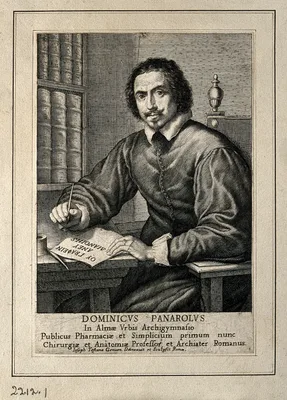
1652 PANAROLI, Domenico (1587 – 1657)
Iatrologismorum seu medicinalium observationum pentecostae quinque utilibus praeceptis.
Panaroli described hemolytic jaundice of the newborn.
GMN 3050 · https://historyofmedicine.com/id/3657
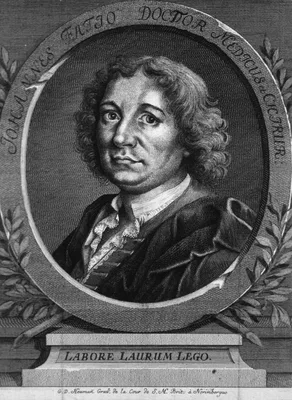
1752 FATIO, Johannes (1649 – 1691)
Der Arzney Doctor, Helvetisch-Vernünftige Wehe-Mutter, oder Gründlicher Unterricht, wie mit den Schwangern, Gebährenden, Kindbetterinnen und neugebohrnen Kindern umzugehen, selbige gebührend zu verpflegen, und in allerhand ihnen zustossenden Kranckheiten zu begegnen seye: Samt einer ausführlichen Beschreibung von Fortpflanzung des menschlichen Geschlechts, und aller weiblichen Leibes-Theilen, auch der Empfängniß, Formir- und Bildung der Frucht im Mutterleibe. Nebst des Verfassers curiösen Anmerckungen, selbst-bewährten Handgriffen, Curen und dazu dienlichen Arzney-Mitteln. Dem löblichen Frauenzimmer, geschwohrnen Weibern, und andern ehrbaren Frauen zu Nutz, mit besonderm Fleisse in fünf Abschnitte eingetheilt. Mit vielen Kupfern und dreyen Registern.
Fatio was probably the first surgeon to study and treat surgical conditions of children in a systematic fashion. His book, first published over 60 years after his death, is divided into five parts: 1) the anatomy of w…
GMN 6357.51 · https://historyofmedicine.com/id/8217
1810 BERTIN, René Joseph Hyacinthe (1757 – 1828)
Traité de la maladie vénérienne chez les enfans nouveau-nés, les femmes enceintes et les nourrices.
The first systematic work on congenital syphilis.
GMN 2378.1 · https://historyofmedicine.com/id/3269
1826 CHAUSSIER, François (1746 – 1828)
Mémoire médico-légal sur la viabilité de l'enfant naissant.
Chaussier introduced a procedure for the revival of near-dead infants. Digital facsimile from BnF Gallica at this link.
GMN 13410 · https://historyofmedicine.com/id/15682
1838 VALLEIX, François Louis Isidore (1807 – 1855)
Clinique des maladies des enfants nouveau-nes.
The first work on the diseases of newborns and the first work on child neurology and pediatric neurosurgery.
GMN 13150 · https://historyofmedicine.com/id/15409
1850 –1853 BEDNAŔ, Alois (1816 – 1888)
Die Krankheiten der Neugebomen und Säuglinge. 4 vols.
Bednaŕ was a famous Viennese pediatrician. His description of aphthae of the palate in the newborn (“Bednaŕ’s aphthae”) is in vol. 1, p. 104 of his book.
GMN 6335 · https://historyofmedicine.com/id/8135
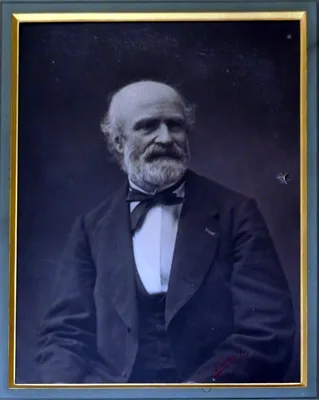
1854 DIDAY, Charles Joseph Paul Edouard (1812 – 1894)
Traité de la syphilis des nouveau-nés et des enfants à la mamelle.
An important work on congenital syphilis. English translation, 1859.
GMN 2383 · https://historyofmedicine.com/id/3284
1857 DENUCÉ, Jean-Louis-Paul (1824 – 1889)
Berceau incubateur pour les enfants nés avant terme.
This brief notice, about 400 words long, citing no references, was the first published account of an incubator for premature infants. Denucé built a double-walled zinc tub in which the space between the walls was fill…
GMN 12966 · https://historyofmedicine.com/id/15214
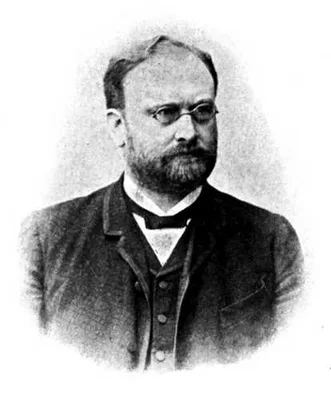
1875 ORTH, Johannes (1847 – 1923)
Ueber das Vorkommen von Bilirubinkrystallen bei neugebornen Kindern.
Kernicterus first described.
GMN 3067 · https://historyofmedicine.com/id/3720
1876 WEIGERT, Carl (1845 – 1904)
Ueber eine Mykose bei einem neugeborenen Kinde (Bakterienfärbung mit Anilinfarben).
In this paper Weigert showed that methyl violet will reveal cocci in tissues.
GMN 2486 · https://historyofmedicine.com/id/3098
1881 CREDÉ, Carl Siegmund Franz (1819 – 1892)
Die Verhütung der Augenentzüngung der Neugeborenen.
Credé introduced the practice of instillation of silver nitrate into the eyes of all newborn children as a preventive measure against ophthalmia neonatorum. Separate expanded edition with the same title, Berlin: A. Hi…
GMN 5924 · https://historyofmedicine.com/id/7555
1883 TARNIER, Étienne Stéphane (1828 – 1897); AUVARD, Pierre-Victor-Adolphe (Alfred) (1855 – 1941)
De la couveuse pour enfants. Part 5: Description d'une nouvelle couveuse.
Auvert described a new and improved closed incubator inspired by a bird/poultry incubator that Tarnier saw at a Paris zoo, and had adapted for human babies by the bird incubator's inventor, Dr. Martin. Tarnier used th…
GMN 12967 · https://historyofmedicine.com/id/15215
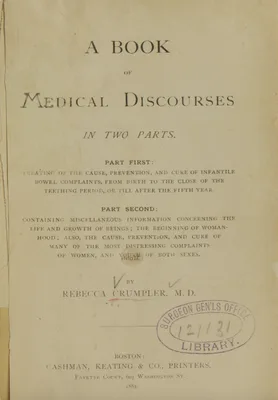
1883 CRUMPLER, Rebecca Lee (1831 – 1895)
A book of medical discourse in two parts. Part first: Creating of the cause, prevention, and cure of infantile bowel complains, from birth to the close of the teething period, or till after the fifth year. Part second: Containing miscellaneous information concerning the life and growth of beings; the beginning of womanhood; also, the cause, prevention, and cure of many of the most distressing compains of women and youth of both sexes.
Crumpler was the first Black woman to receive a medical degree in the United States. Digital facsimile from the Internet Archive.
GMN 14145 · https://historyofmedicine.com/id/16459
1887 –1888 HIRSCHSPRUNG, Harald (1830 – 1916)
Stuhlträgheit Neuegeborener in Folge von Dilatation und Hypertrophie des Colons.
Hirschsprung’s diseases (congenital megacolon).
GMN 3489 · https://historyofmedicine.com/id/3886
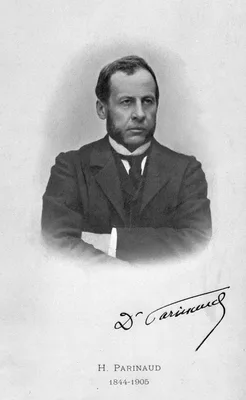
1894 PARINAUD, Henri (1844 – 1905)
Conjonctivite lacrymale à pneumocoques des nouveau-nés.
GMN 5939 · https://historyofmedicine.com/id/6899
1900 BUDIN, Pierre-Constant (1846 – 1907)
Le nourrisson. Alimentation et hygiène.
Pioneer treatise on the care and feeding of premature and newborn infants. Budin sponsored the idea that an infant should be given milk equal in amount to one-tenth of its body weight. English translation, London, 1907.
GMN 6344.1 · https://historyofmedicine.com/id/8177
1908 PFANNENSTIEL, Hermann Johann (1862 – 1909)
Ueber den habituellen Ikterus de Neugeborenen.
First detailed description of familial icterus gravis neonatorum.
GMN 3080.1 · https://historyofmedicine.com/id/3740
1922 HESS, Julius Hays (1876 – 1955)
Premature and congenitally diseased infants.
“The first book ever written dealing solely with premature and congenitally diseased infants” (Cone). Hess founded the first premature infant center in the United States at Michael Reese Hospital in Chicago.
GMN 6348.1 · https://historyofmedicine.com/id/8183
1932 DIAMOND, Louis Klein (1902 – 1999); BLACKFAN, Kenneth Daniel (1883 – 1941); BATY, James M.
Erythroblastosis fetalis and its association with universal edema of the fetus, icterus gravis neonatorum and anemia of the newborn.
The authors described and named this syndrome/illness of newborns for the first time, including pathological findings, clinical data, lab abnormalities, presentation and course of illness. Order of authorship in the o…
GMN 14087 · https://historyofmedicine.com/id/16398
1937 BAUER, A. Robert
A combination resuscitator and incubator for new-born infants.
In 1931 Robert Bauer invented the first incubator to combine heat, oxygen, and humidity. Abstract: "The apparatus herein described was built in July 1931 to meet in a practical way the well established needs of the pr…
GMN 12185 · https://historyofmedicine.com/id/14395
1938 DARROW, Ruth Renter (1895 – 1956)
Icterus gravis (erythroblastosis) neonatorum.
Darrow was the first to identify the cause of hemolytic disease of the newborn (HDN). Three years prior to the discovery of antibodies against the Rh antigen, Darrow correctly hypothesized that the disease was caused …
GMN 14088 · https://historyofmedicine.com/id/16399
1942 TERRY, Theodore Lasater (1899 – 1946)
Extreme prematurity and fibroblastic overgrowth of persistent vascular sheath behind each crystalline lens. I. Preliminary report.
Retrolental fibroplasia first described. See also the same volume, pp. 1409-23, and Trans. Sect. Ophthal. Amer. med. Ass., 1942, 213-29, for later papers.
GMN 5989 · https://historyofmedicine.com/id/7083
1948 DIAMOND, Louis Klein (1902 – 1999)
Replacement transfusion as a treatment for erythroblastosis fetalis.
Exchange transfusion.
GMN 3107.1 · https://historyofmedicine.com/id/3816
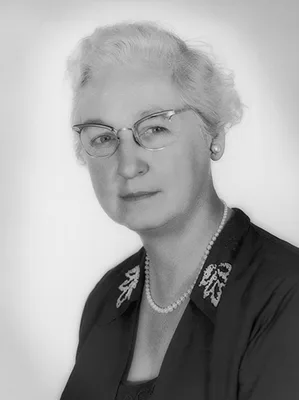
1953 APGAR, Virginia (1909 – 1974)
A proposal for a new method of evaluation of the newborn infant.
The Apgar score for summarizing the health of newborn children, based on skin color, pulse rate, reflex irritability, muscle tone, and respiratory effort. These form a backronym, referring back to the author: Appearan…
GMN 12184 · https://historyofmedicine.com/id/14394
1958 CREMER, Richard J.; PERRYMAN, P. W.; RICHARDS, D. H.
Influence of light on the hyperbilirubinaemia of infants.
In 1956 Sister Jean Ward of the Premature Unit of the Rochford General Hospital in Essex, England noted the benefit of phototherapy when she took infants outside because she assumed that fresh air had healing benefits…
GMN 12971 · https://historyofmedicine.com/id/15219
1963 GUTHRIE, Robert (1916 – 1995); SUSI, Ada J. (1918 – 2002)
A simple phenylalanine method for detecting phenylketonuria in large populations of newborn infants.
Bacterial inhibition test for phenylketonuria.
GMN 3924.4 · https://historyofmedicine.com/id/5084
1969 CRELIN, Edmund Slocum Jr. (1923 – 2004)
Anatomy of the newborn: An atlas.
Self-illustrated by Crelin, this was the first atlas of human infant anatomy. Crelin followed this with a synopsis of the atlas, Functional anatomy of the newborn (New Haven: Yale University Press, 1973).
GMN 10211 · https://historyofmedicine.com/id/12400
1969 RICKHAM, Peter Paul (1917 – 2003); JOHNSTON, J. H.
Neonatal surgery.
Rickham founded the first neonatal surgical unit in the world, at Alder Hey Children's Hospital in Liverpool. This unit became the benchmark for similar units around the world. It brought about an improvement in the s…
GMN 11917 · https://historyofmedicine.com/id/14122
1973 ZIMMERMAN, David R.
Rh: The intimate history of a disease and its conquest.
GMN 14089 · https://historyofmedicine.com/id/16400
1996 BAKER, Jeffrey P.
The machine in the nursery: Incubator technology and the origins of newborn intensive care.
GMN 8602 · https://historyofmedicine.com/id/10779
2011 MINTZ-HITTNER, Helen A.; KENNEDY, Kathleen A.; CHUANG, Alice Z.
Efficacy of intravitreal Bevacizumab for state 3+ retinopathy of prematurity.
The authors, representatives of the "BEAT-ROP Cooperative Group," showed that intravitreal bevacizumab monoclonal antibody therapy in infants with stage 3+ retinopathy of prematurity showed a significant benefit for z…
GMN 14152 · https://historyofmedicine.com/id/16467
2021 WHO IMMEDIATE KMC STUDY GROUP
Immediate "kangaroo mother care" and survival of infants with low birth weight.
This study demonstrated that "vulnerable infants have a better chance of survival if they start receiving 'kangaroo mother care'--which calls for babies to spend as much time as possible in direct contact with a caref…
GMN 13477 · https://historyofmedicine.com/id/15751