1496 BENEDETTI, Alessandro (Alexander Benedictus) (1450 – 1512)
Diaria de bello Carolino, with a dedication letter from the author to the Doge Augustinus Barbadicus, Venice 21.3.1496, to the Venetian Councilors Sebastianus Baduarius and Hieronymus Bernardus, Venice 27.8.1496, and two poems on the Gauls and on the work of Quintius Aemilianus Cimbriacus.
An eyewitness account of the retreat from Italy of Charles VIII of France in 1495, written by a physician of Verona, who was chief surgeon of the Venetian troops in the campaign. Although the book is not written prima…
GMN 12846 · https://historyofmedicine.com/id/15093
1545 PARÉ, Ambroise (1510 – 1590)
La méthode de traicter les playes faictes par hacquebutes et aultres bastons à feu: & de celles qui sont faictes par fleches, dardz & semblables: assy des combustions specialement faictes par la pouldre à canon.
Paré’s first book was his treatise on gunshot wounds. He is one of the greatest of the military surgeons, and is particularly remembered for his abandonment of the practice of cauterization of gunshot wounds with boil…
GMN 2139 · https://historyofmedicine.com/id/2710
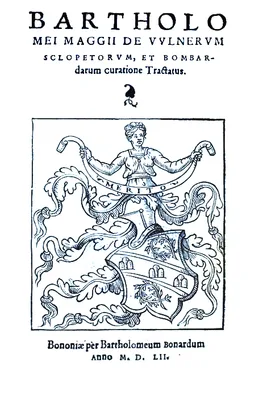
1552 MAGGI, Bartolomeo (1477 – 1552)
De vulnerum sclopetorum et bombardarum curatione tractatus.
In this very early work on gunshot wounds Maggi, Professor of Surgery at Bologna, showed that not all gunshot wounds suppurated and he discarded cauterization, treating such wounds with white of egg and salt water.
GMN 2139.1 · https://historyofmedicine.com/id/2714
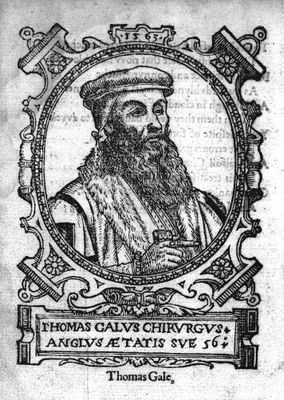
1563 GALE, Thomas (1507 – 1587)
An excellent treatise of wounds made with gonneshot.
Gale, a contemporary of Paré, was surgeon in Henry VIII’s army at Montreuil. His book supported the views of Paré regarding the treatment of gunshot wounds, denying the poisonous effect of bullets; Gale, however, appl…
GMN 2140 · https://historyofmedicine.com/id/2716
1564 PARÉ, Ambroise (1510 – 1590)
Dix livres de la chirurgie avec le magasin des instruments necessaires à icelle.
Paré’s first general treatise on surgery, and the most comprehensive of his treatises before his collected works (1575). Dix livres included Paré's first description of the use of the ligature in amputations, one of h…
GMN 3668.1 · https://historyofmedicine.com/id/6937
1573 CROCE, Giovanni Andrea Della (1514 – 1575)
Chirurgiae Ioannis Andrea a Cruce, Veneti medici libri septem, Quamplurimis instrumentorum imaginibus arti chirurgicae opportunis suis locis exornati, theoricam, practicam ac verissimam experientiam continentes....
Croce improved the instruments for trephination, and published classic woodcuts depicting the operation, including the first illustration of a neurological surgery operation actually taking place. The work is also imp…
GMN 4850.4 · https://historyofmedicine.com/id/5586
1575 PARÉ, Ambroise (1510 – 1590)
Les oeuvres de M. Ambroise Paré.
Paré was the greatest of the army surgeons before Larrey. Born in poor circumstances, he became the most famous surgeon in France. He is particularly remembered for his abandonment of boiling oil and the cautery (No. …
GMN 5565 · https://historyofmedicine.com/id/6944
1606 –1641 FABRY VON HILDEN, Wilhelm (Fabricius Hildanus) (1560 – 1624)
Observationum et curationum chirurgicarum centuriae. 6 vols.
Fabricius’s most important work; it was the best collection of case-records available for many years. Among other things, Fabricius used a magnet to extract an iron splinter from the eye – an idea suggested to him by …
GMN 5570 · https://historyofmedicine.com/id/6969
1967 SCHULLIAN, Dorothy May (1906 – 1989); BENEDETTI, Alessandro (Alexander Benedictus) (1450 – 1512)
Diaria de bello Carolino (Diary of the Caroline war). Edited and translated by Dorothy M. Schullian.
Latin text with parallel English translation.
GMN 12845 · https://historyofmedicine.com/id/15092