1607 BARRIOS, Juan de (1562 – 1645)
Verdadera medicina, cirugía y astrologia en tres libros dividida.
Concerns medicine of the Aztecs, etc. Digital facsimile from Google Books at this link.
GMN 8844 · https://historyofmedicine.com/id/11022
1651 CULPEPER, Nicholas (1616 – 1654)
Semeiotica uranica, or an astrological judgment of diseases from the decumbiture of the sick; 1. From Aven Ezra by the way of introduction. 2. From Noel Duret by way of direction. Wherein is layd down, the way and manner of finding out the cause, change and end of a disease. Also whether the sick be likely to live or dye, and the time when recovery or death is to be expected. To which is added the signs of life or death by the body of the sick party according to the judgment of Hippocrates.
Digital text from quod.lib.umich.edu at this link
GMN 13742 · https://historyofmedicine.com/id/16026
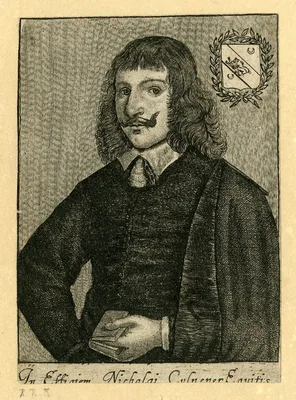
1652 CULPEPER, Nicholas (1616 – 1654)
The English physitian: Or, an astrologo-physical discourse of the vulgar herbs of this nation. Being a compleat method of physick, whereby a man may preserve his body in health; or cure himself, being sick, for three pence charge, with such things only as grow in England, as they being most fit for English bodies. Herein is also shewed, 1. The way of making plaisters, oyntments, oyls, pultisses, syrups, julips, or waters, of all sorts of physical herbs, that you may have them readie for your use at all times of the yeer. 2. What planet governeth every herb or tree (used in physick) that groweth in England. 3. The time of gathering all herbs, both vulgarly, and astrologically. 4. The way of drying and keeping the herbs all the yeer. 5. The way of keeping their juyces ready for use at all times. 6. The way of making and keeping all kind of useful compounds made of herbs. 7. The way of mixing medicines, according to cause and mixture of the disease, and part of the body afflicted.
"Culpeper attempted to make medical treatments more accessible to laypersons by educating them about maintaining their health. Ultimately his ambition was to reform the system of medicine by questioning traditional me…
GMN 8588 · https://historyofmedicine.com/id/10765
1658 CARDANO, Girolamo [Gerolamo; Hieronymus Cardanus] (1501 – 1576)
Metoposcopia libris tredecim et octingentis faciei humanae eiconibus complexa.
Contains 800 illustrations of the human face. Cardan, Professor of Medicine at Padua as well as a celebrated mathematician and scientist, claimed to be able to draw horoscopes from the appearance of the face. A French…
GMN 152 · https://historyofmedicine.com/id/2744
1661 RAMESAY, William (RAMSAY) (1627 – 1672)
Thanasima, kai dēlētēria: Tractatus de venenis. Or, a treatise of poysons. Their sundry sorts, names, natures and virtues, with their severall symptomes, signes diagnosticks, prognosticks, and antidotes. Wherein, are divers necessary questions discussed; the truth by the most learned, confirmed, by many instances, examples & stories illustrated; and, both philosophically and medically handled.
GMN 9671 · https://historyofmedicine.com/id/11858
1663 CARDANO, Girolamo [Gerolamo; Hieronymus Cardanus] (1501 – 1576)
Opera omnia: Tam hactenus excusa, hîc tamen aucta & emendata, quàm nunquam aliàs visa ac primùm ex auctoris ipsius autographis eruta curâ Caroli Sponii .... 10 vols.
Digital facsimile from the Università degli Studi di Milano at this link.
GMN 9576 · https://historyofmedicine.com/id/11763
1677 SAUNDERS, Richard (1613 – 1687)
The astrological judgement and practice of physick, deduced from the position of the heavens at the decumbiture of a sick person.
Saunders "practised astrology and cheiromancy during the golden age of the pseudo-sciences in England." The DNB characterizes this work as "a systematic exposition of astrological therapeutics, based largely upon exam…
GMN 12041 · https://historyofmedicine.com/id/14249
1685 GARCÍA CONDÉ, Pedro (1603 – )
Verdadera albeyteria. Divido en quatro libros....Lleva diferentes estampas, donde vàn delineadas las enfermedades que sobrevienen en el cuerpo, braços, y piernas del cavallo....
Includes both anatomical engravings and engraving that relate to astrological influences. Digital facsimile from the Hathi Trust at this link.
GMN 10190 · https://historyofmedicine.com/id/12379
1914 MERCIER, Charles Arthur (1852 – 1919)
Astrology in medicine.
GMN 6625 · https://historyofmedicine.com/id/7701
1991 O'BOYLE, Cornelius
Mediaeval prognosis and astrology: A working edition of the [anonymous] Aggregationes de crisi et creticis diebus, with introduction and English summary by Cornelius O'Boyle
This pre-Galenic astrological text by an unknown author from the later part of the 13th century concerns astrological prognostication. It was based upon Book III of Galen's De diebus criticis, but provided a "handy sh…
GMN 8298 · https://historyofmedicine.com/id/10474
2005 BOS, Gerrit; YOM TOV, David ben (David Bonjorn del Barri) (1300 – 1360); BURNETT, Charles S. F. (1951 – ); LANGERMANN, Tzvi
Hebrew Medical Astrology: David Ben Yom Tov, Kelal Qaṭan: Original Hebrew text, medieval Latin translation, modern English translation by Gerrit Bos, Charles Burnett, and Tzvi Langermann.
GMN 8254 · https://historyofmedicine.com/id/10430
2005 FORMAN, Simon (1552 – 1611); KASSELL, Lauren
Medicine and magic in Elizabethan London. Simon Forman: Astrologer, alchemist, and physician
GMN 10548 · https://historyofmedicine.com/id/12741
2008 FORMAN, Simon (1552 – 1611); NAPIER, Richard (1559 – 1634); KASSELL, Lauren
The casebooks project: A digital edition of Simon Forman's & Richard Napier's medical records 1596-1634. Lauren Kassell, Project Director.
http://www.magicandmedicine.hps.cam.ac.uk/ "The Casebooks Project offers a tool for searching and reading the medical records of the astrologers Simon Forman and Richard Napier. The project is ongoing: 48,500 cases ar…
GMN 10547 · https://historyofmedicine.com/id/12740
2011 GALEN, [Κλαύδιος Γαληνός; Galen of Pergamon] (129 – 216); HUNAYN IBN ISHAQ [أبو زيد حنين بن إسحاق العبادي; ’ABŪ ZAYD ḤUNAYN IBN ’ISḤĀQ AL-‘IBĀDĪ], (Latin: Iohannitius) (809 – 873); COOPER, Glen M.
Galen, De diebus decretoriis, from Greek into Arabic. A critical edition, with translation and commentary of Hunayn ibn Ishāq, Kitāb ayyām al-buhrān, by Glen M. Cooper.
First printed edition of Hunayn ibn Ishaq's Arabic translation of Galen's Critical Days (De diebus decretoriis), a founding text of astrological medicine, together with the first translation of the text into a modern …
GMN 9314 · https://historyofmedicine.com/id/11496
2013 AZZOLINI, Monica
The duke and the stars: Astrology and politcs in renaissance Milan.
Explores science and medicine as studied and practiced in fifteenth-century Italy, including how astrology was taught in relation to astronomy. It illustrates how the “predictive art” of astrology was often a critical…
GMN 12040 · https://historyofmedicine.com/id/14248
2018 RUDOLF, Stephanie
Syrische Astrologie und das Syrische Medizinbuch.
GMN 12673 · https://historyofmedicine.com/id/14917

![CARDANO, Girolamo [Gerolamo; Hieronymus Cardanus] (1501 – 1576)](/media/portraits/7679)
![GALEN, [Κλαύδιος Γαληνός; Galen of Pergamon] (129 – 216)](/media/portraits/21)