1859 WALLACE, Alfred Russel (1823 – 1913); DARWIN, Charles Robert (1809 – 1882)
On the tendency of species to form varieties: and on the perpetuation of varieties and species by natural means of selection.
The first printed exposition of the “Darwinian” theory of evolution by natural selection. Had not Wallace independently discovered the theory of natural selection, it is possible that the extremely cautious Darwin mig…
GMN 219 · https://historyofmedicine.com/id/4042
1859 DARWIN, Charles Robert (1809 – 1882)
On the origin of species by means of natural selection, or the preservation of favoured races in the struggle for life.
Prepared under the advice of Lyell and Hooker, and brought to press soon after publication of the joint paper by Darwin and Wallace (No. 219), this was Darwin’s greatest work and one of the most important books ever p…
GMN 220 · https://historyofmedicine.com/id/4044
1859 FUHLROTT, Johann Carl (1804 – 1877)
Menschliche Ueberreste aus einer Felsengrotte des Düssenthals. Ein Beitrag zur Frage über die Existenz fossiler Menschen.
Fuhlrott’s first detailed account of the “Neanderthal 1” skeleton discovered in 1856 in the Kleine Feldhofer Grotte, located in the Düssel River gorge in southwestern Germany.
GMN 7251 · https://historyofmedicine.com/id/9420
1859 HOOKER, Sir Joseph Dalton (1817 – 1911)
On the flora of Australia, its origin, affinities, and distribution; being an introductory essay to the Flora of Tasmania. Offprint from The Botany of the Antarctic Voyage of H. M. Discovery Ships ‘Erebus’ and ‘Terror’, Vol. III (Flora Tasmaniae), part I (June, 1859).
The first important botanical work by a supporter of Darwin’s theory of evolution by natural selection. Hooker, a botanist and plant geographer, had been a close friend of Darwin for many years, and was aware of Darwi…
GMN 7446 · https://historyofmedicine.com/id/9618
1860 PRESTWICH, Joseph (1812 – 1896)
On the occurrence of flint-implements, associated with the remains of animals of extinct species in beds of a late geological period, in France at Amiens and Abbeville, and in England at Hoxne.
This paper is a key record of the early recognition of the antiquity of man by the scientific establishment. Having returned from a visit to Abbeville, France, in May 1859, where he viewed the evidence for the antiqui…
GMN 7262 · https://historyofmedicine.com/id/9431
1860 EVANS, John (1823 – 1908)
On the occurrence of flint implements in undisturbed beds of gravel, sand, and clay.
In the spring of 1859, in the company of Joseph Prestwich, Evans visited Abbeville to view Boucher de Perthes’ collection of flint artifacts and to observe a hand-axe in situ at St. Acheul in a deposit containing the …
GMN 11344 · https://historyofmedicine.com/id/13542
1861 DARWIN, Charles Robert (1809 – 1882)
On the various contrivances by which British and foreign orchids are fertilised by insects, and on the good effects of intercrossing.
Darwin's first work on plant fertilization and the first volume of evidence that he published to support the theories advanced in On the origin of species (1859). This was also the only book by Darwin that was issued …
GMN 8914 · https://historyofmedicine.com/id/11092
1861 DARWIN, Charles Robert (1809 – 1882)
On the origin of species by means of natural selection....Third edition with additions and corrections (Seventh thousand).
Extensively revised, and the first edition to include the "historical sketch" crediting the historical precursors to the theory of evolution by natural selection. Darwin added this chapter in response to writings by S…
GMN 8915 · https://historyofmedicine.com/id/11093
1861 LARTET, Édouard (1801 – 1871)
Nouvelles recherches sur la coexistence de l’homme et des grands mammifères fossiles réputés caractéristiques de la dernière période géologique.
In this lengthy paper of nearly 80 pages Lartet proposed the first chronological framework into which both human skeletal and cultural remains could be fitted, based on fossil animal bones recovered from French cave s…
GMN 12983 · https://historyofmedicine.com/id/15231
1862 BATES, Henry Walter (1825 – 1892)
Contributions to an insect fauna of the Amazon valley: Lepidoptera: Heliconidae.
Bates spent eleven years in the Amazon and there collected 8,000 species of insects new to science. In the above paper he clearly stated and solved the problem of “mimicry”, known today as “Batesian mimicry”. The supe…
GMN 220.1 · https://historyofmedicine.com/id/4046
1862 HUXLEY, Thomas Henry (1825 – 1895)
On our knowledge of the causes of the phenomenon of organic nature.
This series of six lectures delivered to “working men” in November and December, 1862 includes Huxley’s first book-form exposition of Darwin’s theories, of which he was probably the greatest popular exponent. A prolif…
GMN 220.2 · https://historyofmedicine.com/id/4048
1863 HUXLEY, Thomas Henry (1825 – 1895)
Evidence as to man’s place in nature.
Huxley showed that in the visible characters man differs less from the higher apes than do the latter from lower members of the same order of primates. He also provided the first thorough and detailed comparative desc…
GMN 165 · https://historyofmedicine.com/id/3242
1863 LYELL, Sir Charles (1797 – 1875)
The geological evidences of the antiquity of man with remarks on theories of the origin of species by variation.
Lyell’s summary discussion of the evidence for human antiquity “introduced a wide readership to the new view and to the facts that supported it, thus laying the synthetic foundation for future work” (Grayson). This wo…
GMN 204.1 · https://historyofmedicine.com/id/3847
1863 BATES, Henry Walter (1825 – 1892)
The naturalist on the river Amazons, a record of adventures, habits of animals, sketches of Brazilian and Indian life, and aspects of nature under the equator, during eleven years of travel. 2 vols.
Digital facsimile from the Internet Archive at this link.
GMN 7442 · https://historyofmedicine.com/id/9614
1864 –1867 SPENCER, Herbert (1820 – 1903)
The principles of biology. 2 vols.
In vol. 1 of this work written after Spencer read Darwin's On the origin of species, Spencer originated the expression "survival of the fittest." Spencer conceived that every species is endowed with its own type of ph…
GMN 119 · https://historyofmedicine.com/id/2055
1864 MÜLLER, Johann Friedrich Theodor (Fritz) (1821 – 1897)
Für Darwin.
Müller, the first German to support Darwin, studied the development of the Crustacea in Brazil and published some of his results in the above little book, which contains much original information. He realized the bear…
GMN 221 · https://historyofmedicine.com/id/4389
1864 LARTET, Édouard (1801 – 1871); CHRISTY, Henry (1810 – 1865)
Cavernes du Périgord. Objets gravés et sculptés des temps pré-historiques dans l’Europe occidentale.
In 1863 Lartet and Christy began systematically examining the caves in the Périgord (Dordogne) region of France. This study of mobiliary or portable art, such as carved stones, carved ivory, carved bones, or carved re…
GMN 7258 · https://historyofmedicine.com/id/9427
1864 WALLACE, Alfred Russel (1823 – 1913)
The origin of human races and the antiquity of man deduced from the theory of “natural selection."
Wallace delivered this paper to the polygenist Anthropological Society of London on 1 March 1864. It represents “the first effort to connect natural selection to the touchy problem of the evolution of human races” (Wa…
GMN 14047 · https://historyofmedicine.com/id/16355
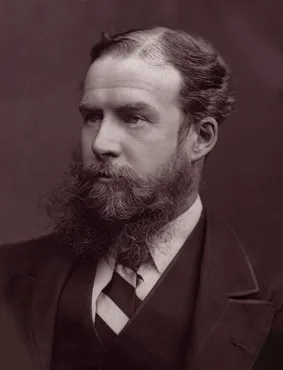
1865 LUBBOCK, John (1834 – 1913)
Pre-historic times, as illustrated by ancient remains, and the manners and customs of modern savages.
Lubbock introduced the terms "Paleolithic" and "Neolithic". His work addressed not only the topic of human antiquity but also the lives and cultures of people in the Stone Age. In contrast to researchers who focused o…
GMN 7257 · https://historyofmedicine.com/id/9426
1865 DARWIN, Charles Robert (1809 – 1882)
On the movements and habits of climbing plants.
Darwin's report on his discoveries concerning the adaptive value of climbing for certain plants, including the development of circumnutation. Darwin waited ten years to publish the first edition in book form (1875) wi…
GMN 8910 · https://historyofmedicine.com/id/11088
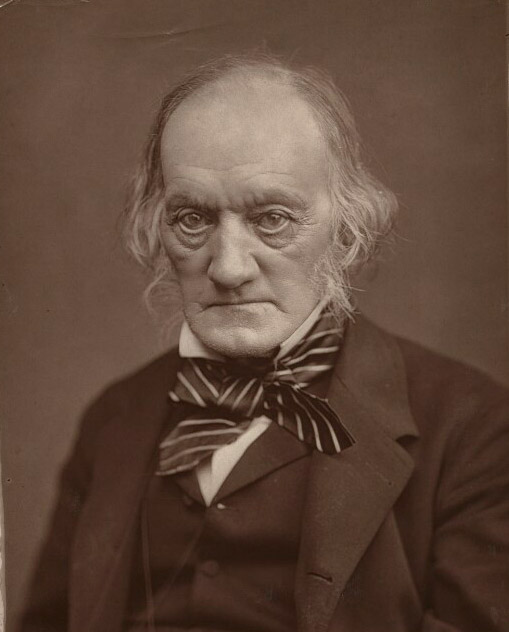
1866 –1868 OWEN, Sir Richard (1804 – 1892)
On the anatomy and physiology of the vertebrates. 3 vols.
Vol. 1. Fishes and reptiles; Vol. 2. Birds; Vol. 3. Mammals. The most important work on the subject after Cuvier, based entirely on personal observations. Owen entitled his 40th and concluding chapter "Derivative hypo…
GMN 336 · https://historyofmedicine.com/id/224
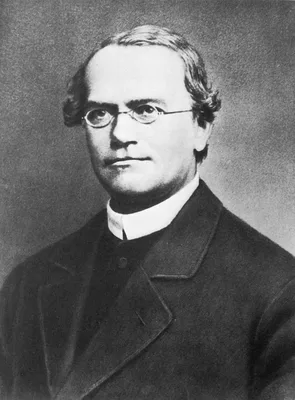
1866 MENDEL, Gregor Johann (1822 – 1884)
Versuche über Pflanzen-Hybriden.
Discovery of the Mendelian ratios, the most significant single achievement in the history of genetics. The story of how Mendel published his paper in this relatively obscure journal only to have his discovery ignored …
GMN 222 · https://historyofmedicine.com/id/4395
1866 HAECKEL, Ernest Heinrich Philipp August (1834 – 1919)
Generelle Morphologie der Organismen. 2 vols.
Haeckel accepted the general principles of Darwinism, disagreeing on some points. He was the first to promote Darwin’s theories in Germany. This work contains the first statement of his theory that “ontogeny recapitul…
GMN 223 · https://historyofmedicine.com/id/4399
1868 HAECKEL, Ernest Heinrich Philipp August (1834 – 1919)
Natürliche Schöpfungsgeschichte. Gemeinverständlich wissenschaftliche Vorträge über die Entwickelungslehre im Allgemeinen und diejenige von Darwin, Goethe und Lamarck im Besonderen, über die Anwendung derselben auf den Ursprung des Menschen . . .
Haeckel constructed the first of the now commonplace ancestral trees, depicting the evolution of life from the simplest organisms through 21 stages of development to modern man – the 22nd and final stage. Within this …
GMN 224 · https://historyofmedicine.com/id/4402
1868 DARWIN, Charles Robert (1809 – 1882)
The variation of animals and plants under domestication. 2 vols.
Darwin carried out numerous investigations with pigeons and various plants. He recognized continuous and discontinuous variation; he concluded that crossing tends to keep populations uniform.
GMN 224.1 · https://historyofmedicine.com/id/4405
1868 LARTET, Louis (1840 – 1899)
Mémoire sur une sépulture des anciens troglodytes du Périgord.
In March 1868, railway workers clearing away debris from a rock shelter known locally as the Abri de Crô-Magnon (shelter of Crô-Magnon) at Les Eyzies, Dordogne, noticed stone tools and pieces of skeleton imbedded in t…
GMN 7252 · https://historyofmedicine.com/id/9421
1868 HUXLEY, Thomas Henry (1825 – 1895)
On the animals which are most nearly intermediate between birds and reptiles.
Huxley proposed a close relationship between birds and dinosaurs after the discovery in Germany of the primitive fossil bird Archaeopteryx. He made detailed comparisons of Archaeopteryx with various prehistoric reptil…
GMN 9351 · https://historyofmedicine.com/id/11533
1868 MURCHISON, Charles (1830 – 1879); FALCONER, Hugh (1808 – 1865)
Palaeontological memoirs and notes of the late Hugh Falconer. For many years superintendent of the H.E.I. Company's botanical gardens at Suharunpoor and Calcutta. With a biographical sketch of the author. Compiled and edited by Charles Murchison. Vol. 1. Fauna Antiqua Sivalensis. Vol. II. Mastodon, elephant, rhinoceros, ossiferous caves, primeval man and his cotemporaries. 2 vols.
Falconer's writings on human antiquity appear in Vol. 2 of his Palaeontogical memoirs. Together with William Pengelly, Falconer was one of the first two scientists to visit Brixham Cave after its discovery in 1858, an…
GMN 14093 · https://historyofmedicine.com/id/16404
1869 AGASSIZ, Louis Jean Rodolphe (1807 – 1873)
De l'espèce et de la classification en zoologie. Traduction de l'anglais par Félix Vogeli. Édition revue et agumentée par l'auteur.
While Agassiz often wrote in general terms regarding his virulent opposition to Darwin's theory of evolution by natural selection, he provided his scientific rationale for that opposition only in an appendix to the Fr…
GMN 9473 · https://historyofmedicine.com/id/11657
1870 GEGENBAUR, Karl (1826 – 1903)
Grundzüge der vergleichenden Anatomie der Wirbelthiere.
Gegenbaur’s best work. He stressed the value of comparative anatomy as the basis of the study of descent, considering that knowledge of the relations of corresponding parts in different animals was more important even…
GMN 337 · https://historyofmedicine.com/id/229
1870 WALLACE, Alfred Russel (1823 – 1913)
Contributions to the theory of natural selection.
Reprints, with important revisions and additions, nine important papers concerning natural selection, which had previously appeared in journals, and publishes for the first time a major paper on The limits of natural …
GMN 228 · https://historyofmedicine.com/id/4412
1871 HUXLEY, Thomas Henry (1825 – 1895)
A manual of the anatomy of vertebrated animals.
Huxley was among those who refuted Owen’s theory of the vertebral skull.
GMN 338 · https://historyofmedicine.com/id/242
1871 –1888 BROCA, Pierre Paul (1824 – 1880)
Mémoires d’anthropologie. 5 vols.
Most often remembered for his contributions to neurology, Broca was also among the greatest of the French anthropologists. He originated modern craniometry and in that connection devised many craniometric and craniosc…
GMN 169 · https://historyofmedicine.com/id/3253
1871 DARWIN, Charles Robert (1809 – 1882)
The descent of man, and selection in relation to sex. 2 vols.
This is really two works. The first demolished the theory that the universe was created for humans while in the second Darwin presented a mass of evidence in support of his earlier hypothesis regarding sexual selectio…
GMN 170 · https://historyofmedicine.com/id/3255
1872 DARWIN, Charles Robert (1809 – 1882)
The expression of the emotions in man and animals.
Darwin examined the causes, physiological and psychological, of all the fundamental emotions in man and animals. He concluded that “the chief expressive actions exhibited by man and by the lower animals are now innate…
GMN 4975 · https://historyofmedicine.com/id/6395
1872 MORTILLET, Louis Laurent Gabriel de (1821 – 1898)
Diverses périodes de l'age de la pierre.
Mortillet rejected the fauna-based cultural subdivisions of the Pleistocene (cave bear, mammoth, reindeer) that had been introduced by Edouard Lartet in favor of a system based on tools and artifacts (“données industr…
GMN 7373 · https://historyofmedicine.com/id/9545
1872 VILANOVA Y PIERA, Juan (1821 – 1893)
Origen, naturaleza y antigüedad del hombre.
The first book on human origins or human evolution published in Spanish. Digital facsimile from Google Books at this link.
GMN 7609 · https://historyofmedicine.com/id/9781
1873 RIVIÈRE, Émile (1835 – 1922)
Découverte d’un squelette humain de l’époque paléolithique dans les cavernes des Baoussé-Roussé dites grottes de Menton.
In March 1872 Rivière discovered an entire fossil human skeleton in a cave at Menton, in the south of France near the Italian border. The skeleton, later known as “Menton man,” closely resembles the Cro-Magnon remains…
GMN 11333 · https://historyofmedicine.com/id/13531
1874 HAECKEL, Ernest Heinrich Philipp August (1834 – 1919)
Anthropogenie oder Entwicklungsgeschichte des Menschen.
GMN 493 · https://historyofmedicine.com/id/1428
1874 HAECKEL, Ernest Heinrich Philipp August (1834 – 1919)
Die Gastraea-Theorie, die phylogenetische Classification des Thierreichs und die Homologie der Keimblätter.
Haeckel’s gastraea theory, which considers the two-layered gastrula the ancestral form of multicellular animals.
GMN 120 · https://historyofmedicine.com/id/2058
1874 BELT, Thomas (1832 – 1878)
The naturalist in Nicaragua: A narrative of a residence at the gold mines of Chontales; journeys in the savannahs and forests, with observations on animals and plants in reference to the theory of evolution of living forms.
In this book Belt first described "the mutualistic relationship of certain Acacias and the ant we now know as Pseudomyrmex spinicola. These are a species of red myrmecophyte-inhabiting neotropical ants which are found…
GMN 7443 · https://historyofmedicine.com/id/9615
1875 DOHRN, Anton (1840 – 1909)
Der Ursprung der Wirbelthiere und das Princip des Functionswechsels.
Dohrn’s theory of change of function as the origin of evolutionary novelties.
GMN 339 · https://historyofmedicine.com/id/243
1875 LARTET, Édouard (1801 – 1871); CHRISTY, Henry (1810 – 1865); JONES, Thomas Rupert (1819 – 1911)
Reliquiae Aquitanicae; being contributions to the archaeology and palaeontology of Périgord and the adjoining provinces of southern France. Edited by Thomas Rupert Jones.
This beautiful and bibliographically complicated work was issued in 17 parts from 1865 to 1875. It includes 82 tinted lithographic plates, and is the first visually spectacular large extensively illustrated publicatio…
GMN 9492 · https://historyofmedicine.com/id/11677
1878 MÜLLER, Johann Friedrich Theodor (Fritz) (1821 – 1897)
Ueber die Vortheile der Mimicry bei Schmetterlingen.
Bates’s theory of mimicry did not account for the superficial resemblances between two or more unpalatable species. Müller explained such mimicry, known today as “Müllerian mimicry”. A predator must learn which potent…
GMN 228.1 · https://historyofmedicine.com/id/8324
1878 WALLACE, Alfred Russel (1823 – 1913)
Tropical nature and other essays.
"Wallace's extensive work in biogeography made him aware of the impact of human activities on the natural world. In Tropical Nature and Other Essays (1878), he warned about the dangers of deforestation and soil erosio…
GMN 9174 · https://historyofmedicine.com/id/11353
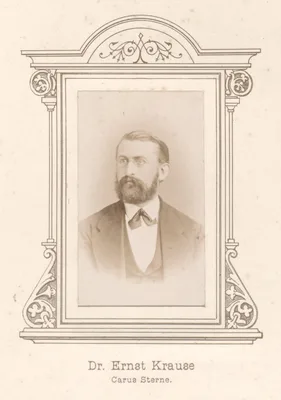
1879 DARWIN, Erasmus (1731 – 1802); DARWIN, Charles Robert (1809 – 1882); KRAUSE, Ernst (1839 – 1903); DALLAS, William Sweetland (1824 – 1890)
Erasmus Darwin. By Ernst Krause. Translated from the German by W. S. Dallas. With a preliminary notice by Charles Darwin.
Krause's short biography originally appeared in the German evolutionary periodical Kosmos in February 1879. In this translation Darwin added a biographical contribution that is longer than Krause's, i.e. 127pp by Darw…
GMN 8919 · https://historyofmedicine.com/id/11097
1880 SANZ DE SAUTUOLA, Marcelino [Marcelino DE SAUTUOLA] (1831 – 1888)
Breves apuntes sobre algunos objetos prehistóricos de la provincia de Santander
Privately printed pamphlet asserting the prehistoric origin of cave paintings discovered in the cave of Altamira, Cantabria, Spain by Maria Sanz de Sautuola, daughter of the author. These were first prehistoric cave p…
GMN 7287 · https://historyofmedicine.com/id/9457
1880 WALLACE, Alfred Russel (1823 – 1913)
Island life: Or, the phenomena and causes of insular faunas and floras, including a revision and attempted solution of the problem of geological climates.
"In 1880, Wallace published the book Island Life as a sequel to The Geographical Distribution of Animals. It surveyed the distribution of both animal and plant species on islands. Wallace classified islands into three…
GMN 7440 · https://historyofmedicine.com/id/9612
1881 LE BARON, Jules Prosper (1855 – 1902)
Lésions osseuses de l'homme préhistorique en France et en Algérie.
Le Baron attempted diagnosis and predicted etiology on thousands of bones collected at the Musée Broca, the Musée Dupuytren, and the Musée d'Histoire Naturelle.. Digital facsimile from BnF Gallica at this link.
GMN 7707 · https://historyofmedicine.com/id/9879
1881 MORTILLET, Louis Laurent Gabriel de (1821 – 1898); MORTILLET, Adrien de (1853 – 1931)
Musée préhistorique
This atlas of 100 plates containing roughly 800 individual images, with accompanying text, was both a comprehensive atlas of then-known prehistoric artifact types and an attempt at their classification. Until 1902 the…
GMN 11334 · https://historyofmedicine.com/id/13532

![SANZ DE SAUTUOLA, Marcelino [Marcelino DE SAUTUOLA] (1831 – 1888)](/media/portraits/10315)