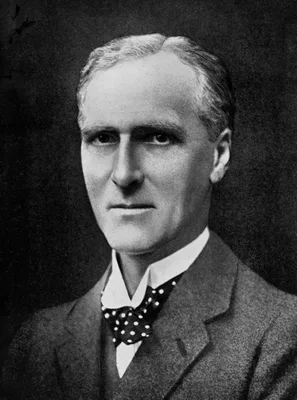
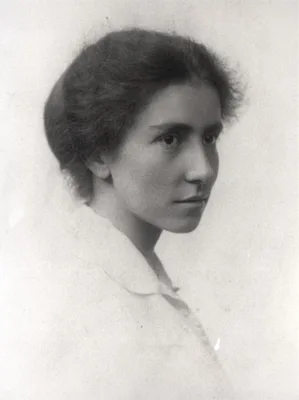
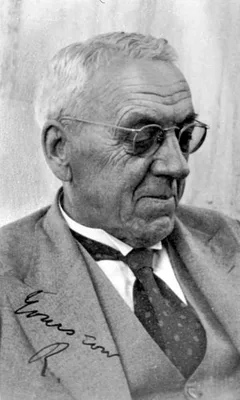
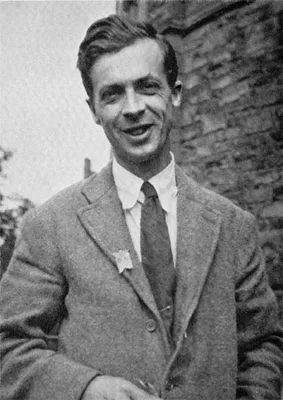
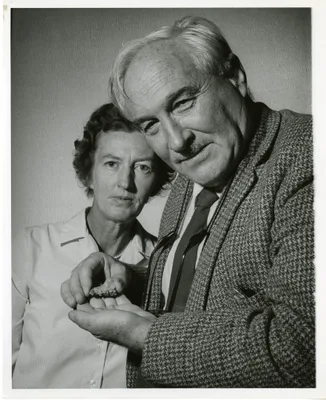
1937 –1939 KEITH, Sir Arthur (1866 – 1955); GARROD, Dorothy Annie Elizabeth (1892 – 1968); BATE, Dorothea Minola Alice (1878 – 1951); MCCOWN, Theodore Doney (1908 – 1969)
The stone age of Mount Carmel. Volume I: Excavations at the Wady el-Mughara. Volume II: The fossil remains from the Lavalloiso-Mousterian.
Garrod carried out her landmark excavations of the el-Wad, el-Tabun and es-Skhul caves on the hills of Mount Carmel, close to Wadi el-Mugharah (Valley of the Caves) between 1929 and 1934. Her monograph on the subject …
GMN 7259 · https://historyofmedicine.com/id/9428
1938 BROOM, Robert (1866 – 1951)
The Pleistocene anthropoid apes of South Africa.
Paranthropus robustus, discovered by Broom in Kromdraal, South Africa, in 1938. The species is generally dated from about 2 million to 1.2 million years before present.
GMN 7281 · https://historyofmedicine.com/id/9451
1940 COTT, Hugh Bamford (1900 – 1987)
Adaptive coloration in animals. With an introduction by Julian S. Huxley.
Published during WWII, Cott's book was the first major work on camouflage in zoology, appreciated by zoologists for its scientific information and carried by many allied soldiers during the war for survival purposes. …
GMN 7719 · https://historyofmedicine.com/id/9891
1940 –1993 SOCIETY OF VERTEBRATE PALEONTOLOGY
Bibliography of fossil vertebrates: The indexed published literature of vertebrate paleontology, 1509-1993.
http://vertpaleo.org/Publications/Bibliography-of-Fossil-Vertebrates.aspx "The Bibliography of Fossil Vertebrates (BFV) aimed to index the world literature of vertebrate paleontology. Although no compilation can ever …
GMN 10743 · https://historyofmedicine.com/id/12939
1940 BREUIL, Henri Édouard Prosper [Abbé Breuil] (1877 – 1961)
Découverte d'une remarkable grotte ornée, au domaine de Lascaux, Montignac (Dordogne).
Lascaux, which has been called "The Sistine Chapel of the Paleolithic", was discovered on September 12, 1940 by 18-year-old Marcel Ravidat when his dog, Robot, fell into a hole. Ravidar returned to the cave with three…
GMN 11401 · https://historyofmedicine.com/id/13600
1942 HUXLEY, Sir Julian Sorell (1887 – 1975)
Evolution: The modern synthesis.
The work which defined the modern synthesis of evolutionary biology of the early 20th century.
GMN 255 · https://historyofmedicine.com/id/8689
1942 MAYR, Ernst Walter (1904 – 2005)
Systematics and the origin of species.
One of the canonical publications of the modern evolutionary synthesis. Mayr discussed the different ways different investigators identify species, and he characterized these different approaches as different species …
GMN 255.1 · https://historyofmedicine.com/id/8690
1943 WEIDENREICH, Franz (1873 – 1948)
The skull of Sinanthropus pekinensis: A comparative study on a primitive hominid skull.
Digital facsimile from the Internet Archive at this link.
GMN 214 · https://historyofmedicine.com/id/8936
1944 SIMPSON, George Gaylord (1902 – 1984)
Tempo and mode in evolution.
Simpson's seminal contribution to the modern evolutionary synthesis integrated the facts of paleontology with those of genetics and natural selection. "Simpson argued that the microevolution of population genetics was…
GMN 255.2 · https://historyofmedicine.com/id/8691
1946 BROOM, Robert (1866 – 1951); SCHEPERS, Gerrit Willem Hendrik (1914 – )
Pretoria: The South African fossil ape-men. The Australopithecinae. Part I. The occurrence and general structure of the South African ape-men.
With this comprehensive report Broom presented his case to the scientific establishment that Australopithecus probably represented the stock from which mankind had evolved.
GMN 214.1 · https://historyofmedicine.com/id/3948
1949 CLARK, Sir Wilfrid Edward Le Gros (1895 – 1971)
History of the primates.
GMN 352 · https://historyofmedicine.com/id/277
1949 LIBBY, Willard Frank (1908 – 1980)
Age determinations by radiocarbon content: checks with samples of known age.
Introduction of radiocarbon dating for dating organic materials, including fossils (maximum 50,000 to 60,000 years old). With J. R. Arnold.
GMN 7297 · https://historyofmedicine.com/id/9467
1950 STEBBINS, George Ledyard Jr. (1906 – 2000)
Variation and evolution in plants.
The first comprehensive exposition of the relationship between genetics and natural selection in plants, and the most imporant book on plant evolution published during the 20th century. Stebbins combined genetics and …
GMN 9185 · https://historyofmedicine.com/id/11365
1951 GILLISPIE, Charles Coulston (1918 – 2015)
Genesis and geology: A study in the relations of scientific thought, natural theology, and social opinion in Great Britain, 1790-1850.
New edition, with a foreward by Nicolaas A. Rupke and a new preface by the author (1996).
GMN 8202 · https://historyofmedicine.com/id/10378
1951 LAWRENCE, Jerome (1915 – 2004); LEE, Robert Edwin (1918 – 1994)
Inherit the wind.
This play about the Scopes Trial that concerned creationism versus evolution was the subject of numerous film adaptations including the most famous one first screened in 1960 starring Spencer Tracy and Fredric March.
GMN 10616 · https://historyofmedicine.com/id/12809
1953 WEINER, Joseph Sidney (1915 – 1982)
The Piltdown Forgery.
Fiftieth anniversary edition with a new introduction and afterward by Chris Stringer (Oxford University Press, 2003).
GMN 7264 · https://historyofmedicine.com/id/9434
1953 CLARK, Sir Wilfrid Edward Le Gros (1895 – 1971); OAKLEY, Kenneth Page (1911 – 1981); WEINER, Joseph Sidney (1915 – 1982)
The solution of the Piltdown problem.
Exposure of the Piltdown fraud. Weiner, Oakley and Le Gros Clark found ample evidence of forgery in the Piltdown remains, including the use of artificial abrasion and staining; they also applied fluorine and nitrogen …
GMN 7301 · https://historyofmedicine.com/id/9471
1954 ALLISON, Anthony Clifford (1925 – 2014)
Protection afforded by sickle-cell trait against subtertian malarial infection.
Allison was the first to connect a hereditary disease (sickle cell disease) to an infectious disease (malaria). He proved that heterozygous and homozygous individuals to the sickle cell trait or disease respectively s…
GMN 11887 · https://historyofmedicine.com/id/14091
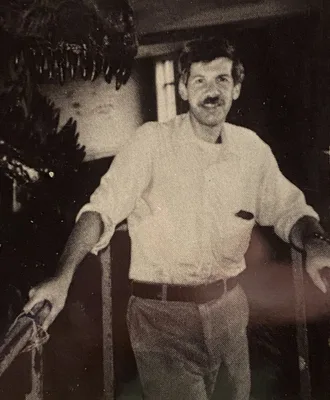
1956 WILSON, Edward Osborne (1929 – 2021); BROWN, William Louis Jr. (1922 – 1977)
Character displacement.
In this paper Brown and Wilson defined character displacement as follows: "Two closely related species have overlapping ranges. In the parts of the ranges where one species occurs alone, the populations of that specie…
GMN 14065 · https://historyofmedicine.com/id/16376
1958 EISELEY, Loren (1907 – 1977)
Darwin's century: Evolution and the men who discovered it.
An elegantly written and profound book that was a powerful influence to my own intellectual development when I read it in 1958; it also a great inspiration for me to study the history of evolution and biology. "Eisele…
GMN 8993 · https://historyofmedicine.com/id/11172
1959 LEAKEY, Louis Seymour Bazett (1903 – 1972)
A new fossil from Olduvai.
In 1959 Mary Leakey discovered the "Zinj" skull (OH 5) at Olduvai Gorge. This became the type specimen for Paranthropus boisei, arguably the most famous early human fossil from Olduvai in Northern Tanzania. The specie…
GMN 7288 · https://historyofmedicine.com/id/9458
1961 LEAKEY, Louis Seymour Bazett (1903 – 1972); ET AL
Age of Bed I, Olduvai Gorge, Tanganyika.
Introduction of the potassium-argon dating method to paleoanthropology, showing that lava at the base of the site of Olduvai Gorge was about 1.8 million years old, and proving that fossils, Australopithecus (Zinjanthr…
GMN 214.2 · https://historyofmedicine.com/id/8937
1963 MAYR, Ernst Walter (1904 – 2005)
Animal species and evolution.
Condensed and extensively revised as Populations, species and evolution. Cambridge: Belknap Press of Harvard University Press, 1970.
GMN 13033 · https://historyofmedicine.com/id/15283
1964 OAKLEY, Kenneth Page (1911 – 1981)
The problem of man's antiquity. An historical survey.
GMN 7263 · https://historyofmedicine.com/id/9433
1964 LEAKEY, Louis Seymour Bazett (1903 – 1972); TOBIAS, Phillip Valentine (1925 – 2012); NAPIER, John Russell (1917 – 1987)
A new species of the genus Homo from Olduvai Gorge.
First report on Homo habilis.
GMN 7270 · https://historyofmedicine.com/id/9440
1966 MERRIHUE, Craig Morris (1933 – 1965); TURNER, Grenville (1936 – )
Potassium-Argon dating by activation with fast neutrons.
Argon 40-argon 39 dating (Argon-argon dating). Astrophysicist Merrihue died in a mount-climbing accident at the age of 32.
GMN 7299 · https://historyofmedicine.com/id/9469
1966 WILLIAMS, George Christopher (1926 – 2010)
Adaptation and natural selection: A Critique of some current evolutionary thought.
GMN 8992 · https://historyofmedicine.com/id/11171
1966 SAHLY, Ali
Les main mutilées dans l'art prehistorique.
A comprehensive study by a physician of the numerous tracings and impressions of mutilated hands that appear in prehistoric painted caves or parietal art.
GMN 11090 · https://historyofmedicine.com/id/13286
1968 COPPENS, Yves (1934 – ); ARAMBOURG, Camille (1885 – 1969)
Sur la decouverte dans le Pleistocene inferieur de la valle de l'Omo (Ethiopie) d'une mandibule d'Australopithecien.
In 1967 Arambourg and Coppens discovered Omo 18, the first specimen of Paranthropus aethiopicus, also known as Paraustralopithecus aethiopicus; however it's classification as a new species was initially dismissed. In …
GMN 7282 · https://historyofmedicine.com/id/9452
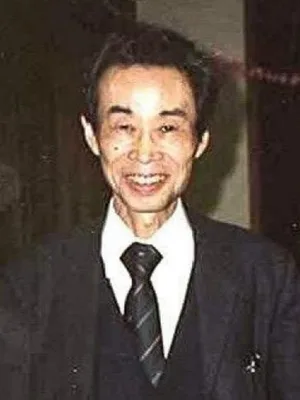
1968 KIMURA, Motoo (Kimura Motō) (1924 – 1994)
Evolutionary rate at the molecular level.
Using complex mathematics, Motoo Kimura calculated that genomes constantly undergo a remarkably high number of mutations per unit of time. He wrote, "Calculating the rate of evolution in terms of nucleotide substituti…
GMN 13551 · https://historyofmedicine.com/id/15828
1971 HALLER, John S. Jr. (1940 – )
Outcasts from evolution: Scientific attitudes of racial inferiority, 1859 - 1900.
GMN 9469 · https://historyofmedicine.com/id/11652
1972 GOULD, Stephen Jay (1941 – 2002); ELDREDGE, Niles (1943 – )
"Punctuated equilibria: an alternative to phyletic gradualism." IN: T.J.M. Schopf, ed., Models in Paleobiology.
The theory of punctuated equilibrium or punctuated equilibria in evolution. This theory argues that once species appeared in the the fossil record they became stable, showing little net evolutionary change for most of…
GMN 7585 · https://historyofmedicine.com/id/9757
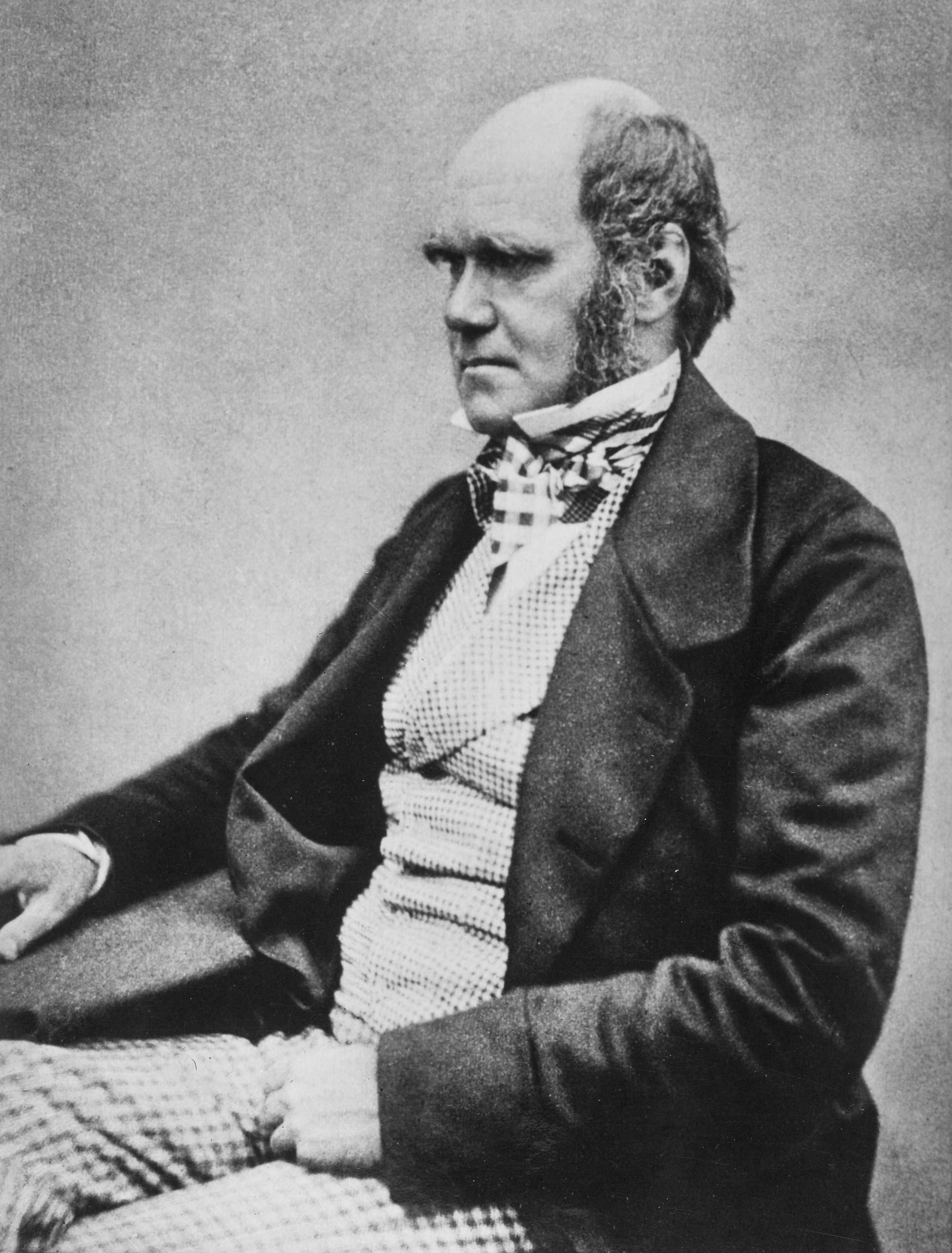
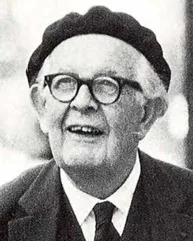
1974 DARWIN, Charles Robert (1809 – 1882); GRUBER, Howard Ernst (1922 – 2005); BARRETT, Paul H.; PIAGET, Jean (1896 – 1980)
Darwin on man: A psychological study of scientific creativity by Howard E. Gruber. Together with Darwin's early and unpublished notebooks transcribed and annotated by Paul H. Barrett. Foreward by Jean Piaget.
In addition to a frequently original study of the development of Darwin's psychological theories, the authors publish for the first time two extremely significant manuscript notebooks by Darwin written in 1837. These …
GMN 8912 · https://historyofmedicine.com/id/11090
1974 DARWIN, Charles Robert (1809 – 1882)
The Darwin correspondence project.
http://www.darwinproject.ac.uk/" "Search over 12000 letters and articles..."
GMN 10551 · https://historyofmedicine.com/id/12744
1975 WILSON, Edward Osborne (1929 – 2021)
Sociobiology: The new synthesis.
Integration of biological and evolutionary theory with the study of social behavior and social organization of animal populations.
GMN 257.6 · https://historyofmedicine.com/id/8716
1975 IKEYA, Motoji (1940 – 2006)
Dating a stalactite by electron paramagnetic resonance.
Ikeya introduced electron spin resonance dating; the first application dated a speleothem in Akiyoshi Cave, Japan. See R. Grün and C. B. Stringer, "Electron spin resonance dating and the evolution of modern humans," A…
GMN 7302 · https://historyofmedicine.com/id/9472
1975 GOODMAN, Morris G. (1925 – 2010); MOORE, G. William (1945 – ); MATSUDA, Genji
Darwinian evolution in the genealogy of haemoglobin.
In 1975 Goodman and his collaborators used sequence data to reconstruct the evolutionary history of hemoglobin (including possible ancestral sequences) and analyze which sites on the hemoglobin complex had evolved at …
GMN 13928 · https://historyofmedicine.com/id/16222
1976 JOHANSON, Donald Carl (1943 – ); TAIEB, Maurice (1935 – )
Plio-Pleistocene hominid discoveries in Hadar, Ethiopia.
Report on the Afar fossils (formally classified and named Australopithiecus afaranesis in 1998) representing a minimum of 35 and a maximum of 65 individuals, all about 3,000,000 years old. The most famous of these, AL…
GMN 214.3 · https://historyofmedicine.com/id/8938
1976 MILLER, Louis Howard (1935 – ); MASON, Steven J.; CLYDE, David Francis (1925 – 2002); ET AL
The resistance factor to Plasmodium vivax in blacks.
The authors showed that the Plasmodium vivax parasite requires the Fya/Fyb Duffy antigen/chemokine receptor on the surface of red blood cells for penetration of human red blood cells. Because most African and American…
GMN 11888 · https://historyofmedicine.com/id/14093
1977 DARWIN, Charles Robert (1809 – 1882); FREEMAN, Richard Broke (1915 – 1986)
Charles Darwin: An annotated bibliographical handlist
This bibliography has been extensively supplemented by the Freeman Bibliographical Database at Darwin Online edited by John van Wyhe. "The database has been supplemented by the entries from unpublished manuscript corr…
GMN 11208 · https://historyofmedicine.com/id/13405
1978 JOHANSON, Donald Carl (1943 – ); WHITE, Timothy Douglas (1950 – ); COPPENS, Yves (1934 – )
A new species of the genus Australopithecus (Primates: Hominidae) from the Pliocene of Eastern Africa.
Johanson and colleagues formally named the species Afarensis of the genus Australopithecus in 1978.
GMN 7277 · https://historyofmedicine.com/id/9447
1980 EWALD, Paul W. (1953 – )
Evolutionary biology and the treatment of signs and symptoms of infectious disease.
"When viewed from an evolutionary perspective, manifestations of infectious diseases can be classified as (1) adaptations of the host to counteract harmful aspects of the disease, (2) adaptations of the pathogen to ma…
GMN 8988 · https://historyofmedicine.com/id/11167
1980 YUNIS, Jorge Jose (1933 – ); SAWYER, Jeffrey R.; DUNHAM, Kelly
The striking resemblance of high-resolution G-banded chromosomes of man and chimpanzee.
Chimpanzees are the closest primates genetically to humans. In this paper the authors demonstrated the genetic changes that differentiated humans from chimpanzees. By comparing human and chimpanzee chromosomes the aut…
GMN 14108 · https://historyofmedicine.com/id/16419
1982 MAYR, Ernst Walter (1904 – 2005)
The growth of biological thought. Diversity, evolution, and inheritance.
An interpretive history of what Mayr calls “ultimate” explanations in biology, reflecting Mayr’s expertise in systematics, evolution, and genetics.
GMN 258.12 · https://historyofmedicine.com/id/8729
1983 GRAYSON, Donald K.
The establishment of human antiquity.
The most complete historical treatment of the pre-1900 literature.
GMN 214.91 · https://historyofmedicine.com/id/3963
1984 BOWLER, Peter J. (1944 – )
Evolution: The history of an idea.
Fourth edition, revised and enlarged, 2009.
GMN 258.13 · https://historyofmedicine.com/id/8730
1984 SPENCER, Frank (1941 – 1999); SMITH, Fred H.
The origins of modern humans: A world survey of the fossil evidence.
An historical and analytical review of the literature up to 1984, with detailed bibliographies, by several outstanding authorities, edited by Smith and Spencer. Includes, pp. 411-483, Milford H. Wolpott, Wu Xin Zhi, a…
GMN 7272 · https://historyofmedicine.com/id/9442
1985 TOBIAS, Phillip Valentine (1925 – 2012)
History of physical anthropology in Southern Africa.
GMN 7273 · https://historyofmedicine.com/id/9443
1985 BROWN, Frank Harold (1943 – 2017); HARRIS, John W. K.; LEAKEY, Richard Erskine Frere (1944 – )
Early Homo erectus skeleton from west Lake Turkana, Kenya.
The Turkana Boy, (KNM-WT 15000) now called Nariokotome Boy, a Homo erectus fossil which was in 2016 the most complete early human skeleton found. It is a nearly complete skeleton of a hominin youth believed to be 1.5 …
GMN 7284 · https://historyofmedicine.com/id/9454
1986 SPENCER, Frank (1941 – 1999)
Ecce Homo: An annotated bibliographic history of physical anthropology.
GMN 6979 · https://historyofmedicine.com/id/9145