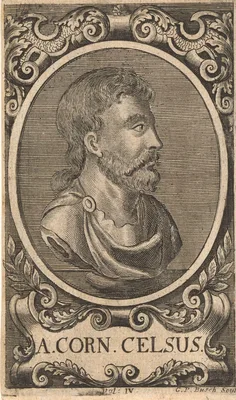
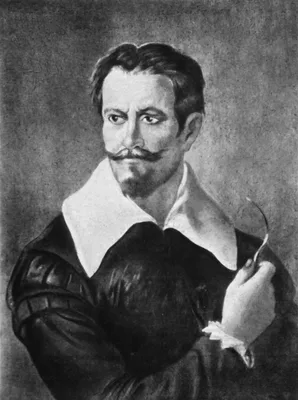
1478 CELSUS, Aulus Aurelius Cornelius (-25 – 50); FONTE, Bartolomeo della (Bartholomaeus Fontius) (1446 – 1513)
De medicina. Ed: Bartholomaeus Fontius.
De Medicina is the oldest Western medical document after the Hippocratic writings. Written about 30 CE, it remains the greatest medical treatise from ancient Rome, and the first Western history of medicine. Celsus’s s…
GMN 20 · https://historyofmedicine.com/id/4660
1535 SANTO, Mariano (1488 – 1577)
De lapide renum curiosum opusculum nuperrime in lucem aeditum. Eiusdem De lapide vesicae per incisionem extrahendo sequitur aureus libellus.
Marianus Sanctus Barolitanus popularized the operation of lithotomy introduced by the father of Giovanni Vigo of Rapallo. This method passed on to Giovanni di Romani and from him to Marianus. It became known as the “M…
GMN 4278 · https://historyofmedicine.com/id/5302
1556 FRANCO, Pierre (1500 – 1561)
Petit traité contenant une des parties principalles de chirurgie, laquelle les chirurgiens hernieres exercent.
Clifford Allbutt considered Franco the best lithotomist of the 16th century. His skill in extracting the stone by the perineal route was of a high order; in 1556 he introduced the operation of suprapubic cystotomy in …
GMN 3573 · https://historyofmedicine.com/id/5304
1561 FRANCO, Pierre (1500 – 1561)
Traité des hernies... et autres excellentes parties de chirurgie assavior de la pierre, des cataractes des yeux, & autres maladies...
Greatly expanded second edition, including Franco's operations for cataract and urinary calculi. Digital facsimile from BnF Gallica at this link.
GMN 3574 · https://historyofmedicine.com/id/4161
1565 KENTMANN, Johannes (1518 – 1574)
Calculorum qui in corpore ac membris hominum innascuntur, genera XII. depicta descriptaque, cum historiis singulorum admirandis.
The first treatise to specifically on urinary calculi and gallstones, with each of the 12 chapters exploring a part of the human body where such stones are found (gall bladder, kidneys, bladder, etc.). Additionally, t…
GMN 11489 · https://historyofmedicine.com/id/13688
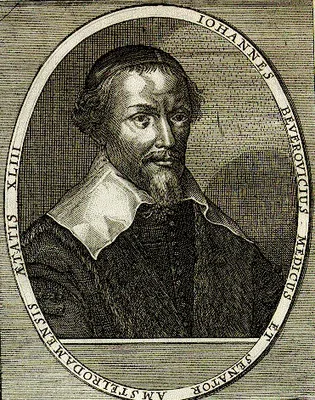
1638 BEVERWIJCK, Johan van (Johannes Beverovicius) (1594 – 1647)
De calculo renum & vesicae liber singularis. Cum epistolis & consultationibus magnorum virorum.
The first medical book to contain an endorsement of Harvey's theory of the circulation of the blood (originally published ten years earlier in 1628). Beverwijck began his work with a treatise on urinary and renal calc…
GMN 11647 · https://historyofmedicine.com/id/13848
1682 TOLET, François (1647 – 1724)
Traité de la lithotomie ou de l'extraction de la pierre hors la vessie.
In Tolet's day lithotomy was one of the major and most dangerous of operations. Tollet provided explicit directions for the operation in children as well as adults of both sexes. He particularly stressed the need for …
GMN 14336 · https://historyofmedicine.com/id/16664
1700 MÉRY, Jean (1645 – 1722)
Observations sur la maniere de tailler dans les deux sexes pour l'extraction de la pierre, pratiqué par Frere Jacques. Nouveau system de la circulation du sang pour le trou ovale dans le foetus humain, avec les réponses aux objections qui ont été faites contre cette hypothese.
"Méry became closely associated with the comparative-anatomical work led by Claude Perrault and J.-G. Duverney. As a member of this group, Méry made contributions to their joint publications, in which each man’s speci…
GMN 11894 · https://historyofmedicine.com/id/14099
1707 ALGHISI, Tommaso (1669 – 1713)
Litotomia…
A renowned specialist and pupil of Bellini, Alghisi was probably the first to use an indwelling urethral catheter to drain urine away from the wound after lithotomy. The inclined position of the patient with the head …
GMN 4279.1 · https://historyofmedicine.com/id/5306
1710 GROENVELDT, Jan [GREENFIELD (1647 – 1710)
A compleat treatise of the stone and gravel.
Groenveldt was a famous lithotomist, using the suprapubic technique. He also enjoyed a rather unsavoury reputation as a quack for his determination to promote the use of cantharides. He changed his name to Greenfield …
GMN 4280 · https://historyofmedicine.com/id/5308
1720 DOUGLAS, John (lithotomist) (1680 – 1743)
Lithotomia Douglassiana; or, an account of a new method of making the high operation, in order to extract the stone out of the bladder.
Douglas accused Cheselden of plagiarizing his work, although the latter had acknowledged his indebtedness to Douglas. It is possible that this was the reason which prompted Cheselden to drop the high operation in favo…
GMN 4281 · https://historyofmedicine.com/id/5311
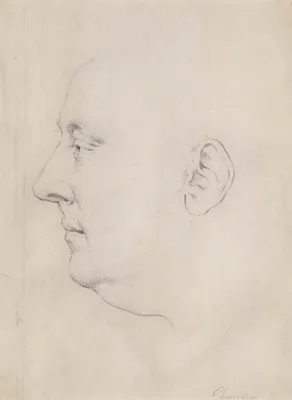
1723 CHESELDEN, William (1688 – 1752)
A treatise on the high operation for the stone.
Cheselden was surgeon to St. Thomas’s Hospital and an outstanding figure in British surgery in the first half of the 18th century. The above work describes his method of performing suprapubic lithotomy, a method which…
GMN 4282 · https://historyofmedicine.com/id/5315
1727 COLOT, François (1630 – 1706)
Traité de l’opération de la taille.
François Colot was the last and best-known member of the Colot family, itinerant lithotomists.
GMN 4282.1 · https://historyofmedicine.com/id/5322
1730 LE DRAN, Henri François (1685 – 1770)
Parallèle des différentes manières de tirer la pierre hors de la vessie.
Le Dran, famous French lithotomist, improved the operation of lithotomy. Murphy credits him for originating the lateral lithotomy usually attributed to Cheselden, whose method he discusses. Le Dran was one of Haller’s…
GMN 4283 · https://historyofmedicine.com/id/5326
1748 CHESELDEN, William (1688 – 1752); REID, Alexander (1719 – 1789)
A remarkable case of a person cut for the stone in the new way, commonly called the lateral, by William Cheselden, Surgeon to Her late Majesty; communicated to Martin Folkes, Pr. R. S
Cheselden’s lateral lithotomy first described in this brief paper by Alexander Reid. Digital facsimile from royalsocietypublishing.org at this link.
GMN 4284 · https://historyofmedicine.com/id/5336
1779 BASEILHAC, Jean (1703 – 1781)
Nouvelle méthode d'extraire la pierre de la vessie urinaire par-dessus le pubis, qu'on nomme vulgairement le haut-appareil dans l'un & l'autre sexe, sans le secours d'aucun fluide retenu ni forcé dans la vessie: suivie de l'analyse des expériences de l'Academie Royale de Chirurgie de Paris, sur l'extraction de la pierre de la vessie urinaire de l'homme, par-dessous le pubis.
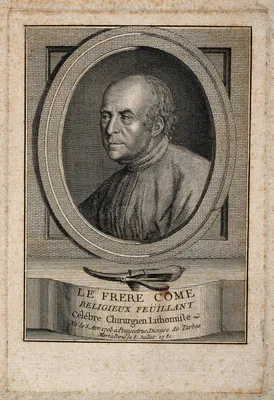
Frère Côme devised several new instruments for use in suprapubic lithotomy. This operation, placed in retirement when Cheselden adopted the lateral approach, was once more brought to the fore by Frère Côme. Digital fa…
GMN 4285 · https://historyofmedicine.com/id/5339
1784 CAMPER, Petrus (Pieter) (1722 – 1789)
Observationes circa mutationes quas subeunt calculi in vesica.
GMN 4286 · https://historyofmedicine.com/id/5342
1796 WALTER, Johann Gottlieb (1734 – 1818); WALTER, Friedrich August (1764 – 1826)
Anatomisches museum. Gesammelt von Johann Gottlieb Walter. Beschrieben von Friedrich August Walter. 2 vols.
Includes fine hand-colored plates of kidney stones and gall stones. Digital facsimile from the Internet Archive at this link.
GMN 7723 · https://historyofmedicine.com/id/9895
1797 WOLLASTON, William Hyde (1766 – 1828)
On gouty and urinary concretions.
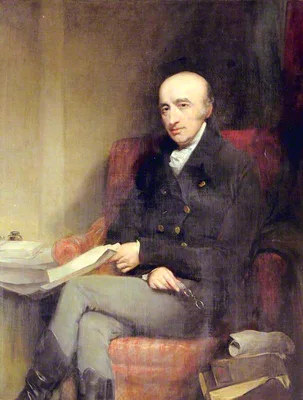
Wollaston showed that, in addition to stones consisting of uric acid, renal calculi might also consist of calcium phosphate, magnesium, ammonium phosphate, and calcium oxalate, or a mixture of these.
GMN 4287 · https://historyofmedicine.com/id/5346
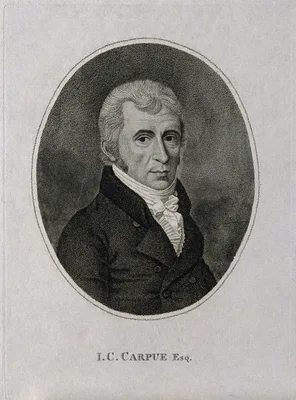
1819 CARPUE, Joseph Constantine (1764 – 1846)
A history of the high operation for the stone, by incision above the pubis; with observations on the advantages attending it; and an account of the various methods of lithotomy, from the earliest periods to the present time.
Carpue popularized suprapubic lithotomy, a procedure not often previously carried out.
GMN 4288 · https://historyofmedicine.com/id/5350
1822 ANDERSON, William; DURAND, Asher Brown (1796 – 1886)
System of surgical anatomy. Part first [all published]: On the structure of the groin, pelvis, and perineum. As connected with inguinal and femoral hernia; Tyeing the iliac arteries; and the operation of lithotomy. Illustrated by nine copper-plate engravings
Anderson trained at the Royal College of Surgeons in Edinburgh, emigrated to America in 1820 and, after delivering a series of anatomical lectures in New York under the patronage of Valentine Mott, became affiliated w…
GMN 13314 · https://historyofmedicine.com/id/15580
1826 CIVIALE, Jean (1792 – 1867)
Sur la lithotritie ou broiement de la pierre dans la vessie.
Civiale invented a lithotriteur for crushing stones inside the bladder and was responsible for putting the operation of lithotrity upon a sound basis. His claim to have introduced the operation was opposed by Leroy d’…
GMN 4289 · https://historyofmedicine.com/id/5353
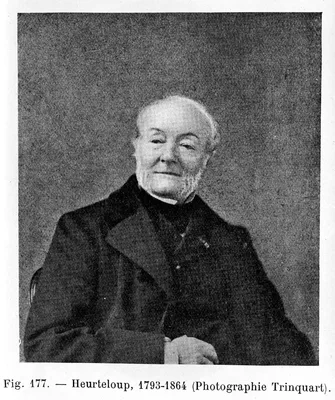
1833 HEURTELOUP, Charles Louis Stanislaus (1793 – 1864)
Lithotripsie. Mémoires sur la lithotripsie par percussion.
Heurteloup designed the best lithotrite of the time. He was one of several claimants to the distinction of having introduced modern lithotrity. See Lancet, 1831-32, 2, 567-70.
GMN 4290 · https://historyofmedicine.com/id/5357
1836 DUPUYTREN, Guillaume, Le Baron (1777 – 1835)
Mémoire sur une manière nouvelle de pratiquer l’opération de la pierre… Terminé et publié par J.L. Sanson et par L.J. Bégin…
Posthumously published by Sanson, whose method of rectovesical lithotomy is considered here along with the controversial method of lithotrity. Dupuytren tried both but dropped them in favor of continuing the method of…
GMN 4290.1 · https://historyofmedicine.com/id/5362
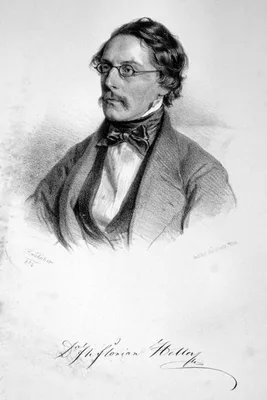
1860 HELLER, Johann Florian (1813 – 1871)
Die Harnconcretionen.
Heller introduced several urine tests and wrote (above) an important work on urinary calculi.
GMN 4291 · https://historyofmedicine.com/id/5368
1878 BIGELOW, Henry Jacob (1818 – 1890)
Lithotrity by a single operation.
Introduction of litholapaxy at one sitting.
GMN 4292 · https://historyofmedicine.com/id/5372
1896 MACINTYRE, John (1857 – 1928)
Roentgen rays. Photography of renal calculus.
First radiogram of renal calculus.
GMN 4293 · https://historyofmedicine.com/id/5383
1901 ILLYÉS, Géza (1870 – 1951)
Uretercatheterezés és radiographia.
Géza von Illyés showed that ureteral calculi could be accurately demonstrated by x rays with the help of an indwelling opaque catheter. German translation in Dtsch. Z. Chir., 1901, 62, 132-40.
GMN 4294 · https://historyofmedicine.com/id/5388
1901 KELLY, Howard Atwood (1858 – 1943)
Scratch-marks on the wax-tipped catheter as a means of determining the presence of stone in the kidney and in the ureter.
Kelly tipped the catheter with wax, so that it registered clearly any pressure from sharp stones. This became an important means of diagnosing calculi.
GMN 4295 · https://historyofmedicine.com/id/5393
1903 WITTEK, Arnold (1871 – 1956)
Zur Technik der Röntgenphotographie (Lendenwirbel, Blasensteine).
Cystography. Wittek filled the bladder with air and was able to demonstrate vertebrae and urinary calculus.
GMN 4191.3 · https://historyofmedicine.com/id/6125
1927 –1928 MCCARRISON, Sir Robert (1878 – 1960)
The experimental production of stone-in-the-bladder.
McCarrison’s experiments showed that urinary calculi could follow a diet probably deficient in vitamin A.
GMN 4296 · https://historyofmedicine.com/id/5406
2014 MORAN, Michael Edward
Urolithiasis: A comprehensive history.
GMN 12149 · https://historyofmedicine.com/id/14359