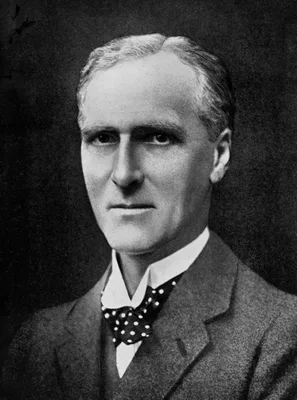
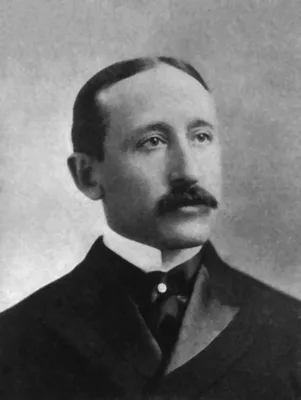
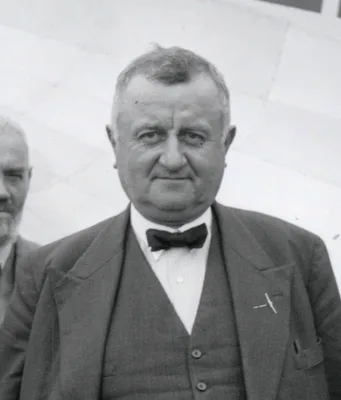
1898 PARKHILL, Clayton (1860 – 1902)
Further observations regarding the use of the bone-clamp in ununited fractures, fractures with malunion, and recent fractures with a tendency to displacement.
Parkhill introduced external fixation for the treatment of fractures.
GMN 4429.2 · https://historyofmedicine.com/id/6268
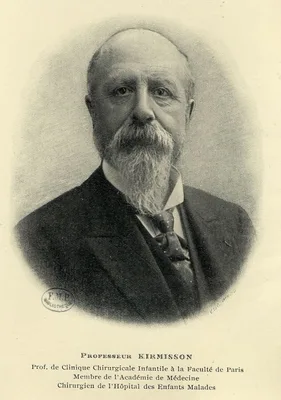
1898 KIRMISSON, Édouard François (1848 – 1927)
Traité des maladies chirurgicales d'origine congénitale.
The first book entirely devoted to the surgical treatment of congenital abnormalities. The work also contains pp. 593-698 an exposition of Kirmisson's staged reduction of congenital dislocations of the hip, and discus…
GMN 10269 · https://historyofmedicine.com/id/12460
1901 KIENBÖCK, Robert (1871 – 1953)
Ueber acute Knochenatrophie bei Entzündungsprocessen an den Extremitäten (fälschlich sogenannte Inactivitätsatrophie der Knochen) und ihre Diagnose nach dem Röntgen-Bilde.
“Kienböck’s atrophy” – acute atrophy of bone in inflammatory conditions of the extremities.
GMN 4370 · https://historyofmedicine.com/id/5852
1903 MOSETIG-MOORHOF, Albert von (1838 – 1907)
Die Jodoformknochenplombe.
Use of iodoform to plug bone defects.
GMN 4371 · https://historyofmedicine.com/id/5854
1903 –1904 ALBERS-SCHÖNBERG, Heinrich Ernst (1865 – 1921)
Projektions-Röntgenbilder einer seltenen Knochenerkrankung.
First description of osteosclerosis fragilis, marble bones (“Albers-Schönberg disease”).
GMN 4372 · https://historyofmedicine.com/id/5858
1903 OSGOOD, Robert Bayley (1873 – 1956)
Lesions of the tibial tubercle occurring during adolescence.
Osgood was the first to draw attention to a condition of the tibial tuberosity; this is now referred to as “Osgood–Schlatter disease” (see also No. 4374).
GMN 4373 · https://historyofmedicine.com/id/5863
1903 SCHLATTER, Carl B. (1864 – 1934)
Verletzungen des schnabelförmigen Fortsatzes der oberen Tibia-epiphyse.
“Osgood–Schlatter disease”. A further description of the painful affection of the tibial tuberosity first noted by Osgood.
GMN 4374 · https://historyofmedicine.com/id/5869
1904 NAU, Pierre
Les scolioses congénitales.
First description of platyspondylia.
GMN 4375 · https://historyofmedicine.com/id/5872
1905 CODIVILLA, Alessandro (1861 – 1912)
On the means of lengthening in the lower limbs, the muscles and tissues which are shortened through deformity.
First attempt at surgical lengthening of limbs.
GMN 4375.1 · https://historyofmedicine.com/id/5875
1905 REISNER, George Andrew (1867 – 1942)
The Hearst Medical Papyrus: Hieratic text in 17 facsimile plates in collotype with introduction and vocabulary by George A. Reisner. University of California Publications. Egyptian Archaeology, Volume 1.
The papyrus has been dated to the 18th Dynasty of Egypt, around the time of pharaoh Tuthmosis III. The text is believed to have been composed earlier, during the Middle Kingdom, around 2000 BCE. The papyrus is so unus…
GMN 8390 · https://historyofmedicine.com/id/10567
1905 KANAVEL, Allen Buchner (1874 – 1938)
An anatomical, experimental, and clinical study of acute phlegmons of the hand.
"Kanavel produced the classic paper on infection in Surgery, Gynecology and Obstetrics in 1905. In that paper, he described the anatomy and clinical study of acute infections of the hand. This clearly changed the cour…
GMN 14147 · https://historyofmedicine.com/id/16462
1906 CECI, Antonio (1852 – 1920)
Tecnica generale della amputazioni mucosi. Amputazioni plastico-ortopediche con metodo proprio secundo la proposta del Vanghetti. Dimonstrazioni pratiche.
Ceci was the first to operate on the lines suggested by Vanghetti.
GMN 4475 · https://historyofmedicine.com/id/75
1906 BÜDINGER, Konrad (1867 – 1944)
Ueber Ablösung von Gelenkteilen und verwandte Prozesse.
Büdinger was the first to describe pathological fracture of the cartilage of the patella. See also his later paper in the same journal, 1908, 92, 510-36. Later descriptions by Karl Ludloff, Verh. dtsch. Ges. Chir., 19…
GMN 4376 · https://historyofmedicine.com/id/5877
1906 LOOSER, Emil (1877 – 1936)
Ueber Osteogenesis imperfecta tarda.
Looser’s syndrome.
GMN 4376.1 · https://historyofmedicine.com/id/5880
1907 LANE, Sir William Arbuthnot (1856 – 1943)
Clinical remarks on the operative treatment of fractures.
Lane’s plates and screws for union of fractures.
GMN 4430 · https://historyofmedicine.com/id/6271
1907 STEINMANN, Fritz (1872 – 1932)
Eine neue Extensionsmethode in der Frakturenbehandlung.
Steinmann nail or pin, for insertion through a distal fragment and controlled by direct skeletal traction. English translation in Bick, Classics of orthopaedics.
GMN 4431 · https://historyofmedicine.com/id/6275
1907 LAMBOTTE, Albin (1866 – 1956)
L’intervention opératoire dans les fractures.
Lambotte developed an external fracture fixation device using pins on either side of the fracture, connected by a solid rod.
GMN 4431.1 · https://historyofmedicine.com/id/6276
1908 KÖHLER, Alban (1874 – 1947)
Ueber eine häufige, bisher anscheinend unbekannte Erkrankung einzelner kindlicher Knochen.
“Köhler’s disease” of the scaphoid bone of the foot in children. See No. 4387.
GMN 4377 · https://historyofmedicine.com/id/5882
1908 LEXER, Erich (1867 – 1937)
Ueber Gelenktransplantation.
First osteoarticular joint transplant. English translation in Clin. orthop., 1985, 197, 1-10. See also his paper, "Substitution of whole or half joints from freshly amputated extremities by free plastic operation," Su…
GMN 4377.1 · https://historyofmedicine.com/id/5884
1909 KIRSCHNER, Martin (1879 – 1942)
Ueber Nagelextension.
Kirschner wire, for skeletal traction, and for stabilization of bone fragments or joint immobilization.
GMN 4378 · https://historyofmedicine.com/id/5887
1910 –1911 KIENBÖCK, Robert (1871 – 1953)
Über Luxationen im Bereiche der Handwurzel.
First description of a slowly progressive osteonecrosis of the lunate bone of the wrist; carpal lunate malacia. (“Kienböck’s disease”).
GMN 4379 · https://historyofmedicine.com/id/5889
1910 LEGG, Arthur Thornton (1874 – 1939)
An obscure affection of the hip-joint.
Juvenile osteochondritis deformans (“Calvé–Legg–Perthes disease”; see also Nos. 4381 and 4382.). Previously described by H. Waldenström, Z. orthop. Chir., 1909, 24, 486.
GMN 4380 · https://historyofmedicine.com/id/5890
1910 CALVÉ, Jacques (1875 – 1954)
Sur une forme particulière de pseudo-coxalgie greffée sur des déformations caractéristiques de l’extrémité supérieure du fémur.
See No. 4380.
GMN 4381 · https://historyofmedicine.com/id/5892
1910 PERTHES, Georg Clemens (1869 – 1927)
Ueber Arthritis deformans juvenilis.
See No. 4380.
GMN 4382 · https://historyofmedicine.com/id/5895
1910 SPAULDING, James Alfred (1846 – 1938)
Lowell vs. Faxon and Hawkes: A celebrated malpractice suit in Maine.
Digital facsimile from Google Books at this link.
GMN 11729 · https://historyofmedicine.com/id/13930
1911 GOLDTHWAIT, Joel Ernest (1866 – 1961)
The lumbo-sacral articulation. An explanation of many cases of “lumbago”, “sciatica” and paraplegia.
Goldthwait suggested that lumbago and sciatica might be due to intervertebral disc injury.
GMN 4383 · https://historyofmedicine.com/id/5898
1911 HIBBS, Russell Aubra (1869 – 1932)
An operation for progressive spinal deformities.
Spinal fusion first used for the treatment of scoliosis.
GMN 4383.1 · https://historyofmedicine.com/id/5902
1911 TEACHER, John Hammond (1869 – 1930); MIDDLETON, George Stevenson (1854 – 1928)
Injury of the spinal cord due to rupture of an intervertebral disc during muscular effort.
Report of a case of “sciatica” due to rupture of an intervertebral disc.
GMN 4384 · https://historyofmedicine.com/id/5908
1911 ALBEE, Fred Houdlett (1876 – 1945)
Transplantation of a portion of the tibia into the spine for Pott’s disease. A preliminary report.
The beginning of bone graft surgery as a planned, carefully designed procedure. Albee was the first to employ living bone grafts as internal splints. See No. 5757.
GMN 4384.1 · https://historyofmedicine.com/id/5912
1912 MACEWEN, Sir William (1848 – 1924)
The growth of bone.
Throughout his life Macewen devoted much time to the study of bone growth. His researches revolutionized ideas concerning osteogenesis.
GMN 656.1 · https://historyofmedicine.com/id/533
1912 CROUZON, Octave (1874 – 1938)
Dysostose cranio-faciale héréditaire.
First description of cranio-facial dysostosis, hypertelorism (Crouzon's syndrome).
GMN 4385 · https://historyofmedicine.com/id/5913
1912 KLIPPEL, Maurice (1858 – 1942); FEIL, André (1884 – )
Un cas d’absence des vertèbres cervicales avec cage thoracique remontant jusqu’à la base du crâne (cage thoracique cervicale).
“Klippel–Feil syndrome” – absence or incomplete development of cervical vertebrae. English translation in Bick, Classics of orthopaedics, 511-16.
GMN 4386 · https://historyofmedicine.com/id/5919
1912 KANAVEL, Allen Buchner (1874 – 1938)
Infections of the hand: A guide to the surgical treatment of acute and chronic suppurative processes in the fingers, hand, and forearm.
The first comprehensive treatise on hand surgery, and the classic work on tendon and bursal hand spaces relevant to management of hand infections. Kanavel developed the method of forcible injection of radio-opaque mat…
GMN 4386.01 · https://historyofmedicine.com/id/5922
1912 DARRACH, William (1876 – 1948)
Anterior dislocation of the head of the ulna.
Darrach procedure for problems of the distal ulna.
GMN 4386.02 · https://historyofmedicine.com/id/5924
1915 ALBERS-SCHÖNBERG, Heinrich Ernst (1865 – 1921)
Eine seltene, bisher nicht bekannte Strukturanomalie des Skelettes.
First definitive description of osteopoikilosis.
GMN 4386.1 · https://historyofmedicine.com/id/5929
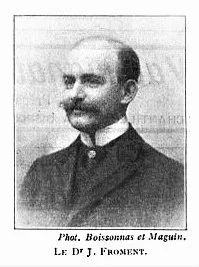
1915 FROMENT, Jules (1876 – 1946)
La préhension dans les paralysies du nerf cubital et le signe du pouce.
“Froment’s sign” of ulnar nerve paralysis.
GMN 4386.2 · https://historyofmedicine.com/id/5932
1915 ALBEE, Fred Houdlett (1876 – 1945)
Bone-graft surgery.
Albee was the first to employ living bone grafts as internal splints. He used cutting machines and saws to make inlaid, perfectly-fitting grafts. See especially his “Transplantation of a portion of the tibia into the …
GMN 5757 · https://historyofmedicine.com/id/6678
1916 MAYER, Leo (1884 – 1972)
The physiological method of tendon transplanation.
Mayer’s method of tendon transfer, using tendon sheaths to preserve the gliding surfaces.
GMN 4386.3 · https://historyofmedicine.com/id/5936
1916 SAUERBRUCH, Ernst Ferdinand (1875 – 1951)
Die willkürlich bewegbare künstliche Hand: Eine Anleitung für Chirurgen und Techniker. Mit. anatomischen Beiträgen von G. Ruge and W. Felix.
GMN 9590 · https://historyofmedicine.com/id/11777
1917 KRUKENBERG, Hermann (1863 – 1935)
Eine neue osteoplastische Amputationsmethode des Oberschenkels.
GMN 4476 · https://historyofmedicine.com/id/315
1918 PUTTI, Vittorio (1880 – 1940)
The utilization of the muscles of a stump to actuate artificial limbs: cinematic amputations.
Putti developed and improved kineplastic surgery.
GMN 4477 · https://historyofmedicine.com/id/76
1919 KEITH, Sir Arthur (1866 – 1955)
Menders of the maimed.
Gives details of the work of John Hunter, John Hilton, Hugh Owen Thomas, Little, Stromeyer, Marshall Hall, Arbuthnot Lane, Syme, Julius Wolff, etc., in the development of modern orthopaedics. Second edition, 1925. Fac…
GMN 4479 · https://historyofmedicine.com/id/85
1920 KÖHLER, Alban (1874 – 1947)
Eine typische Erkrankung des 2. Metatarsophalangealgelenkes.
“Köhler’s second disease” – juvenile deforming metatarsophalangeal Osteochondritis. English translation in Amer. J. Roentgenol., 1923, 10,705-10. Also known as “Freiberg’s infraction” or “Freiberg–Köhler disease”.
GMN 4387 · https://historyofmedicine.com/id/5941
1920 MACEWEN, Sir William (1848 – 1924)
The growth and shedding of the antlers of the deer. The histological phenomena and their relation to the growth of bone.
The first study of the unusual and dramatic physiology of the annual growth and shedding of the antlers of deer. "The amount of bony matter annually secreted to form antlers of the larger deer is enormous, antlers of …
GMN 7000 · https://historyofmedicine.com/id/9166
1921 EWING, James (1866 – 1943)
Diffuse endothelioma of bone.
Ewing described a form of bone sarcoma (“Ewing’s sarcoma”), usually involving the shaft of long bones.
GMN 4388 · https://historyofmedicine.com/id/5947
1921 LÉRI, André (1875 – 1930)
Une maladie congénitale et héréditaire de l’ossification: la pléonostéose familiale.
“Léri’s pleonosteosis” first described.
GMN 4388.1 · https://historyofmedicine.com/id/5952
1921 BIRCHER, Eugen (1882 – 1956)
Die Arthroendoskopie.
First published account of the use of the laparoscope for arthroscopy.
GMN 4388.2 · https://historyofmedicine.com/id/5956
1921 SCHEUERMANN, Holger Werfel (1877 – 1960)
Kyphosis dorsalis juvenilis.
“Scheuermann’s disease” – necrosis of the epiphyses of the vertebrae, causing kyphosis.
GMN 4389 · https://historyofmedicine.com/id/5957
1922 CAMURATI, M
Di un raro caso di osteite simmetrica ereditaria degli arti inferior.
"Camurati-Engelmann disease", a very rare autosomal dominant genetic disorder that causes characteristic anomalies in the skeleton. It is a form of dysplasia. See No. 4395.1.
GMN 7832 · https://historyofmedicine.com/id/10004
1923 ROBISON, Robert (1883 – 1941)
The possible significance of hexosephosphoric esters in ossification.
Records an important advance in the knowledge concerning the conversion of blood calcium into the insoluble calcium of bone.
GMN 746 · https://historyofmedicine.com/id/1730