1922 FLEMING, Sir Alexander (1881 – 1955)
On a remarkable bacteriolytic element found in secretions and tissues.
Lysozyme, an antimicrobial enzyme that is a component of secretions such as tears and saliva. Digital facsimile from royalsocietypublishing.org at this link
GMN 1910.1 · https://historyofmedicine.com/id/2667
1922 –1925 MCINTOSH, James (1882 – 1948); JAMES, W. Warwick (1874 – 1965); LAZARUS-BARLOW, Percy (1895 – 1967)
An investigation into the aetiology of dental caries. I: The nature of the destructive agent and the production of artificial caries. II" The biological characteristics and distribution of B. acidolphilus odontolyticus. III: Further experiments on the production of artificial caries. IV: Accessory factors in dental caries. (1) Reaction of the saliva (2) Acid resistance of teeth.(3) Bacteriotropic action of saliva.
Isolation of Lactobacillus odontolyticus I and II from carious teeth. Digital facsimile of part 1 from PubMedCentral at this link. Digital facsimile of part 4 from PubMedCentral at this link.
GMN 3691 · https://historyofmedicine.com/id/5725
1922 TODD, John Lancelot (1876 – 1949); WOLBACH, Simeon Burt (1880 – 1954); PALFREY, Francis Winslow (1876 – 1953)
The etiology and pathology of typhus. Being the main report of the Typhus Research Commission of the League of Red Cross Societies to Poland.
The carefully controlled experiments of Wolbach, Todd, and Palfrey eliminated all doubt that R. prowazeki was the causal agent in typhus. Digital facsimile from the U.S. National Library of Medicine at this link.
GMN 5393 · https://historyofmedicine.com/id/7155
1922 RODRÍQUEZ VARGAS, Fernando E. (1888 – 1932)
Studies in the specific study of the bacteriology of dental cavities.
Rodríguez discovered that three types of the Lactobacillus species of bacteria, during the process of fermentation, are the causes of cavities. Digital facsimile from Google Books at this link.
GMN 12656 · https://historyofmedicine.com/id/14900
1923 BERGEY, David Hendricks (1860 – 1937)
Manual of determinative bacteriology.
The Society of American Bacteriologists appointed in 1920 a Committee on Characterization and Classification of Bacterial Types. Their reports were incorporated in the above Manual issued under the names of Bergey and…
GMN 2522 · https://historyofmedicine.com/id/3304
1924 CALMETTE, Léon Charles Albert (1863 – 1933); GUÉRIN, Camille (1872 – 1961); WEILL-HALLÉ, Benjamin (1875 – 1958); ET AL
Essai d’immunisation contre l’infection tuberculeuse.
B.C.G. (Bacille Calmette–Guérin) vaccine was first produced in 1906 and subcultured for 13 years. It was first used as a prophylactic against tuberculosis in children in 1921. It remains in use. See also No. 2346.
GMN 2343 · https://historyofmedicine.com/id/3094
1924 DICK, George Frederick (1881 – 1967); DICK, Gladys Rowena Henry (1881 – 1963)
A skin test for susceptibility to scarlet fever.
The “Dick test” for the determination of individual susceptibility to scarlet fever.
GMN 5082 · https://historyofmedicine.com/id/5946
1924 DICK, George Frederick (1881 – 1967); DICK, Gladys Rowena Henry (1881 – 1963)
The etiology of scarlet fever.
Proof that streptococcus is the cause of scarlet fever.
GMN 5082.1 · https://historyofmedicine.com/id/5949
1924 ROBERTSON, Andrew
Observations on the causal organism of rat-bite fever in man.
Robertson proved one of the causal organisms of rat-bite fever to be Sp. morsus muris. He re-named it Spirillum minus Carter, 1887, identifying it as the first spiral micro-organism to be described from a rodent.
GMN 5327 · https://historyofmedicine.com/id/6633
1924 WOLBACH, Simeon Burt (1880 – 1954); HERTIG, Marshall (1893 – 1978)
Studies on Rickettsia-like micro-organisms in insects.
Hertig and Wolbach first described the parasitic microbe Wolbachia in the common house mosquito in 1924. In 1936 Hertig formally described the species as Wolbachia pipientis. Since then the genus Wolbachia has become …
GMN 10943 · https://historyofmedicine.com/id/13139
1925 CHURCHMAN, John Woolman (1877 – 1937)
Intravenous use of dyes.
Churchman demonstrated the selective bactericidal action of gentian violet against staphylococci. See also J. exp. Med., 1912, 16, 221-47; J. Urol., 1924, 11, 1-18.
GMN 1911 · https://historyofmedicine.com/id/2673
1925 FLETCHER, William ( – 1938); LESSLAR, J. E.
Tropical typhus in the Federated Malay States, with a compilation on epidemic typhus.
Bull. Inst. med. Res., F. M. S., No. 2. Drew attention to scrub typhus in Malaya.
GMN 5394 · https://historyofmedicine.com/id/7160
1925 GRATIA, André (1893 – 1950)
Sur un remarquable example d'antogonisme entre deux souches de colibacille.
Discovery of bacteriocins. Gratia called his discovery a colicine because bacteriocins killed E. coli.
GMN 11479 · https://historyofmedicine.com/id/13678
1925 CHATTON, Édouard (1883 – 1947)
Pansporella perplexa. Réflexions sur la biologie et la phylogénie des protozoaires.
Chatton was the first to characterize the distinction between the eukaryotic and prokaryotic systems of cellular organization. See Jan Sapp, "The prokaryote-Eukaryote dichtomy: meanings and mythology," Microbiol. Mol.…
GMN 12035 · https://historyofmedicine.com/id/14243
1926 MURRAY, Everitt George Dunne (1890 – 1964); ET AL
A disease of rabbits characterised by a large mononuclear leucocytosis, caused by a hitherto undescribed bacillus acterium monocytogenes (n. sp.).
Isolation of Listeria monocytogenes. With R. A. Webb and M. B. R. Swann.
GMN 2522.1 · https://historyofmedicine.com/id/3312
1926 PLACE, Edwin Hemphill (1880 – ); ET AL
Erythema arthriticum epidemicum; preliminary report.
“Haverhill fever” first reported. The writers isolated an organism, later found to be identical with Streptothrix muris ratti and Streptobacillus moniliformis. With L. E. Sutton and O. Willner.
GMN 5328 · https://historyofmedicine.com/id/6636
1926 MAXCY, Kenneth Fuller (1889 – 1966)
Clinical observations on endemic typhus (Brill’s disease) in Southern United States.
Maxcy described murine (flea-borne) typhus (“Maxcy’s disease”).
GMN 5396 · https://historyofmedicine.com/id/7169
1926 SEIBERT, Florence Barbara (1897 – 1991)
Isolation of a crystalline protein with tuberculin activity.
Siebert identified the active agent in tuberculin as a protein.
GMN 12386 · https://historyofmedicine.com/id/14613
1927 CALMETTE, Léon Charles Albert (1863 – 1933); GUÉRIN, Camille (1872 – 1961); BOQUET, Alfred (1879 – 1947); NÈGRE, Léopold (1879 – 1961)
Sur la vaccination préventive des enfants nouveau-nés contre la tuberculose par le B.C.G.
GMN 2346 · https://historyofmedicine.com/id/3105
1927 CALMETTE, Léon Charles Albert (1863 – 1933); GUÉRIN, Camille (1872 – 1961); BOQUET, Alfred (1879 – 1947); NÈGRE, Léopold (1879 – 1961)
La vaccination préventive contre la tuberculose par le "BGG". Par Albert Calmette avec la collaboration de C. Guérin, A. Boquet et L. Nègre.
A 250-page monograph, with bibliographical references, on the development of the BCG vaccine from M. bovis, from 1909 to 1927 by the scientists involved. (Thanks to Ron Cox for this reference.)
GMN 11994 · https://historyofmedicine.com/id/14202
1928 –1929 THOMSON, David (1884 – 1969); THOMSON, Robert (1888 – )
The pathogenic streptococci. An historical survey of their role in human and animal disease.
Documents over 1,600 studies.
GMN 2523 · https://historyofmedicine.com/id/3321
1928 MOOSER, Hermann (1891 – 1971)
Experiments relating to the pathology and the etiology of Mexican typhus (tabardillo).
Mooser differentiated murine from epidemic typhus. The causative organism was later named Rickettsia mooseri.
GMN 5396.1 · https://historyofmedicine.com/id/7173
1931 ELFORD, William Joseph (1900 – 1952)
A new series of graded collodion membranes suitable for general bacteriological use, especially in filterable virus studies.
In his important studies on the filtration of virus preparations, Elford showed that different viruses possessed different and characteristic sizes.
GMN 2524 · https://historyofmedicine.com/id/3327
1931 KAUFFMANN, Fritz (1899 – 1978)
Der heutige Stand der Paratyphusforschung.
Kauffmann–White classification of Salmonella based on antigenic structure. For historical note, including the part played by P. B. White, see J. Hyg. (camb), 1934, 34, 335.
GMN 5044.1 · https://historyofmedicine.com/id/5823
1931 ANDERSON, James Stirling (1891 – 1976); ET AL
On the existence of two forms of diphtheria bacillus B. diphtheria gravis and B. diphtheriae mitis.
J. S. Anderson, F. C. Happold, J. W. McLeod, and J. G. Thomson were the first to distinguish the gravis, mitis, and intermediate types of C. diphtheriae.
GMN 5072 · https://historyofmedicine.com/id/5914
1931 LESLIE, Patrick Holt (1900 – 1972); GARDNER, Arthur Duncan (1884 – 1977)
The phases of Haemophilus pertussis.
Leslie and Gardner classified H. pertussis cultures into four types and established an experimental basis for the development of an effective vaccine.
GMN 5087.1 · https://historyofmedicine.com/id/5975
1931 DYER, Rollo Eugene (1886 – ); ET AL
Typhus fever. A virus of the typhus type derived from fleas collected from wild rats.
Murine typhus shown to be caused by an organism later named Rickettsia mooseri, transmitted by fleas from rats to man. With A. Rumreich and L. F. Badger.
GMN 5396.2 · https://historyofmedicine.com/id/7175
1931 OGATA, Norio (1883 – )
Aetiologie der Tsutsugamushi-Kiankheit: Rickettsia tsutsugamushi.
Ogata isolated the causal agent of tsutsugamushi disease, Orientia Tsutsugamushi, in 1927.
GMN 5396.3 · https://historyofmedicine.com/id/7176
1932 CROHN, Burrill Bernard (1884 – 1983); ET AL
Regional ileitis. A pathologic and clinical entity.
“Crohn’s disease” – regional ileitis. With L. Ginzburg and G. D. Oppenheimer. "Some of Crohn's initial research into the causes of the Crohn's disease was centered around his personal conviction that it was caused by …
GMN 3551 · https://historyofmedicine.com/id/4062
1932 THOMSON, David (1884 – 1969); THOMSON, Robert (1888 – )
The common cold, with special reference to the part played by streptococci, pneumococci, and other organisms.
Annals of the Pickett-Thomson Research Lab., Vol. 8.
GMN 3204 · https://historyofmedicine.com/id/4321
1932 FLEMING, Sir Alexander (1881 – 1955)
On the specific antibacterial properties of penicillin and potassium tellurite. Incorporating a method of demonstrating some bacterial antagonisms.
In this paper Fleming first described the use of penicillin as an antibacterial agent in man, and reported on experiments using it as a wound dressing for septic wounds. He also corrected the species name from Penicil…
GMN 10784 · https://historyofmedicine.com/id/12980
1933 LANCEFIELD, Rebecca Craighill (1895 – 1981)
A serological differentiation of human and other groups of hemolytic streptococci.
Lancefield determined the principal pathogenic strains of hemolytic streptococci and subdivided them into types. All important strains pathogenic to humans fall into Lancefield’s Group A.
GMN 2524.2 · https://historyofmedicine.com/id/3337
1933 KLARENBEEK, Arie (1888 – ); SCHÜFFNER, Wilhelm August Paul (1867 – 1949)
Het voorkomen van een afwijkend Leptospira-ras in Nederland.
Leptospira canicola first isolated (1913) from the urine of a dog.
GMN 5335 · https://historyofmedicine.com/id/6683
1933 WANI, Hidetsune
Ueber die Prophylaxe der Spirochaetosis icterohaemorrhagica Inada (Weilschen Krankheit) durch Schutzimpfung.
Prophylactic vaccination against leptospirosis.
GMN 5335.1 · https://historyofmedicine.com/id/6688
1934 GRIFFITH, Frederick (1879 – 1941)
The serological classification of Streptococcus pyogenes.
Griffith’s classification of streptococci. Digital facsimile from PubMedCentral at this link.
GMN 2524.3 · https://historyofmedicine.com/id/3346
1934 DHONT, C. M.; ET AL
De leptospiroses bij den hond, en de beteekenis der Leptospira canicola.
First reported cases of human infection with L. canicola. With A. Klarenbeek, W. A. P. Schüffner, and J. Voet.
GMN 5336 · https://historyofmedicine.com/id/6696
1934 SEIBERT, Florence Barbara (1897 – 1991)
The isolation and properties of the purified protein derivative of tuberculin
Purification of tuberculin (PPD). By the 1940s Seibert's PPD was the international standard for tuberculin tests.
GMN 12387 · https://historyofmedicine.com/id/14614
1935 KLIENEBERGER-NOBEL, Emmy (1892 – 1985)
The natural occurrence of pleuropneumonia-like organisms in apparent symbiosis with Streptobacillus moniliformis and other bacteria.
Klieneberger isolated typical strains of pleuropneumonia-like organisms from Strep, moniliformis.
GMN 2524.4 · https://historyofmedicine.com/id/3350
1936 LEMIERRE, André (1875 – 1956)
On certain septicemias due to anaerobic organisms.
"Lemierre's syndrome (or Lemierre's disease, also known as postanginal shock including sepsis and human necrobacillosis) refers to infectious thrombophlebitis of the internal jugular vein. It most often develops as a …
GMN 9893 · https://historyofmedicine.com/id/12081
1937 DIENES, Louis L. (1886 – 1974); EDSALL, Geoffrey (1908 – 1980)
Observations on L-organism of Kleineberger.
Isolation of a mycoplasma from man.
GMN 3215 · https://historyofmedicine.com/id/4360
1937 LEMIERRE, André (1875 – 1956); ET AL
Sur une nouvelle fièvre par morsure de rat.
A. Lemierre, J. Reilly, A. Laporte, and M. Morin isolated Streptobacillus moniliformis from a case of rat-bite fever.
GMN 5329 · https://historyofmedicine.com/id/6643
1937 BURNET, Sir Frank Macfarlane (1899 – 1985); FREEMAN, Mavis Louisa (1907 – 1992)
Experimental studies on the virus of “Q” fever.
Discovery of Rickettsia burneti, causal agent in Q fever.
GMN 5398 · https://historyofmedicine.com/id/7187
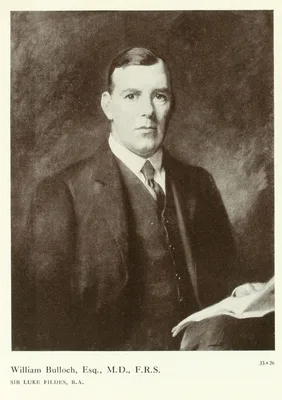
1938 BULLOCH, William (1868 – 1941)
The history of bacteriology.
This pioneering and classic history includes brief biographical notes of the more important workers (arranged in a separate section), and an extensive bibliography.
GMN 2580 · https://historyofmedicine.com/id/4319
1938 SAENZ RICART, Braulio (1886 – 1961)
Demonstratión de un treponema en el borde activo un caso de pinto de las manos y pies y en la linfa de ganglios superficiales (reporte preliminar).
B. Saenz, J. Grau Triana, and J. Alfonso Armenteros indicated that pinta is caused by a treponeme, T. carateum.
GMN 5308.1 · https://historyofmedicine.com/id/6564
1939 MCCOY, Elizabeth Florence (1903 – 1978); MCCLUNG, Leland Swint (1910 – 2000)
The anaerobic bacteria and their activities in nature and disease. A subject bibliography. 2 vols.
Supplements were published: 1938-1975, 8 vols., 1941-82.
GMN 2525 · https://historyofmedicine.com/id/3658
1939 FORD, William Webber (1871 – 1941)
Bacteriology.
A much briefer history than Bulloch’s but with a thorough and accurate bibliography.
GMN 2581 · https://historyofmedicine.com/id/4323
1939 STERNE, Max (1905 – 1997)
The use of anthrax vaccines prepared from avirulent (uncapsulatec) variants of Bacillus anthracis.
Nonencapsulated spore vaccine.
GMN 5172.1 · https://historyofmedicine.com/id/6264
1940 LEWTHWAITE, Raymond (1894 – 1972); SAVOOR, S. R. (1900 – 1980)
Rickettsia disease of Malaya. Identity of tsutsugamushi and rural typhus.
Lewthwaite and Savoor showed scrub typhus to be identical to tsutsugamushi fever.
GMN 5398.2 · https://historyofmedicine.com/id/7195
1941 HIRST, George Keble (1909 – 1994)
The agglutination of red cells by allantoic fluid of chick embryos infected with influenza virus.
Discovery of virus hemagglutination. Between 1941 and 1942 Hirst developed the hemagglutination assay for quantifying the relative concentration of viruses, bacteria or antibodies.
GMN 2577 · https://historyofmedicine.com/id/4130
1944 YEOMANS, Andrew (1907 – ); ET AL
The therapeutic effect of para-aminobenzic acid in louse-borne typhus fever.
With J. C. Snyder, E. S. Murray, C. J. D. Zarafonetis, and R. S. Ecke.
GMN 5398.3 · https://historyofmedicine.com/id/7199