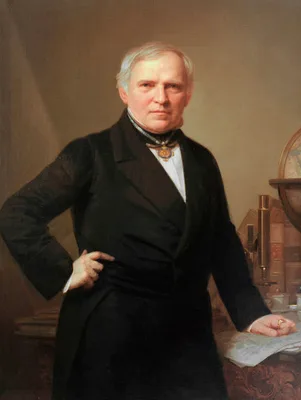
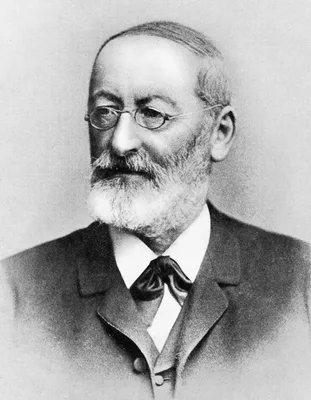
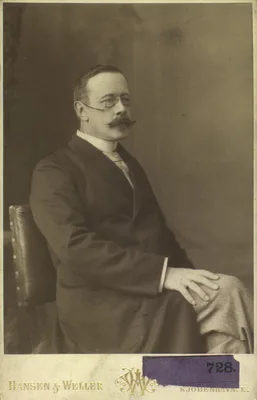
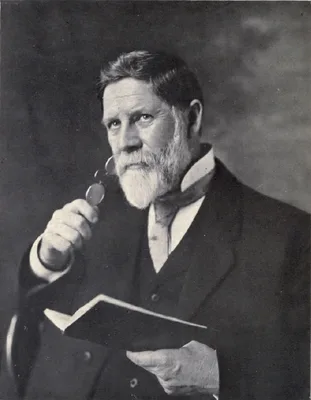
1773 –1774 MÜLLER, Otto Friedrich (1730 – 1784)
Vermium terrestrium et fluviatilium, seu animalium infusoriorum, helminthecorum, et testaceorum non marinorum, succincta historia. 2 vols.
In this work Müller arranged the Infusoria into genera and species for the first time. Digital facsimile from the Biodiversity Heritage Library at this link.
GMN 11779 · https://historyofmedicine.com/id/13980
1786 MÜLLER, Otto Friedrich (1730 – 1784)
Animalcula infusoria fluviatilia et marina, quae detexit, systematice descripsit et ad vivum delineari.
Müller was the first to attempt a systematic classification of infusoria. He published several papers on the subject, the best being the above posthumous work. Muller described 8 species of the genus Vibrio (included …
GMN 2466 · https://historyofmedicine.com/id/3031
1830 EHRENBERG, Christian Gottfried (1795 – 1876)
Organisation, Systematik und geographische Verhältniss der Infusionsthierchen. Zwei Vorträge, in der Akademie der Wissenschaften zu Berlin gehalten in den Jahren 1828 und 1830.
In this work Ehrenberg first published his classification of infusioria, including the naming of bacteria for the first time. The work published two papers based on his expeditions. The first, read on January 10, 1828…
GMN 11452 · https://historyofmedicine.com/id/13651
1838 EHRENBERG, Christian Gottfried (1795 – 1876)
Die Infusionsthierchen als vollkommene Organismen. 1 vol. and atlas of 64 hand-colored engraved plates.
In this monumental work in folio format Ehrenberg extended Otto Friedrich Müller’s bacteriological classification. Like Müller, he made no distinction between protozoa and bacteria, classing them both as infusoria. Hi…
GMN 111 · https://historyofmedicine.com/id/1664
1841 DUJARDIN, Félix (1801 – 1860)
Histoire naturelle des zoophytes.
Further modification of and improvements in the classification of bacteria.
GMN 2470 · https://historyofmedicine.com/id/3045
1872 COHN, Ferdinand Julius (1828 – 1898)
Untersuchungen über Bacterien.
Cohn’s morphological classification of bacteria. He founded the Beiträge.
GMN 2483 · https://historyofmedicine.com/id/3087
1884 GRAM, Hans Christian Joachim (1853 – 1938)
Ueber die isolirte Färbung der Schizomyceten in Schnitt- und Trocken-präparaten.
Gram’s method of staining bacteria (Gram stain). While not all bacteria may be definitively classified in this way, it is almost always the first step in the preliminary identification of a bacterial organism.
GMN 2499 · https://historyofmedicine.com/id/3188
1884 ROSENBACH, Anton Julius Friedrich (1842 – 1923)
Mikro-Organismen bei den Wund-Infections-Krankheiten des Menschen.
Rosenbach proved that streptococci and staphylococci are distinct and differentiated two strains of staphylococci (“aureus” and “albus”). He cultured cocci from a considerable range of septic conditions, thus more acc…
GMN 5619 · https://historyofmedicine.com/id/7159
1905 –1914 SMITH, Erwin Frink (1854 – 1927)
Bacteria in relation to plant diseases. 3 vols.
One of the most careful investigations of the bacterial diseases in plants was made by Smith, who conclusively demonstrated the existence of such diseases and proposed a scheme of classification for the bacteria conce…
GMN 2518 · https://historyofmedicine.com/id/3275
1919 BROWN, James Howard (1884 – 1956)
The use of blood agar for the study of streptococci.
In this monograph with numerous charts and 34 full-page plates Brown classified streptococci into α, β, A prime and γ based on the type and degree of hemolysis produced by the bacteria on a blood agar plate. He also d…
GMN 12006 · https://historyofmedicine.com/id/14214
1923 BERGEY, David Hendricks (1860 – 1937)
Manual of determinative bacteriology.
The Society of American Bacteriologists appointed in 1920 a Committee on Characterization and Classification of Bacterial Types. Their reports were incorporated in the above Manual issued under the names of Bergey and…
GMN 2522 · https://historyofmedicine.com/id/3304