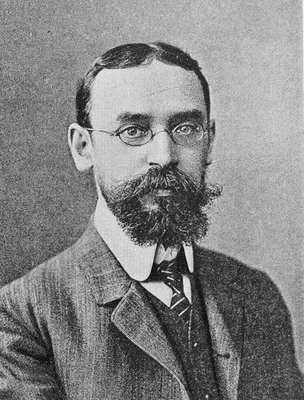
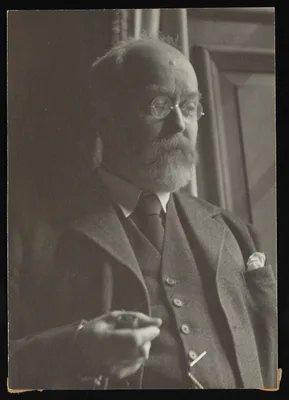
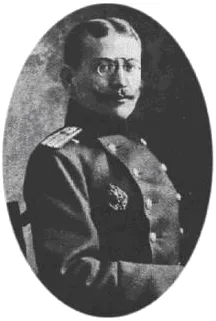
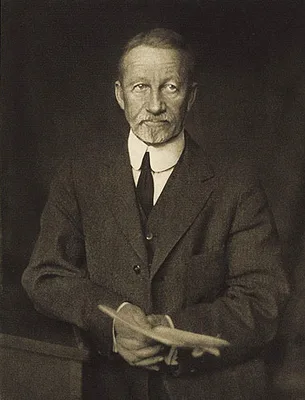
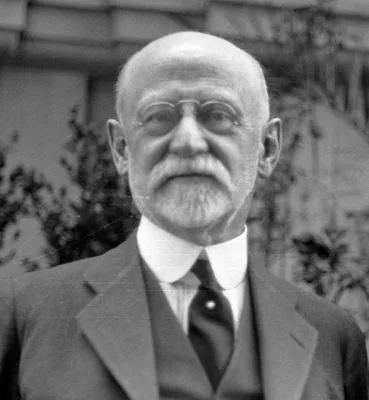
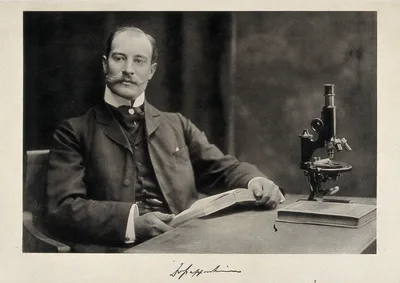
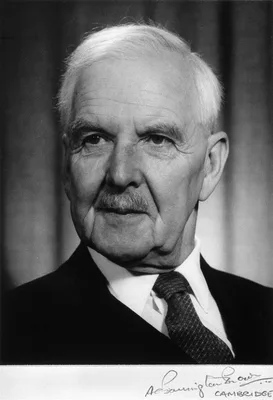
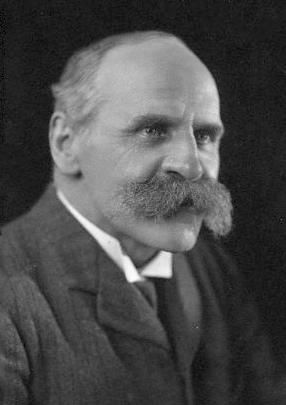
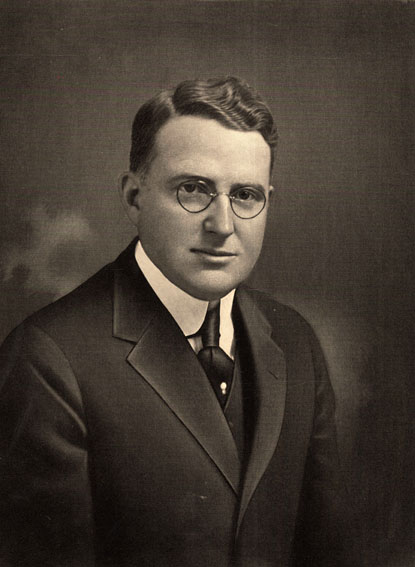
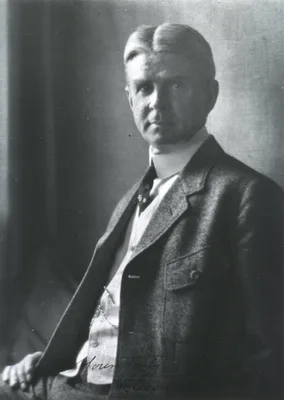
1908 ELLERMANN, Vilhelm (1871 – 1924); BANG, O.
Experimentelle Leukämie bei Hühnern.
Cell-free transmission of fowl leukemia. Ellermann and Bang produced leukemia by means of a filterable agent.
GMN 3079.1 · https://historyofmedicine.com/id/3736
1908 GHEDINI, Giovanni (1877 – 1959)
Per la patogenesi e per la diagnosi delle malattie del sangue e degli organi emopoietici. Puntura esplorativa del midollo osseo.
Introduction of bone marrow biopsy by puncturing the shaft of the tibia.
GMN 3080 · https://historyofmedicine.com/id/3737
1908 PFANNENSTIEL, Hermann Johann (1862 – 1909)
Ueber den habituellen Ikterus de Neugeborenen.
First detailed description of familial icterus gravis neonatorum.
GMN 3080.1 · https://historyofmedicine.com/id/3740
1908 HENDERSON, Lawrence Joseph (1878 – 1942)
Concerning the relationship between the strength of acids and their capacity to preserve neutrality.
Henderson-Hasselbalch equation for the determination of pH concentration in the blood. See Hasselbalch's paper. Digital facsimile of Henderson's paper from the American Journal of Physiology at this link. Henderson's …
GMN 9645 · https://historyofmedicine.com/id/11832
1909 REICHERT, Edward Tyson (1855 – 1931); BROWN, Amos Peaslee (1864 – 1917)
The differentiation and specificity of corresponding proteins and other vital substances in relation to biological classification and organic evolution: The crystallography of hemoglobins.
This massive work with 100 plates including 600 images, was the first large-scale investigation of species differences at the molecular level. Digital facsimile from the Internet Archive at this link.
GMN 6845 · https://historyofmedicine.com/id/9009
1909 MAXIMOW, Alexander Alexandrowitsch (1874 – 1928)
Der Lymphozyt als gemeinsame Stammzelle der verschiedenen Blutelemente in der embryonalen Entwicklung und im postfetalen Leben der Säugetiere.
Maximow developed and introduced a unitarian theory of hematopoiesis, a theory upon which the modern concept of blood cells' origin and differentiation is based. He introduced the term "stem cell." Translated into Eng…
GMN 12426 · https://historyofmedicine.com/id/14657
1910 DUNGERN, Emil von (1867 – 1961); HIRSZFELD, Ludwik Maurycy [Hirschfeld] (1884 – 1954)
Ueber Vererbung gruppenspezifischer Strukturen des Blutes.
Proof that blood groups are inherited according to Mendelian laws.
GMN 898 · https://historyofmedicine.com/id/1017
1910 HOWELL, William Henry (1860 – 1945)
The preparation and properties of thrombin, together with observations on antithrombin and prothrombin.
GMN 899 · https://historyofmedicine.com/id/1019
1910 MOSS, William Lorenzo (1876 – 1957)
Studies on isoagglutinins and isohemolysins.
Moss showed that the blood of all individuals could be placed into one of four groups. His classification has been the one most commonly used until recently. The work was similar to that of Janský and completed before…
GMN 900 · https://historyofmedicine.com/id/1022
1910 PRICE-JONES, Cecil (1863 – 1943)
The variation in the sizes of red blood cells.
Price-Jones described a method for the direct measurement of red blood cells, which led to the term, “Price-Jones curve”. See also his book, Red blood cell diameters, London, 1933.
GMN 901 · https://historyofmedicine.com/id/1027
1910 HERRICK, James Bryan (1861 – 1954)
Peculiar elongated and sickle-shaped red blood corpuscles in a case of severe anemia.
Identification of the sickle-cell type of anemia. Abstract "This case is reported because of the unusual blood findings, no duplicate of which I have ever seen described. Whether the blood picture represents merely a …
GMN 3133 · https://historyofmedicine.com/id/3939
1911 –1912 HOWELL, William Henry (1860 – 1945)
The role of antithrombin and thromboplastin (thromboplastic substance) in the coagulation of blood.
GMN 902 · https://historyofmedicine.com/id/1028
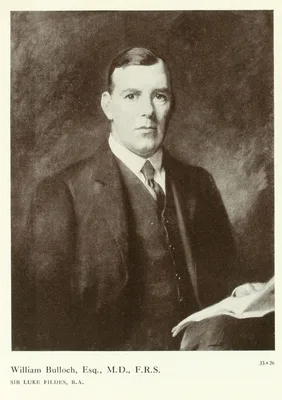
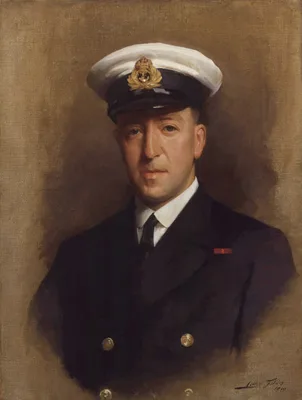
1911 BULLOCH, William (1868 – 1941); FILDES, Sir Paul Gordon (1882 – 1971)
Haemophilia.
Bulloch and Fildes, in their detailed account of hemophilia, claimed to have established immunity to the disease in females, and denied the authenticity of published cases of female hemophilia. They confirmed the law …
GMN 3081 · https://historyofmedicine.com/id/3741
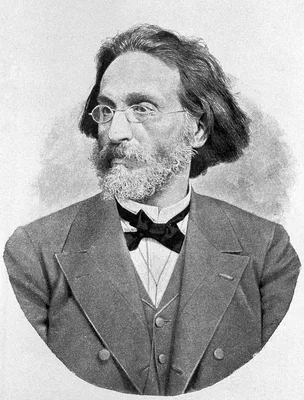
1911 PAPPENHEIM, Artur (1870 – 1916)
Grundriss der hämatologischen Diagnostik.
One of the leaders in modern hematology, Pappenheim improved the methods of staining blood cells.
GMN 3082 · https://historyofmedicine.com/id/3742
1912 PETERS, Sir Rudolph Albert (1889 – 1982)
Chemical nature of specific oxygen capacity in haemoglobin.
Peters made accurate determinations of the ratio of iron to oxygen in the blood.
GMN 956 · https://historyofmedicine.com/id/250
1913 KIMPTON, Arthur Ronald (1881 – 1962); BROWN, James Howard (1884 – 1956)
A new and simple method of transfusion.
In order to prevent blood coagulation during transfusion, Kimpton and Brown used apparatus lined with paraffin wax. See also Boston med. surg. J., 1915, 173, 425-7.
GMN 2018.1 · https://historyofmedicine.com/id/2006
1913 RESCHAD, Hassan; SCHILLING-TORGAU, V
Ueber eine neue Leukämie durch echte Uebergangsformen (Splenozytenleukämie) und ihre Bedeutung für die Selbständigkeit dieser Zellen.
Monocytic leukemia reported.
GMN 3082.1 · https://historyofmedicine.com/id/3744
1913 FABER, Knud Helge (1862 – 1956)
Anämische Zustände bei der chronischen Achylia gastrica.
Simple achlorhydric (idiopathic microcytic) anemia described. Faber advanced the view that achylia gastrica was a cause both of pernicious anemia and of simple chlorotic anemia.
GMN 3134 · https://historyofmedicine.com/id/3940
1913 HIJMANS VAN DEN BERGH, Albert Abraham (1869 – 1943); SNAPPER, J
Die Farbstoffe des Blutserums. 1. Eine quantitative Bestimmung des Bilirubins im Blutserum.
The van den Bergh test.
GMN 3647 · https://historyofmedicine.com/id/4725
1914 HALDANE, John Scott (1860 – 1936); DOUGLAS, Claude Gordon (1882 – 1963); CHRISTIANSEN, Johanne Ostenfeld (1882 – 1968)
The absorption and dissociation of carbon dioxide by human blood.
CO2 dissociation curves. These workers discovered that hemoglobin indirectly greatly assists the transport of CO2 by the blood.
GMN 958 · https://historyofmedicine.com/id/256
1914 HUSTIN, Albert (1882 – 1967)
Note sur une nouvelle méthode de transfusion.
Hustin demonstrated the anticoagulant powers of sodium citrate and glucose in blood transfusion.
GMN 2019 · https://historyofmedicine.com/id/2008
1915 KEITH, Norman Macdonnell (1885 – 1976); ROWNTREE, Leonard George (1883 – 1959); GERAGHTY, John Timothy (1876 – 1924)
A method for the determination of plasma and blood volume.
Keith, Rowntree, and Geraghty devised a method for determination of plasma and blood volume, which includes the injection of a dye.
GMN 903 · https://historyofmedicine.com/id/1030
1915 FRANK, Alfred Erich (1884 – 1957)
Die essentielle Thrombopenie (konstitutionelle Purpura-Pseudo-Hämophilie).
Frank’s essential thrombopenia.
GMN 3083 · https://historyofmedicine.com/id/3746
1916 MCLEAN, Jay (1890 – 1957)
The thromboplastic action of cephalin.
McLean extracted from dog liver a substance which retarded blood coagulation in vitro and which, after further work by Howell and Holt (No.905), was named heparin.
GMN 904 · https://historyofmedicine.com/id/1033
1917 HASSELBALCH, Karl Albert (1874 – 1962)
Die Berechnung der Wasserstoffzahl des Blutes aus der freien und gebundenen Kohlensäure desselben, und die Sauerstoffbindung des Blutes als Funktion der Wasserstoffzahl.
Henderson-Hasselbalch equation for the determination of pH concentration in the blood. English translation in No. 1588.16. For Henderson's papers see No. 9645.
GMN 742 · https://historyofmedicine.com/id/1143
1918 –1919 HOWELL, William Henry (1860 – 1945); HOLT, Luther Emmett (1855 – 1924)
Two new factors in blood coagulation — heparin and pro-antithrombin.
Isolation of heparin.
GMN 905 · https://historyofmedicine.com/id/1039
1918 EPPINGER, Hans (1879 – 1946); KLOSS, Karl
Zur Therapie der Polyzythämie.
Phenylhydrazine hydrochloride first used in the treatment of polycythemia.
GMN 3084 · https://historyofmedicine.com/id/3748
1918 SCHMIDT, Harry Burke (1882 – )
A clinical study of puerperal anaemia.
Four cases of pernicious anemia of pregnancy treated by blood transfusion.
GMN 3135 · https://historyofmedicine.com/id/3941
1919 PAPPENHEIM, Artur (1870 – 1916); HIRSCHFELD, Hans (1873 – 1944)
Morphologische Hämatologie. Vol. 1.
GMN 906 · https://historyofmedicine.com/id/1053
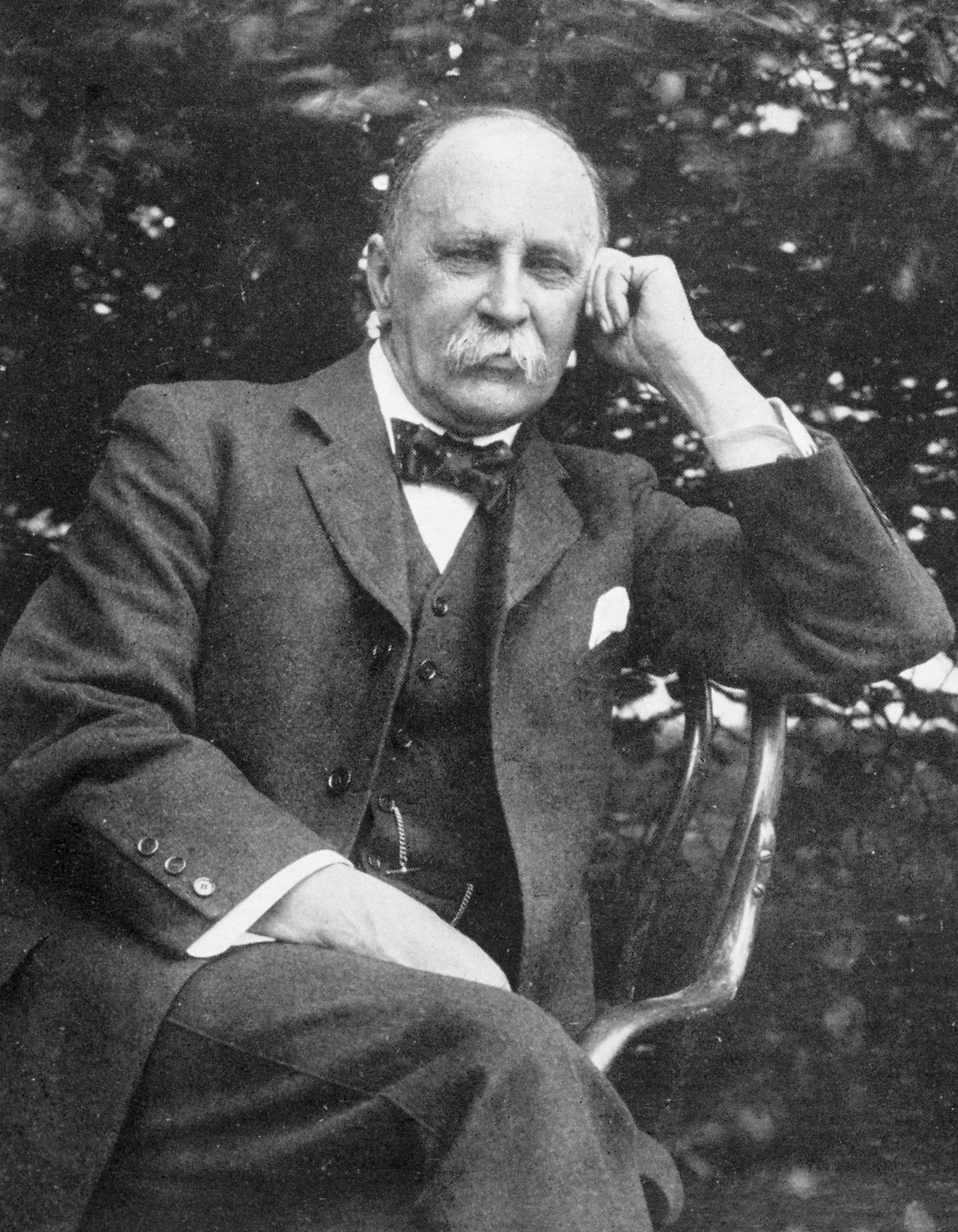
1919 OSLER, Sir William (1849 – 1919)
Observations on the severe anaemias of pregnancy and the post-partum state.
Osler described his four-part classification of anemias of pregnancy: anemia from post-partum hemorrhage, severe anemia of pregnancy, post-partum anemia, and the acute anemia of post-partum sepsis. This was Osler's la…
GMN 3136 · https://historyofmedicine.com/id/3942
1920 –1921 JOFFE, Jack; POULTON, Edward Palmer (1883 – 1939)
The partition of CO2, between plasma and corpuscles in oxygenated and reduced blood.
GMN 960 · https://historyofmedicine.com/id/262
1921 OTTENBERG, Reuben (1882 – 1959)
Medicolegal application of human blood grouping.
An important series of papers on blood-grouping and the jurisprudence of paternity. Ottenberg performed the first matched-blood transfusion.
GMN 1756 · https://historyofmedicine.com/id/3145
1921 WESTERGREN, Alf Vilhelm Albertsson (1891 – 1968)
Studies of the suspension stability of the blood in pulmonary tuberculosis.
Westergren’s method of measuring the erythrocyte sedimentation rate.
GMN 3085 · https://historyofmedicine.com/id/3752
1922 SCHULTZ, Werner (1878 – 1944)
Gangräneszierende Prozesse und Defekt des Granulocytensystems.
“Schultz’s syndrome” – first description of agranulocytic angina. Schultz reported four cases of necrotic ulcerative infection of the throat with complete or almost complete disappearance of polymorphonuclears. To des…
GMN 3086 · https://historyofmedicine.com/id/3753
1922 MASON, Verne Rheem (1889 – 1965)
Sickle-cell anemia.
Mason gave sickle-cell anemia its present name.
GMN 3136.1 · https://historyofmedicine.com/id/3943
1923 HARTRIDGE, Hamilton (1886 – 1976); ROUGHTON, Francis John Worsley (1899 – 1972)
The velocity with which carbon monoxide displaces oxygen from combination with haemoglobin.
GMN 962 · https://historyofmedicine.com/id/267
1923 HAYEM, Georges (1841 – 1933)
L’hématoblaste, troisiéme élement du sang.
Hayem first named the hematoblasts in 1877 (Mém. Soc. Biol. (Paris), 1877, 29, 97). His view, reiterated in 1923, was that they were the early stages of red blood cells and regenerated the blood.
GMN 907 · https://historyofmedicine.com/id/1044
1923 SEYFARTH, Paul Carly (1890 – 1950)
Die Sternumtrepanation, ein einfache Methode zur diagnostischen Entnahme von Knochenmark bei Lebenden.
Bone marrow biopsy by sternal puncture.
GMN 3087 · https://historyofmedicine.com/id/3754
1923 GUTHRIE, Clyde Graeme (1880 – 1931); HUCK, John Gardiner (1891 – )
On the existence of more than four isoagglutinin groups in human blood.
First genetic study of sickling.
GMN 3136.2 · https://historyofmedicine.com/id/3944
1923 DOWNEY, Hal (1877 – 1959); MCKINLAY, C. A.
Acute lymphadenosis compared with acute lymphatic leukemia, Part II - Hematologic studies.
Downey characterized reactive lymphocytes, usually associated with viral illnesses, such as Epstein-Barr virus, but which can also be caused by drug reactions or other pathogens. He classified the cells into type 1, t…
GMN 12116 · https://historyofmedicine.com/id/14325
1924 VAN SLYKE, Donald Dexter (1883 – 1971); NEILL, James M. (1894 – 1964)
The determination of gases in blood and other solutions by vacuum extraction and manometric measurement.
Method for the manometric analysis of gases in blood and other solutions.
GMN 963.1 · https://historyofmedicine.com/id/273
1924 BERNSTEIN, Felix (1878 – 1956)
Ergebniss einer biostatischen zusammenfassenden Betrachtung über die erblichen Blutstrukturen des Menschen.
Bernstein, a mathematician, determined the correct blood group inheritance pattern of multiple alleles at one locus through statistical analysis.
GMN 907.1 · https://historyofmedicine.com/id/1049
1924 MAXIMOW, Alexander Alexandrowitsch (1874 – 1928)
Relation of blood cells to connective tissues and endothelium.
Maximow’s blood regeneration theory.
GMN 908 · https://historyofmedicine.com/id/1055
1924 JACKSON, Henry (1892 – )
Studies in nuclein metabolism. II. The isolation of a nucleotide from human blood.
Jackson demonstrated the existence of pentose nucleotides in normal blood.
GMN 747 · https://historyofmedicine.com/id/1839
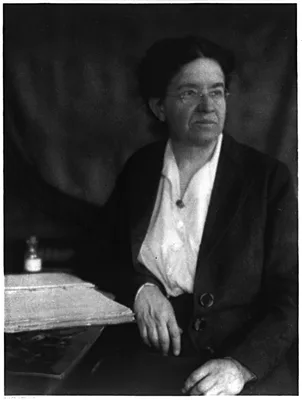
1925 DOAN, Charles Austin (1896 – 1990); CUNNINGHAM, Robert Sydney (1891 – 1963); SABIN, Florence Rena (1871 – 1953)
Experimental studies on the origin and maturation of avian and mammalian red blood-cells.
GMN 909 · https://historyofmedicine.com/id/1058
1925 HART, Alfred Purvis (1887 – 1954)
Familial icterus gravis of the new-born and its treatment.
Successful exchange transfusion.
GMN 3087.1 · https://historyofmedicine.com/id/3757
1925 EDELMANN, Adolf (1885 – 1939)
Ueber Anaemia infectiosa chronica und ihre Aetiologie.
“Edelmann’s disease” – a type of chronic infectious anemia.
GMN 3137 · https://historyofmedicine.com/id/3945
1925 LEDERER, Max (1885 – 1952)
A form of acute hemolytic anemia probably of infectious origin.
“Lederer’s anemia” first described.
GMN 3138 · https://historyofmedicine.com/id/3947
1925 ROBSCHEIT-ROBBINS, Frieda Saur (1893 – 1973); WHIPPLE, George Hoyt (1878 – 1976)
Blood regeneration in severe anaemia. II. Favourable influence of liver, heart and skeletal muscle in diet.
These workers showed the beneficial effect of raw beef liver upon blood regeneration in anemia. Their work paved the way for the liver diet treatment of Minot and Murphy. In 1934 Whipple shared the Nobel Prize in Phys…
GMN 3139 · https://historyofmedicine.com/id/3949
1926 WILLEBRAND, Erik Adolf von (1870 – 1949)
Hereditär pseudohemofili.
Von Willebrand’s disease, pseudo-hemophilia type B, an hereditary bleeding disorder affecting both sexes.
GMN 3087.2 · https://historyofmedicine.com/id/3759