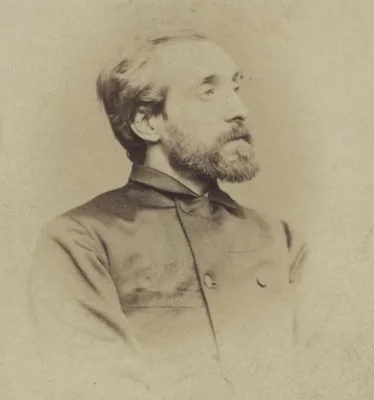
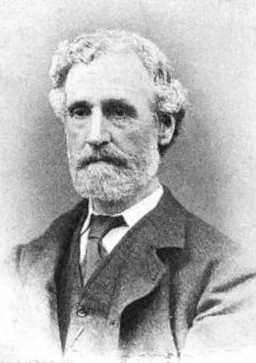
1849 MACKENZIE, Richard James (1821 – 1854)
On amputation at the ankle-joint by internal lateral flap.
“Mackenzie’s operation”, a modification of Syme’s amputation (No. 4459). Mackenzie volunteered for service in the Crimean War and died of Asiatic cholera near Sebastopol.
GMN 4460 · https://historyofmedicine.com/id/65
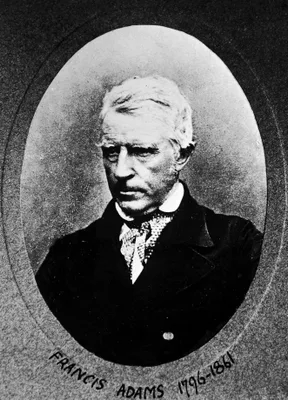
1849 HIPPOCRATES, [Ἱπποκράτης; Hippocrates of Kos] (-460 – -370); ADAMS, Francis (1796 – 1861)
The genuine works of Hippocrates. Translated from the Greek with a preliminary discourse and annotations by Francis Adams. 2 vols.
Francis Adams, surgeon of Banchory, Scotland, prepared this partial translation to acquaint his contemporaries with “the opinions of an author, whom I verily believe to be the highest exemplar of professional excellen…
GMN 14 · https://historyofmedicine.com/id/914
1850 MACINTYRE, William (1791 – 1857)
Case of mollities and fragilitas ossium.
Multiple myeloma first described.
GMN 4327 · https://historyofmedicine.com/id/5554
1850 LANGENBECK, Bernard Rudolf Conrad von (1810 – 1887)
Grosses Enchondrom (Gallertknorpel-Geschwulst) des Schulterblattes; Exstirpation des ganzen Schulterblattes mit Ausnahme des Processus coracoides am 6 Febr.; Tod am 7 Febr.
Complete excision of the scapula.
GMN 4326.1 · https://historyofmedicine.com/id/5559
1851 –1852 REID, William Wharry (1799 – 1866)
Dislocation of the femur on the dorsum ilii, reducible without pulleys, or any other mechanical power, three cases.
Reduction of dislocation without manipulation. Reid demonstrated the futility of attempting to reduce a dorsal dislocation of the hip by forcible longitudinal traction with pulleys.
GMN 4418 · https://historyofmedicine.com/id/6203
1852 BIGELOW, Henry Jacob (1818 – 1890)
Resection of the head of the femur.
First excision of the hip-joint in America. Unfortunately the one-page article provides no details.
GMN 4461 · https://historyofmedicine.com/id/66
1852 MATHIJSEN, Antonius (1805 – 1878)
Nieuwe wijze van aanwending van het gips-verband bij beenbreuken. Eene bijdrage tot de militaire chirurgie.
Introduction of the modern plaster of Paris bandage. Two different French translations of the above work were published in journals in 1852-53. In 1854 Mathijsen published two separate expanded French versions, of whi…
GMN 4328 · https://historyofmedicine.com/id/5555
1853 BRASHEAR, Walter (1776 – 1860)
Amputations.
The first successful amputation of the hip-joint was performed by Brashear in 1806 at Bardstown, Kentucky; he first amputated the thigh through its middle third, and tied off the bleeding vessels; then he made a long …
GMN 4462 · https://historyofmedicine.com/id/67
1853 MCCREARY, Charles (1785 – 1826)
Exsection of the clavicle.
J. H. Johnson (New Orleans med. surg. J., 1850, 6, 474-76) stated that McCreary performed the first resection of the clavicle in the United States on 4 May, 1811. Valentine Mott reported the operation in 1828. See No.…
GMN 4463 · https://historyofmedicine.com/id/68
1853 LITTLE, William John (1810 – 1894)
On the nature and treatment of the deformities of the human frame.
Little was the first eminent orthopedic surgeon in the British Isles. He studied under Stromeyer and, in 1838, he founded the Orthopaedic Institution, now the (Royal) National Orthopaedic Hospital, London. The above w…
GMN 4329 · https://historyofmedicine.com/id/1293
1854 PIROGOV, Nikolai Ivanovich (Pirogoff) (1810 – 1881)
Kostno-plasticheskoye udlineniye kostei goleni pri vilushtshenii stopi. [Osteoplastic elongation of the bones of the leg in amputation of the foot.]
Pirogov’s method of complete osteoplastic amputation of the foot. German translation, Leipzig, 1854.
GMN 4465 · https://historyofmedicine.com/id/137
1854 BRAINARD, Daniel (1812 – 1866)
Essay on a new method of treating ununited fractures and certain deformities of the osseous system.
Experimenting on animals and cadavers, Brainard developed a special bone drill or “perforator” introduced subcutaneously to perforate the bone ends, simulating a recent fracture, and thus stimulating callus formation.
GMN 4418.1 · https://historyofmedicine.com/id/6206
1854 HEYFELDER, Johann Ferdinand Martin (1798 – 1869)
Ueber Resectionen und Amputationen.
GMN 4464 · https://historyofmedicine.com/id/8865
1855 HAMILTON, Frank Hastings (1813 – 1886)
Deformities after fractures.
Hamilton was a medical inspector of the U.S. Army and later became Professor of Surgery at Bellevue Hospital. See No. 4420.
GMN 1742 · https://historyofmedicine.com/id/3101
1855 BREITHAUPT
Zur Pathologie des menschlichen Fusses.
First description of osteoperiostitis of the metatarsal bones, named “Busquet’s disease” after the latter’s description of it in Rev. Chir. (Paris), 1897, 17, 1065.
GMN 4330 · https://historyofmedicine.com/id/5557
1855 SAYRE, Lewis Albert (1820 – 1900)
Exsection of the head of the femur and removal of the upper rim of the acetabulum, for morbus coxarius, with perfect recovery.
Resection of the hip for ankylosis.
GMN 4331 · https://historyofmedicine.com/id/5562
1857 GRITTI, Rocco (1828 – 1920)
Dell’amputazione del femore al terzo inferiore e della disarticulazione del ginocchio.
Gritti’s amputation of the thigh was later improved by Stokes (see No. 4470).
GMN 4466 · https://historyofmedicine.com/id/69
1857 RAINEY, George (1801 – 1884)
On the formation of the skeletons of animals, and other hard structures formed in connexion with living tissues.
Includes description of “Rainey’s tubes” or “corpuscles” in connexion with the process of calcification of tissues.
GMN 619 · https://historyofmedicine.com/id/502
1858 TEALE, Thomas Pridgin (1800 – 1867)
On amputation by a long and a short rectangular flap.
Teale’s method of amputation.
GMN 4467 · https://historyofmedicine.com/id/70
1858 HUMPHRY, Sir George Murray (1820 – 1896)
A treatise on the human skeleton, including the joints.
Humphry was professor of anatomy at Cambridge and became the first professor of surgery there. He founded the Journal of Anatomy and Physiology in 1867. “Humphry’s ligament” of the knee-joint is described on p. 546 of…
GMN 419 · https://historyofmedicine.com/id/959
1860 –1862 BUCK, Gurdon (1807 – 1877)
New treatment for fractures of the femur.
Buck’s extension apparatus, an improved method of treating fractures of the femur. Reprinted in Med. Classics, 1939, 3, 764-82.
GMN 4419 · https://historyofmedicine.com/id/6209
1860 HAMILTON, Frank Hastings (1813 – 1886)
A practical treatise on fractures and dislocations.
The first comprehensive treatise in English on the treatment of fractures and dislocations. See No. 1742.
GMN 4420 · https://historyofmedicine.com/id/6212
1860 PERRIN, Maurice (1826 – 1889)
Luxation traumatique suivie de luxation volontaire du fémur droit.
“Perrin–Ferraton disease” of the hip, later more fully dealt with by L. Ferraton, Rev. Orthop. (Paris), 1905, 2 sér., 6, 45-51.
GMN 4421 · https://historyofmedicine.com/id/6215
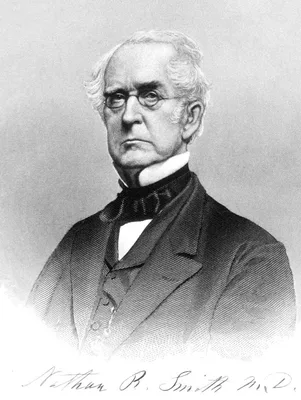
1860 SMITH, Nathan Ryno (1797 – 1877)
A new instrument for the treatment of fractures of the lower extremity.
Smith devised an anterior or suspensatory splint for use in the treatment of fractures of the femur. The apparatus was heavily used during the U.S. Civil War and was especially valuable in treating compound fractures.
GMN 4422 · https://historyofmedicine.com/id/6217
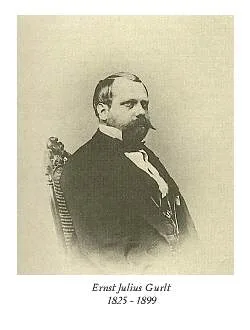
1862 –1865 GURLT, Ernst Julius (1825 – 1899)
Handbuch der Lehre von den Knochenbruchen. 2 vols.
Gurlt, the celebrated historian of surgery (see No. 5800), wrote an exhaustive and detailed review of the literature on fractures. As a source of obscure and arcane information it is unsurpassed. Digital facsimile fro…
GMN 4422.1 · https://historyofmedicine.com/id/6223
1863 EULENBURG, Moritz Michael (1811 – 1877)
Hochgradige Dislocation der Scapula.
First description of congenital high-scapula “Sprengel’s deformity”; see also No. 4359.
GMN 4332 · https://historyofmedicine.com/id/5563
1863 HENKE, Philipp Jakob Wilhelm von (1834 – 1896)
Contractur des Metatarsus.
Congenital metatarsus varus described.
GMN 4333 · https://historyofmedicine.com/id/5564
1864 CARDEN, Henry Douglas ( – 1873)
On amputation by a single flap.
Carden devised a single flap operation, cutting through the femur just above the knee-joint. He published a book on the subject in 1864.
GMN 4468 · https://historyofmedicine.com/id/162
1864 BAUER, Louis (1814 – 1898)
Lectures on orthopaedic surgery.
Before emigrating to America, Bauer studied under Stromeyer. Hugh Owen Thomas considered him “the first exponent of American orthopaedics”. This is the first comprehensive American textbook of orthopedics. First publi…
GMN 4334 · https://historyofmedicine.com/id/5565
1864 ENGEL, Gerhard
Ueber einen Fall von cystoider Entartung des ganzen Skelettes.
First description of osteitis fibrosa cystica – hyperparathyroid bone disease, also known as “von Recklinghausen’s disease of bone”.
GMN 4335 · https://historyofmedicine.com/id/5650
1865 PRICE, Peter Charles (1832 – 1864)
A description of the diseased conditions of the knee-joint which require amputation of the limb, and those conditions which are favourable to excision of the joint.
A valuable contribution to the knowledge and surgical treatment of diseases of the knee-joint.
GMN 4336 · https://historyofmedicine.com/id/5655
1865 LISTER, Joseph, 1st Baron Lister (1827 – 1912)
On excision of the wrist for caries.
GMN 4469 · https://historyofmedicine.com/id/8867
1867 OLLIER, Louis Xavier Édouard Léopold (1830 – 1900)
Traité expérimentale et clinique de la régenération des os. 2 vols.
Ollier pioneered research in bone allografting.
GMN 4336.1 · https://historyofmedicine.com/id/5659
1867 SMITH, Nathan Ryno (1797 – 1877)
Treatment of fractures of the lower extremity, by use of the anterior suspensory apparatus.
GMN 4423 · https://historyofmedicine.com/id/6226
1867 LISTER, Joseph, 1st Baron Lister (1827 – 1912)
On a new method of treating compound fracture, abscess, etc., with observations on the conditions of suppuration.
Lister’s work on the antiseptic principle in surgery. He believed that bacteria could enter wounds and cause suppuration and putrefaction and that it was necessary to kill the bacteria already in wounds and to apply d…
GMN 4423.1 · https://historyofmedicine.com/id/6230
1867 WALES, Philip Skinner (1837 – 1906)
Mechanical therapeutics. A practical treatise on surgical apparatus, appliances, and elementary operations; embracing bandaging, minor surgery, orthopraxy, and the treatment of fractures and dislocations.
Digital facsimile from the Hathi Trust at this link.
GMN 10718 · https://historyofmedicine.com/id/12912
1868 CHARCOT, Jean Martin (1825 – 1893)
Sur quelques arthropathies qui paraissent dépendre d’une lésion du cerveau ou de la moëlle épinière.
Charcot called attention to tabetic arthropathy, a condition which has since borne his name, while the tabetic joints he so well described are now known as “Charcot’s joints”.
GMN 4337 · https://historyofmedicine.com/id/1488
1868 –1869 WILKS, Sir Samuel (1824 – 1911)
Case of osteoporosis, or spongy hypertrophy of the bones (calvaria, clavicle, os femoris, and rib).
A classic account of osteitis deformans. Wilks was associated with Guy’s Hospital all his life. A kindly, charming man, he was described by Osler as one of the handsomest men in London in his time, even until the age …
GMN 4338 · https://historyofmedicine.com/id/5673
1869 BIGELOW, Henry Jacob (1818 – 1890)
The mechanism of dislocation and fracture of the hip. With the reduction of the dislocations by the flexion method.
Bigelow was the first to describe in detail the mechanism of the iliofemoral (Bigelow’s) ligament, and to show its importance in the reduction of dislocation by the flexion method.
GMN 4424 · https://historyofmedicine.com/id/6232
1870 STOKES, Sir William (1839 – 1900)
On supra-condyloid amputation of the thigh.
Gritti–Stokes amputation (see also No. 4466).
GMN 4470 · https://historyofmedicine.com/id/71
1870 WEGNER, Friedrich Rudolph Georg (1843 – 1917)
Ueber hereditäre Knochensyphilis bei jungen Kindern.
“Wegner’s disease” – osteochondritic separation of the epiphyses in congenital syphilis.
GMN 4339 · https://historyofmedicine.com/id/5678
1870 KOCHER, Emil Theodor (1841 – 1917)
Eine neue Reductionsmethode für Schulterverrenkung.
Kocher was Professor of Surgery at Berne, and among the greatest surgeons of his day. He is remembered, among other things, for his method of reduction of subluxation of the shoulder-joint.
GMN 4425 · https://historyofmedicine.com/id/6236
1870 BERENGER-FÉRAUD, Laurent Jean Baptiste (1832 – 1900)
Traité de l’immobilisation directe des fragments osseux dans les fractures.
First book devoted to the treatment of fractures by internal fixation.
GMN 4425.1 · https://historyofmedicine.com/id/6242
1871 HOOD, Wharton Peter (1833 – 1916)
On bone-setting (so-called), and its relation to the treatment of joints crippled by injury, rheumatism, inflammation, etc.
The first work on manipulation written by a physician. Digital facsimile from the Medical Heritage Library, Internet Archive, at this link.
GMN 4339.1 · https://historyofmedicine.com/id/5684
1872 DUPLAY, Simon (1836 – 1924)
De la périarthrite scapulo-humérale et des raideurs de l’épaule qui en sont la conséquence.
“Frozen shoulder” syndrome described.
GMN 4339.2 · https://historyofmedicine.com/id/5689
1875 THOMAS, Hugh Owen (1834 – 1891)
Diseases of the hip, knee and ankle joints, with their deformities, treated by a new and efficient method.
Thomas splint. Enlarged second edition, 1876. See No. 4348.
GMN 4340 · https://historyofmedicine.com/id/5693
1876 MORTON, Thomas George (1835 – 1903)
A peculiar and painful affection of the fourth metatarso-phalangeal articulation.
First complete description of anterior metatarsalgia (“Morton’s disease”). See also No. 4325.
GMN 4341 · https://historyofmedicine.com/id/5695
1876 SAYRE, Lewis Albert (1820 – 1900)
Lectures on orthopaedic surgery and diseases of the joints.
See Nos. 4344 & 4344.1.
GMN 4342.1 · https://historyofmedicine.com/id/5702
1876 SAYRE, Lewis Albert (1820 – 1900)
Report on Pott’s disease, or caries of the spine; treated by extension, and the plaster of Paris bandage.
Sayre was the first to use plaster of Paris as a support for the spinal column in scoliosis and Pott’s disease. His name is eponymically linked with Sayre’s jacket, a plaster of Paris jacket applied while the patient …
GMN 4344 · https://historyofmedicine.com/id/5714
1876 SMITH, Sir Thomas (1833 – 1909)
Haemorrhagic periostitis of the shafts of several of the long bones, with separation of the epiphyses.
Craniohypophyseal xanthomatosis was first reported by Sir Thomas Smith (see also No. 6359). Hand in 1893 (No. 6361), Schüller in 1915 (No. 6362), and Christian in 1919 (No. 6363) also reported cases, and the condition…
GMN 6360 · https://historyofmedicine.com/id/8259

![HIPPOCRATES, [Ἱπποκράτης; Hippocrates of Kos] (-460 – -370)](/media/portraits/50)