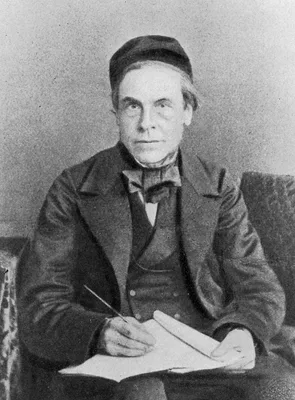
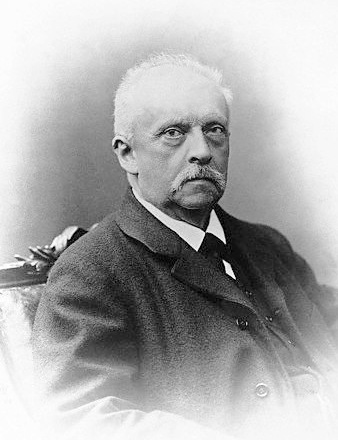
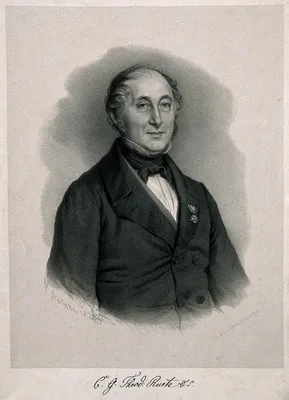
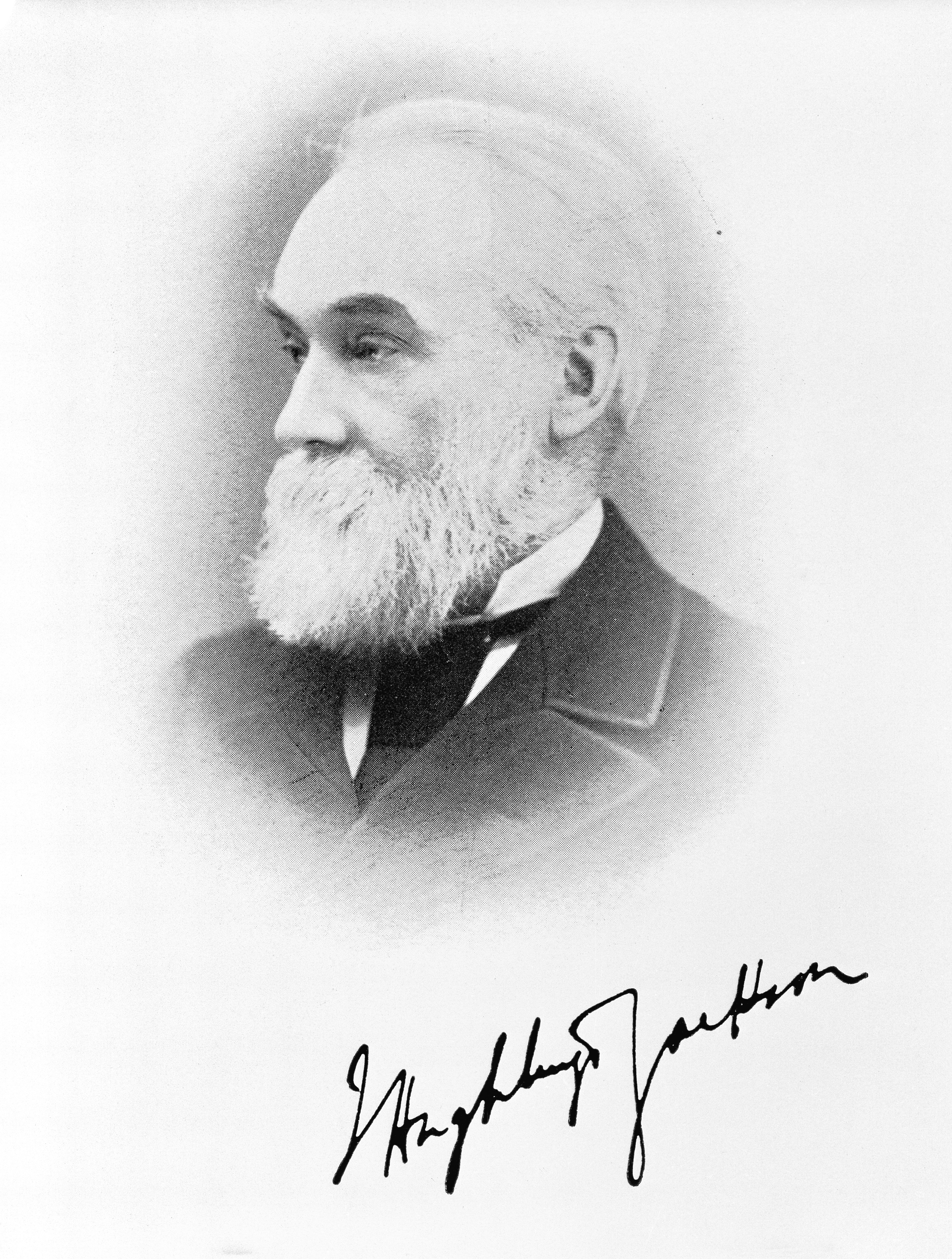
1823 PURKYNĔ, Jan Evangelista [PURKINJE] (1787 – 1869)
Commentatio de examine physiologico organi visus et systematis cutanei.
Purkynĕ was first to examine the interior of the human eye and the dog eye, using only a candle and a concave spherical lens. He thus invented the ophthalmoscope three decades before Helmholtz (1851; No. 5866). Reprin…
GMN 1492.1 · https://historyofmedicine.com/id/8806
1845 BRÜCKE, Ernst Wilhelm von (1819 – 1892)
Anatomische Untersuchungen über die sogenannten leuchtenden Augen bei den Wirbelthieren.
Von Brücke studied the luminosity of the eye in animals, and by passing a tube through a candle flame, was able to see the fundus. See also the same journal, 1847, 225-27.
GMN 5859 · https://historyofmedicine.com/id/7218
1846 CUMMING, William (1812 – 1886)
On a luminous appearance of the human eye, and its application to the detection of disease of the retina and posterior part of the eye.
While a student at the London Hospital, Cumming, by shading the eye of a fellow student from the light, was able to look directly into it and obtain both the retinal reflex and the white light from the entrance of the…
GMN 5861 · https://historyofmedicine.com/id/7224
1847 JONES, Thomas Wharton (1808 – 1891)
A manual of the principles and practice of ophthalmic medicine and surgery.
The last important English work on opthalmology published before the invention of the ophthalmoscope. Jones did not appreciate the prototype ophthalmoscope devised by Charles Babbage, and shown to him in 1847. After t…
GMN 5862 · https://historyofmedicine.com/id/7227
1851 HELMHOLTZ, Hermann Ludwig Ferdinand von (1821 – 1894)
Beschreibung eines Augen-Spiegels zur Untersuchung der Netzhaut im lebenden Auge.
Invention of the ophthalmoscope, one of the greatest events in the history of ophthalmology. English translation by T. H. Shastid, Chicago, Cleveland Press, 1916.
GMN 5866 · https://historyofmedicine.com/id/7238
1852 RUETE, Christian Georg Theodor (1810 – 1867)
Der Augenspiegel und des Optometer für practische Aerzte.
Ruete introduced a practical lens system for examining the inverted image, and improved the illumination, producing the first practical ophthalmoscope.
GMN 5866.1 · https://historyofmedicine.com/id/7240
1853 TRIGT, Adrien Christophe van (1825 – 1864)
Dissertatio ophthalmologica inauguralis de speculo oculi.
Trigt's thesis contains the first printed illustrations of the fundus of the eye. Digital facsimile from Google Books at this link. The following year Trigt's thesis was translated into German by C. H. Schauenberg as …
GMN 5869.1 · https://historyofmedicine.com/id/7258
1854 JONES, Thomas Wharton (1808 – 1891)
Report on the ophthalmoscope.
Jones reported that Charles Babbage (1792-1871), the computer pioneer, had produced a simple ophthalmoscope in 1847. After the success of Helmholtz’s instrument in 1851 (No. 5866) Jones wrote about Babbage’s instrumen…
GMN 5874 · https://historyofmedicine.com/id/7269
1855 LIEBREICH, Richard (1830 – 1917)
Ophthalmoskopische Notizen 4. Seitliche Beleuchtung und mikroskopische Untersuchung am lebenden Auge.
Liebreich introduced lateral illumination in microscopic investigation of the living eye.
GMN 5877 · https://historyofmedicine.com/id/7275
1858 GRAEFE, Alfred Carl (1830 – 1899)
Klinische Analyse der Motilitätsstörungendes Auges.
Alfred Carl Graefe, cousin of Albrecht, made a careful clinical analysis of disordered movements of the eye. He also invented a special “localization ophthalmoscope”, and, with Saemisch, edited the great Handbuch der …
GMN 5883 · https://historyofmedicine.com/id/7286
1863 LIEBREICH, Richard (1830 – 1917)
Atlas der Ophthalmoscopie. Darstellung des Augengrundes im gesunden und krankhaften Zustande enthalten.
First atlas of the fundus. The author was an assistant to Helmholtz at the time of the invention of the ophthalmoscope. The work is illustrated with reproductions of his own paintings. Text in French and German. Engli…
GMN 5892 · https://historyofmedicine.com/id/7366
1863 –1865 JACKSON, John Hughlings (1835 – 1911)
Observations on defects of sight in brain disease.
In this work Jackson showed the importance of the ophthalmoscope in the investigation of diseases of the nervous system. Reprinted in Med. Classics, 1939, 3, 918-26.
GMN 4537 · https://historyofmedicine.com/id/8899
1869 JÄGER VON JAXTHAL, Eduard (1818 – 1884)
Opthalmoskopischer Hand-Atlas.
A fine atlas which was for many years unsurpassed. The illustrations were reproduced from Jaeger’s own paintings, each of which required from 20 to 50 sittings of from two to three hours each. English translation, Lon…
GMN 5904 · https://historyofmedicine.com/id/7411
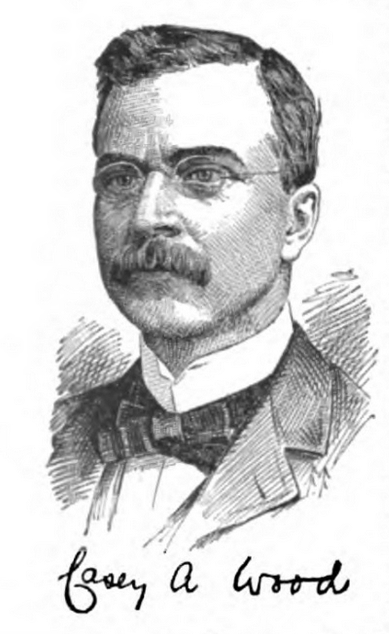
1917 WOOD, Casey Albert (1856 – 1942)
The fundus oculi of birds especially as viewed by the ophthalmoscope. A study in comparative anatomy and physiology. Illustrated by 143 drawings... also by sixty-one colored paintings prepared for this work by Arthur W. Head.
Digital facsimile from the Biodiversity Heritage Library, Internet Archive, at this link.
GMN 7116 · https://historyofmedicine.com/id/9283
1937 MARZIO, Qurino di (1883 – 1954)
Fundus oculi: diagnostica oftalmoscopica…
The first atlas of ophthalmoscopy published in Italy, considered by many to be the most beautiful ever published. German translation, Torino, Rosenberg und Sellier, [1941]. Some copies of that edition contain an Engli…
GMN 5988.1 · https://historyofmedicine.com/id/7080
1960 KEYS, Thomas Edward (1908 – 1995); RUCKER, C. Wilbur (1900 – 1991)
The atlases of ophthalmoscopy: A bibliography, 1850-1960.
GMN 10488 · https://historyofmedicine.com/id/12681
1981 HAUGWITZ, Thilo von
Ophthalmologisch-optische Untersuchungsgeräte.
English translation by F.C. Blodi as The history of optical instruments for the examination of the eye, Bonn: J. P. Wayenborgh, 1986.
GMN 6007.2 · https://historyofmedicine.com/id/7162
1996 –1997 SCHETT, Alfred
The ophthalmoscope - Der Augenspiegel. Textbook and atlas. 2 vols. Translated by Donald L. Blanchard.
GMN 10850 · https://historyofmedicine.com/id/13046