1572 IBN AL-HAYTHAM, Hasan (ALHAZEN) (965 – 1040); RISNER, Friedrich (1533 – 1580); WITELO ( ERAZMUS CIOŁEK WITELO) (1230 – 1300)
Opticae thesaurus: Alhazeni Arabis libri septem, nunc primum editi; Eiusdem liber De Crepusculis et nubium ascensionibus. Edited by Friedrich Risner.
The Arab mathematician, astronomer, and physicist of the Islamic Golden Age Alhazen made significant contributions to the principles of optics and the theory of visual perception in his Opticae thesaurus. Risner's edi…
GMN 10937 · https://historyofmedicine.com/id/13133
1573 VAROLIO, Costanzo (1543 – 1575)
De nervis opticis nonnulisque aliis praeter communem opinionem in humano capite observatis.
Varolio described a new method of dissection which enabled him to observe and describe the pons for the first time. By this new method Varolio was able to make some contributions to the knowledge of the course and ter…
GMN 1377.2 · https://historyofmedicine.com/id/1782
1613 D'AGUILON, François (1567 – 1617)
Opticorum libri sex philosophis juxta ac mathematicis utiles.
This work, beautifully printed by the Plantin-Moretus Press, includes an engraved title page and illustrations heading each chapter by Peter Paul Rubens. It contains one of the first studies of binocular vision. Digit…
GMN 13260 · https://historyofmedicine.com/id/15526
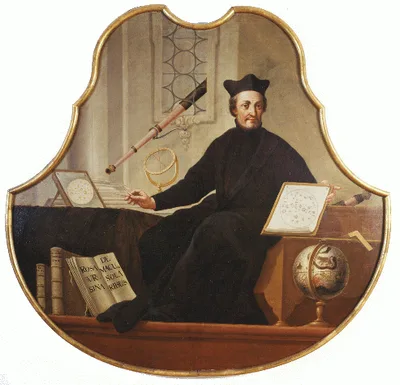
1619 SCHEINER, Christoph (1575 – 1650)
Oculus, hoc est: fundamentum opticum.
Scheiner, a Jesuit astronomer, was a pioneer in physiological optics. He demonstrated how images fall on the human retina, noting the change in curvature of the lens during accommodation, and devised the pin-hole test…
GMN 1480 · https://historyofmedicine.com/id/2465
1668 MARIOTTE, Edme (1620 – 1684)
Nouvelle découverte touchant la veüe.
Discovery of the blind spot in the retina, the existence of which Mariotte deduced from his experiments investigating the fate of light rays striking the base of the optic nerve. Facsimile reprint in J. Brons, The bli…
GMN 1481.1 · https://historyofmedicine.com/id/2472
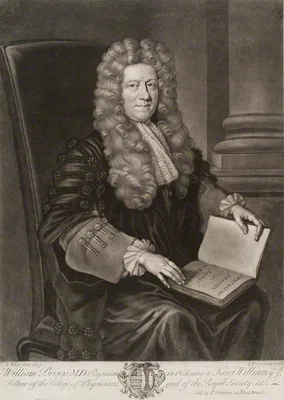
1676 BRIGGS, William (1642 – 1704)
Ophthalmo-graphia; sive, oculi eiusque partium descriptio anatomica.
First English treatise on the anatomy of the eye. Briggs described the papilla of the optic disc and hypothesized that vibrations caused by rays of light striking fibers of the retina were conveyed to the papilla, and…
GMN 1481.2 · https://historyofmedicine.com/id/2476
1682 BRIGGS, William (1642 – 1704)
Nova visionis theoria.
Briggs’ treatise on the physiology of vision influenced Sir Isaac Newton, who reprinted it in book form with his own introduction, London, 1685.
GMN 1481.3 · https://historyofmedicine.com/id/2485
1751 WHYTT, Robert (1714 – 1766)
An essay on the vital and other involuntary motions of animals.
Whytt, famous Edinburgh neurophysiologist, was the first to prove that the response of the pupils to light is a reflex action (“Whytt’s reflex”). He described this reflex at length and mentioned that its afferent path…
GMN 1381 · https://historyofmedicine.com/id/1795
1759 PORTERFIELD, William (1695 – 1771)
A treatise on the eye. The manner and phenomena of vision. 2 vols.
Porterfield was Professor of the Institutes and Practice of Medicine at Edinburgh from 1724-26. His book included many original observations. It was the first important British work on the anatomy and physiology of th…
GMN 1484.2 · https://historyofmedicine.com/id/2513
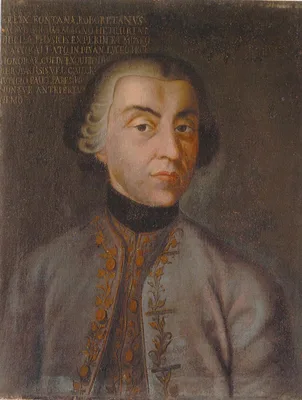
1765 FONTANA, Felice (1730 – 1805)
Ricerche de motu del iride.
An investigation of how and why the iris contracts. See P.K. Knoefel, Felice Fontana: life and works, Trento, [1984], See also No.2103.
GMN 1485 · https://historyofmedicine.com/id/2516
1768 WHYTT, Robert (1714 – 1766)
The works of Robert Whytt, M.D. Late physician to his Majesty.... Published by his son.
Digital facsimile from the Internet Archive at this link.
GMN 11733 · https://historyofmedicine.com/id/13934
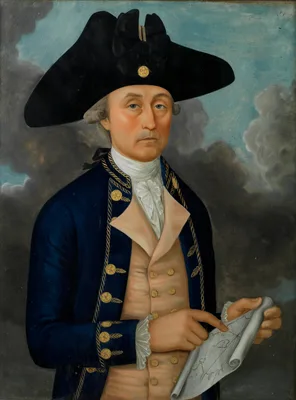
1777 HUDDART, Joseph (1741 – 1816)
An account of persons who could not distinguish colours.
First reliable record of color blindness. Written in the form of a letter to Joseph Priestley, who communicated it to the Royal Society. Huddart was a British hydrographer, engineer and inventor.
GMN 5832 · https://historyofmedicine.com/id/7085
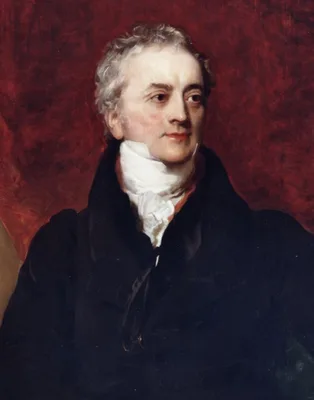
1793 YOUNG, Thomas (1773 – 1829)
Observations on vision.
Thomas Young is regarded as one of the most versatile of all scientists. In the above work he showed that the act of accommodation is due to a change of curvature of the crystalline lens, whereby light rays of various…
GMN 1486 · https://historyofmedicine.com/id/2521
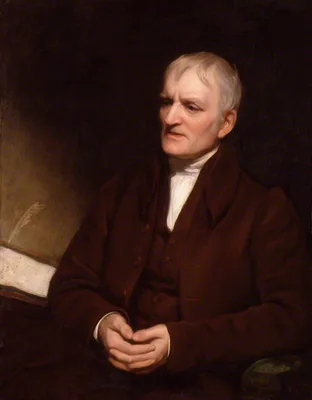
1798 DALTON, John (1766 – 1844)
Extraordinary facts relating to the vision of colours.
First scientific description of color-blindness, or “Daltonism”. Dalton himself suffered from red–green blindness. His paper was read to the Society in 1794.
GMN 5834 · https://historyofmedicine.com/id/7106
1801 YOUNG, Thomas (1773 – 1829)
On the mechanism of the eye.
Includes the first description of astigmatism, with measurements and optical constants.
GMN 1487 · https://historyofmedicine.com/id/2525
1802 YOUNG, Thomas (1773 – 1829)
On the theory of light and colours.
Young, the “Father of physiological optics”, established the wave theory of light, explaining the phenomena of interference and dispersion.
GMN 1488 · https://historyofmedicine.com/id/2529
1819 PURKYNĔ, Jan Evangelista [PURKINJE] (1787 – 1869)
Beiträge zur Kenntniss des Sehens in subjectiver Hinsicht.
Purkynĕ’s graduation dissertation on the subjective visual phenomena earned for him the appreciation of Goethe and the chair of physiology at Breslau. Reprinted in his Opera omnia, vol. 1, pp. 1-56,1918. There were tw…
GMN 1492 · https://historyofmedicine.com/id/2563
1823 PURKYNĔ, Jan Evangelista [PURKINJE] (1787 – 1869)
Commentatio de examine physiologico organi visus et systematis cutanei.
Purkynĕ was first to examine the interior of the human eye and the dog eye, using only a candle and a concave spherical lens. He thus invented the ophthalmoscope three decades before Helmholtz (1851; No. 5866). Reprin…
GMN 1492.1 · https://historyofmedicine.com/id/8806
1824 FLOURENS, Marie Jean Pierre (1794 – 1867)
Recherches expérimentales sur les propriétés et les fonctions du système nerveux, dans les animaux vertébrés.
Experimental proof that vision depends on the integrity of the cerebral cortex. See No. 1391 for his first paper on the subject. Partial English translation in von Bonin, Some papers on the cerebral cortex, Springfiel…
GMN 1493 · https://historyofmedicine.com/id/2568
1825 PURKYNĔ, Jan Evangelista [PURKINJE] (1787 – 1869)
Beobachtungen und Versuche zur Physiologie der Sinne. Neue Beiträge zur Kenntniss des Sehens in subjectiver Hinsicht. 2 vols.
“Purkynĕ phenomenon” or “Purkynĕ shift”, a change in the apparent relative luminosity of colors in a dim light (scotopic vision) compared with that in full daylight (photopic vision). Also published in Rust’s Mag. ges…
GMN 1494.1 · https://historyofmedicine.com/id/2573
1826 MÜLLER, Johannes Peter (1801 – 1858)
Zur vergleichenden Physiologie des Gesichtssinnes des Menschen und der Thiere.
Includes Müller’s law of specific nerve energies. For an English translation, see his Elements of physiology, transl. W. Baly, London, 1838, vol. 1, pp. 766-67. Includes (p. 73) his explanation of the color sensations…
GMN 1257 · https://historyofmedicine.com/id/2130
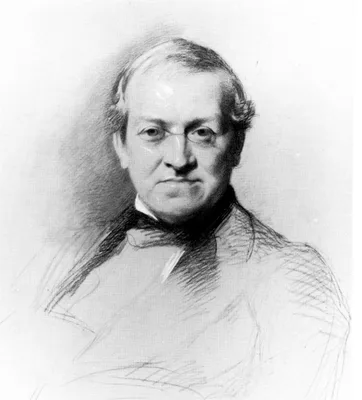
1838 WHEATSTONE, Sir Charles (1802 – 1875)
Contributions to the physiology of vision.
GMN 1498 · https://historyofmedicine.com/id/2576
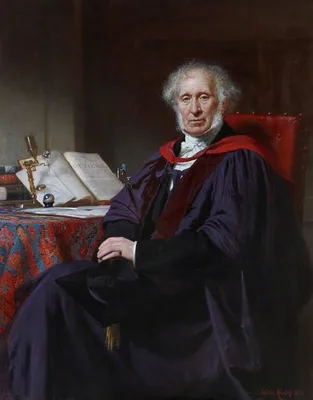
1840 –1844 BREWSTER, Sir David (1781 – 1868)
On the conversion of relief by inverted vision.
GMN 1499 · https://historyofmedicine.com/id/2577
1840 –1844 BREWSTER, Sir David (1781 – 1868)
On the knowledge of distance given by binocular vision.
GMN 1500 · https://historyofmedicine.com/id/2578
1845 KUSSMAUL, Adolf (1822 – 1902)
Die Farbenerscheinungen im Grunde des menschlichen Auges.
An important description of colour phenomena in the fundus oculi. This paper won for Kussmaul the Karl Friedrich Medal of the University of Heidelberg.
GMN 1502 · https://historyofmedicine.com/id/2580
1845 LISTING, Johann Benedict (1808 – 1882)
Beitrag zur physiologischen Optik.
GMN 1503 · https://historyofmedicine.com/id/2581
1845 MACKENZIE, William (1791 – 1868)
On the vision of objects on and in the eye.
An introduction to the then little-known subject of catoptrics.
GMN 1504 · https://historyofmedicine.com/id/2583
1845 BRÜCKE, Ernst Wilhelm von (1819 – 1892)
Anatomische Untersuchungen über die sogenannten leuchtenden Augen bei den Wirbelthieren.
Von Brücke studied the luminosity of the eye in animals, and by passing a tube through a candle flame, was able to see the fundus. See also the same journal, 1847, 225-27.
GMN 5859 · https://historyofmedicine.com/id/7218
1846 CUMMING, William (1812 – 1886)
On a luminous appearance of the human eye, and its application to the detection of disease of the retina and posterior part of the eye.
While a student at the London Hospital, Cumming, by shading the eye of a fellow student from the light, was able to look directly into it and obtain both the retinal reflex and the white light from the entrance of the…
GMN 5861 · https://historyofmedicine.com/id/7224
1851 MÜLLER, Heinrich (1820 – 1864)
Zur Histologie der Netzhaut.
Discovery of visual purple.
GMN 1506 · https://historyofmedicine.com/id/2589
1852 BUDGE, Ludwig Julius (1811 – 1884)
Ueber den Einfluss des Nervensystems auf die Bewegung der Iris.
GMN 1507 · https://historyofmedicine.com/id/2591
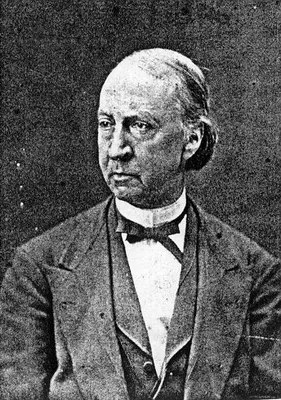
1852 HELMHOLTZ, Hermann Ludwig Ferdinand von (1821 – 1894)
Ueber die Theorie der zusammengesetzten Farben.
GMN 1508 · https://historyofmedicine.com/id/2593
1854 –1855 HELMHOLTZ, Hermann Ludwig Ferdinand von (1821 – 1894)
Ueber die Accommodation des Auges.
Helmholtz determined the optical constants and explained the mechanism of accommodation, with the help of the ophthalmometer which he had invented in 1852.
GMN 1509 · https://historyofmedicine.com/id/2595
1855 BUDGE, Ludwig Julius (1811 – 1884)
Ueber die Bewegung der Iris: Für Physiologen und Ärzte,
Digital facsimile from the Internet Archive at this link.
GMN 1510 · https://historyofmedicine.com/id/2597
1855 PANIZZA, Bartolomeo (1785 – 1867)
Osservazioni sul nervo ottico.
Panizza was the first to attribute the vision function to the posterior cortex.
GMN 1511 · https://historyofmedicine.com/id/2600
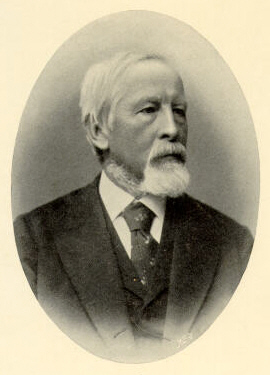
1862 DONDERS, Frans Cornelis (1818 – 1889)
Astigmatisme en cilindrische glazen.
Includes statement of “Donders’s law” – the rotation of the eye around the line of sight is not voluntary. French and German translations, 1862.
GMN 5889 · https://historyofmedicine.com/id/7354
1864 DONDERS, Frans Cornelis (1818 – 1889)
On the anomalies of accommodation and refraction of the eye… Translated from the author’s manuscript by W.D. Moore.
Donders’s greatest work, the basis for all succeeding studies of the subject, and a classic of physiological optics. It contains Donders’s explanation of astigmatism, his definition of aphakia and hypermetropia, his s…
GMN 5893 · https://historyofmedicine.com/id/7470
1865 HOLMGREN, Alarik Frithiof (1831 – 1897)
Method att objectivera effecten av ljusintryck pa retina.
Discovery of the electroretinogram, the beginning of the use of electrophysiological methods for studying visual systems.
GMN 1511.1 · https://historyofmedicine.com/id/2602
1866 SCHULTZE, Max Johann Sigismund (1825 – 1874)
Zur Anatomie und Physiologie der Retina.
One of the greatest of all histologists, Max Schultze is remembered by ophthalmologists for his monograph on the nerve-endings in the retina.
GMN 1512 · https://historyofmedicine.com/id/2605
1867 HELMHOLTZ, Hermann Ludwig Ferdinand von (1821 – 1894)
Handbuch der physiologischen Optik. 1 vol. and atlas.
Includes Helmholtz’s revival of the Young theory of color vision. English translation by J.P.C. Southall of 3rd German edition, 3 vols., Menasha, Wis., 1924-25.
GMN 1513 · https://historyofmedicine.com/id/2606
1868 HERING, Karl Ewald Konstantin (1834 – 1918)
Die Lehre vom binokularen Sehen.
Hering’s law: that the corresponding muscles of the two eyes are always equally innervated. The book includes classic experiments and observations on eye movement control. English translation by B. Bridgeman and L. St…
GMN 1513.1 · https://historyofmedicine.com/id/2608
1870 –1871 HOLMGREN, Alarik Frithiof (1831 – 1897)
Om retinaströmmen.
First demonstration of retinal action currents.
GMN 1514 · https://historyofmedicine.com/id/2611
1872 –1875 HERING, Karl Ewald Konstantin (1834 – 1918)
Zur Lehre vom Lichtsinne. 6 parts.
Hering’s theory of color sense. First edition in book form (Vienna, 1878). Hering expanded this work in Grundzüge der Lehre vom Lichtsinn (1905-11; 1920) English translation of that expanded work by Leo M. Hurvich and…
GMN 1515 · https://historyofmedicine.com/id/2615
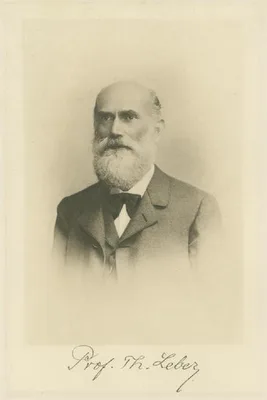
1873 LEBER, Theodor (1840 – 1917)
Studien über den Flüssigkeitswechsel im Auge.
Leber discovered how the ciliary body excretes intraocular fluid.
GMN 1515.1 · https://historyofmedicine.com/id/2616
1874 –1879 GUDDEN, Bernhard Aloys von (1824 – 1886)
Ueber die Kreuzung der Fasern im Chiasma nervorum opticorum.
Important studies on the partial decussation of optic paths.
GMN 1516 · https://historyofmedicine.com/id/2619
1876 –1877 HOLMGREN, Alarik Frithiof (1831 – 1897)
Om färgblindheten i dess förhallande till jernvägstrafiken och sjöväsendet.
A serious railway accident in Sweden in 1875 was believed by Holmgren to be due to color-blindness, and resulted in the above important paper dealing with the condition and its relation to railway and maritime traffic…
GMN 5916 · https://historyofmedicine.com/id/6815
1877 BOLL, Franz Christian (1849 – 1879)
Zur Physiologie des Sehens und der Farbenempfindung.
Boll noted that visual purple is bleached on exposure to light.
GMN 1517 · https://historyofmedicine.com/id/2620
1877 –1882 PLATEAU, Joseph Antoine Ferdinand (1801 – 1883)
Bibliographie analytique des principaux phénomènes subjectifs de la vision, depuis les temps anciens jusqu'a la fin du XVIIIe siècle, suivie d'une bibliographie simple pour la partie écoulée du siècle actuel.
Première section: Persistance des impressions sur la rétine. Deuxième section: couleurs accidentelles ordinaires du succession. Troisième section: images qui succèdent à la contemplation d'objets brillants. Quatrième …
GMN 9640 · https://historyofmedicine.com/id/11827
1878 KÜHNE, Wilhelm Friedrich (1837 – 1900)
Ueber den Sehpurpur.
Kühne was Professor of Physiology at Amsterdam and Heidelberg. Among his best work is his investigation of visual purple (rhodopsin) which he was first to extract from the retina. Several other papers by him on the sa…
GMN 1519 · https://historyofmedicine.com/id/2624
1879 THOMSON, William (1833 – 1907)
On astigmatism as a cause for persistent headache and other nervous symptoms.
Thomson was a pioneer in the study of refraction. He was much interested in color-blindness and modified Holmgren’s wool-skein test. Himself affected with hypermetropia, he made important investigations on this condit…
GMN 5917 · https://historyofmedicine.com/id/6819