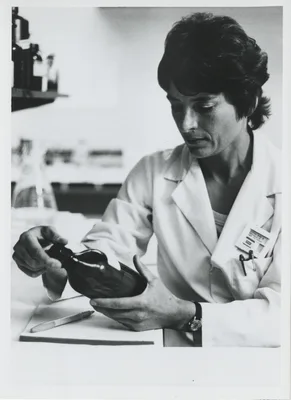
1967 RATHLEV, Tara (1927 – 2009)
Haemagglutination test utilizing pathogenic Treponema pallidum for the sero-diagnosis of syphilis.
Treponemal hemagglutination (TPHA) test.
GMN 2419.4 · https://historyofmedicine.com/id/2879
1967 STEWART, George Louis (1936 – ); ET AL
Rubella-virus hemagglutination-inhibition test.
With five co-authors.
GMN 5509.4 · https://historyofmedicine.com/id/6510
1971 PERLMANN, Peter (1919 – 2005); ENGVALL, Eva (1940 – )
Enzyme-linked immunosorbent assay (ELISA). Quantitative assay of immunoglobulin G.
Perlmann (principal investigator) and Engvall conceptualized and developed the very commonly used enzyme-lined immunosorbent assay (ELISA) that uses antibodies to detect proteins and other different immunogens. The as…
GMN 12601 · https://historyofmedicine.com/id/14841
1976 KOENIG, Ronald Jay; PETERSON, Charles M.; CERAMI, Anthony (1940 – ); ET AL
Correlation of glucose regulation and hemoglobin AIc in diabetes mellitus.
The authors studied 5 diabetic patients and first realized that A1c was an ideal index to reveal the overall control of a patient’s blood sugar over the past several months before a doctor’s visit. They were the first…
GMN 14222 · https://historyofmedicine.com/id/16539
1992 CUNNINGHAM, Andrew; WILLIAMS, Perry
The laboratory revolution in medicine. Edited by Andrew Cunningham and Perry Williams.
Laboratory medicine developed in the nineteenth century, principally in Germany, France, Britain, and the United States. While a number of scholars have studied various aspects of laboratory medicine in the nineteenth…
GMN 11539 · https://historyofmedicine.com/id/13738
2020 FEDER, Henry M. Jr.; REZUKE, William N.
Infectious mononucleosis diagnosed by Downey cells: Sometimes the old ways are better.
The Downey cell method for the diagnosis of infectious mononucleosis remains effective and cost-effective nearly 100 years after it was discovered: "An 18-year-old woman visited her physician because she had a fever, …

GMN 12117 · https://historyofmedicine.com/id/14326