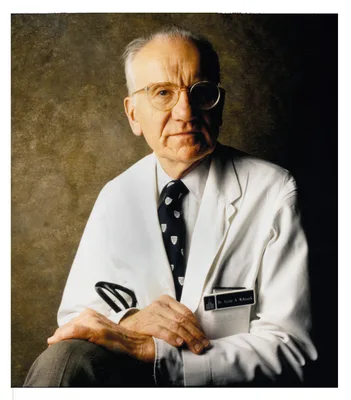
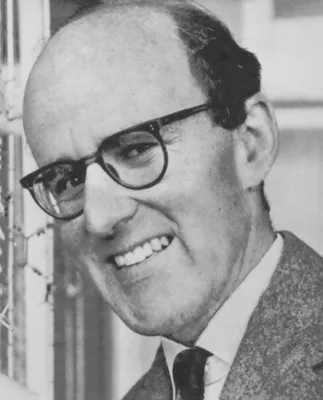
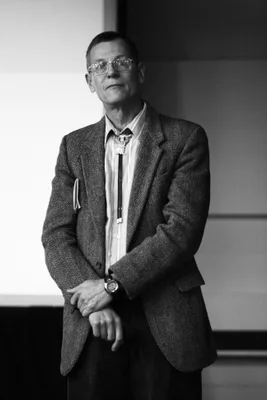
1966 LEHMANN, Hermann (1910 – 1985); HUNTSMAN, Richard George (1927 – 2015)
Man’s haemoglobins: including the haemoglobinopathies and their investigation.
Explains the current distribution of sickling throughout the world.
GMN 3155.4 · https://historyofmedicine.com/id/4091
1966 CARLSON, Elof Axel (1931 – )
The gene: A critical history.
GMN 258.5 · https://historyofmedicine.com/id/8722
1966 MCKUSICK, Victor Almon (1921 – 2008)
Mendelian inheritance in man; catalogs of autosomal dominant, autosomal recessive, and X-linked phenotypes.
Last expanded printed edition: 12th edition, 3 vols., 1998. "Dr Victor A. McKusick wrote an article in 1962 for the Quarterly Review of Biology titled ‘On the X Chromosome of Man’ (1). At that time, X-linkage had been…
GMN 14202 · https://historyofmedicine.com/id/16518
1967 JACOBSON, Cecil Bryan (1936 – ); BARTER, Robert Henry (1913 – 1999)
Intrauterine diagnosis and management of genetic defects.
Amniocentesis used to diagnose genetic disorders in utero. First detailed report. See also Fuchs, F., Genetic information from amniotic fluid contents. Lancet, 1960, 2, 180. "During the course of the criminal investig…
GMN 6235.2 · https://historyofmedicine.com/id/7874
1967 STERN, Curt (1902 – 1981); SHERWOOD, Eva R.
The origins of genetics: A Mendel source book.
GMN 258.6 · https://historyofmedicine.com/id/8723
1967 TESSIER, Paul Louis (1917 – 2008)
Osteotomies totales de la face: Syndrome de Crouzon, syndrome d'Apert: oxcephalies, scaphocephalies, turricephalies.
GMN 7732 · https://historyofmedicine.com/id/9904
1968 LEHMANN, Hermann (1910 – 1985); PERUTZ, Max Ferdinand (1914 – 2002)
Molecular pathology of human haemoglobin.
Perutz opened up "the field of 'molecular pathology,' relating a structural abnormality to a disease" (Aaron Klug, "Max Perutz 1914-2002," Science 295 ([2002] 2383). Specifically Perutz showed that hemoglobin molecule…
GMN 6916 · https://historyofmedicine.com/id/9081
1969 BECKWITH, Jonathan Roger (1935 – ); SHAPIRO, James Alan (1943 – ); ERON, Lawrence (1944 – ); MACHATTIE, Lorne; IHLER, Garret; IPPEN, Karen
Isolation of pure lac operon DNA.
Order of authorship in the original publication: Shapiro, MacHattie, Eron, Ihler, Ippen, Beckwith. Beckwith led the research group that in 1969 isolated the first gene from an organism, specifically a gene from a bact…
GMN 13971 · https://historyofmedicine.com/id/16273
1970 HARTWELL, Leland Harrison (1939 – ); CULOTTI, Joseph; REID, Brian J.
Genetic control of the cell-division cycle in yeast 1. Detection of mutants.
This was the first paper to describe cdc mutants. The authors also coined the term 'execution point' — the stage in the cell cycle when the gene function is required. In this paper, three cdc genes were described, whi…
GMN 13933 · https://historyofmedicine.com/id/16229
1971 PROVINE, William Ball (1942 – 2015)
The origins of theoretical population genetics.
GMN 258.7 · https://historyofmedicine.com/id/8724
1971 KNUDSON, JR., Alfred George (1922 – 2016)
Mutation and cancer: Statistical study of retinoblastoma.
In this paper Knudson first described his "two-hit hypothesis," also known as the "Knudson hypothesis," which explains the incidence of hereditary cancers, such as retinoblastoma. "Humans inherit two copies of every g…
GMN 13964 · https://historyofmedicine.com/id/16266
1972 STACK, H. Graham
The palmar fascia.
"There have been many descriptions of the palmar fascia by anatomists and in papers dealing with the surgical treatment of Dupuytren's contracture, but what seems to be lacking is an overall view of the problem, based…
GMN 7433 · https://historyofmedicine.com/id/9605
1973 ZIMMERMAN, David R.
Rh: The intimate history of a disease and its conquest.
GMN 14089 · https://historyofmedicine.com/id/16400
1974 BRUYN, George Willem (1928 – 2002)
A centennial bibliography of Huntington’s chorea, 1872-1972.
Over 2,000 references to original works. Chronological arrangement. Author, geographic and other indexes. With F. Baro and N. C. Myrianthopoulos.
GMN 5019.15 · https://historyofmedicine.com/id/6691
1974 BRENNER, Sydney (1927 – 2019)
The genetics of CAENORHABDITIS ELEGANS.
In 2002 Brenner shared the Nobel Prize in Physiology or Medicine in Physiology or Medicine with H. Robert Horvitz and John Sulston "for their discoveries concerning genetic regulation of organ development and programm…
GMN 9941 · https://historyofmedicine.com/id/12129
1974 HARTWELL, Leland Harrison (1939 – ); CULOTTI, Joseph; REID, Brian J.; PRINGLE, John R. (1943 – )
Genetic control of the cell division cycle in yeast.
In 2001 Hartwell shared the Nobel Prize in Physiology or Medicine with Tim Hunt and Sir Paul M. Nurse "for their discoveries of key regulators of the cell cycle." See also No. 13933. In this paper the authors demonstr…
GMN 13934 · https://historyofmedicine.com/id/16230
1976 VARMUS, Harold Eliot (1942 – ); BISHOP, John Michael (1936 – ); STEHELIN, Dominique (1943 – 2019); VOGT, Peter K. (1932 – )
DNA related to the transforming gene(s) of avian sarcoma viruses is present in normal avian DNA.
Discovery of the first “oncogene. In 1989 Varmus and Bishop shared the Nobel Prize for in Physiology or Medicine "for their discovery of the cellular origin of retroviral oncogenes."
GMN 2660.28 · https://historyofmedicine.com/id/3441
1978 LEWIS, Edward Butts (1918 – 2004)
A gene complex controlling segmentation in Drosophila.
Discovery of the Drosophila Bithorax complex and elucidation of its function. Lewis founded the field of developmental genetics and laid the groundwork for current understanding of the universal, evolutionarily conser…
GMN 7456 · https://historyofmedicine.com/id/9628
1980 NÜSSLEIN-VOLHARD, Christiane (1942 – ); WIESCHAUS, Eric Francis (1947 – )
Mutations affecting segment number and polarity in Drosophilia.
In 1995 Nüsslein-Volhard and Wieschaus shared the Nobel Prize in Physiology or Medicine with Edward B. Lewis "for their discoveries concerning the genetic control of early embryonic development."
GMN 7455 · https://historyofmedicine.com/id/9627
1980 BERG, Paul (1926 – ); MULLIGAN, Richard C. (1954 – )
Expression of a bacterial gene in mammalian cells.
(Order of authorship in the original publication: Mulligan, Berg.) In an understated paper the authors suggested the potential of treating recessive diseases like Lesch-Nyhan syndrome by gene therapy. (Thanks to Juan …
GMN 12304 · https://historyofmedicine.com/id/14526
1980 CLINE, Martin J. (1934 – ); STANG, Howard J.; MERCOLA, Karen E.; SALSER, Winston; ET AL
Gene transfer in intact animals.
Cline and colleagues were the first to successfully transfer a functioning gene into a living mouse, creating the first transgenic organism.
GMN 13918 · https://historyofmedicine.com/id/16212
1980 YUNIS, Jorge Jose (1933 – ); SAWYER, Jeffrey R.; DUNHAM, Kelly
The striking resemblance of high-resolution G-banded chromosomes of man and chimpanzee.
Chimpanzees are the closest primates genetically to humans. In this paper the authors demonstrated the genetic changes that differentiated humans from chimpanzees. By comparing human and chimpanzee chromosomes the aut…
GMN 14108 · https://historyofmedicine.com/id/16419
1985 KEVLES, Daniel J. (1939 – )
In the name of eugenics: Genetics and the uses of human heredity.
GMN 10319 · https://historyofmedicine.com/id/12511
1985 MULLIS, Kary Banks (1944 – 2019); ET AL
Enzymatic amplication of B-globin genomic sequences and restriction site analysis for diagnosis of sickle cell anemia.
Polymerase chain reaction first published. With Randall K. Saiki, Stephen Scharf, Fred Faloona et al. Order of authorship in the original paper was Saiki, Scharf, Faloona, Mullis.... In 1993 the Nobel Prize in Chemist…
GMN 10785 · https://historyofmedicine.com/id/12981
1986 BEIGHTON, Peter H. (1934 – ); BEIGHTON, Greta
The man behind the syndrome.
Portraits and biographies, emphasizing genetic syndromes. Followed by the authors' The person behind the syndrome (1997).
GMN 8606 · https://historyofmedicine.com/id/10783
1986 ALBERT, Daniel Myron (1936 – ); DRYJA, Thaddeus P.; FRIEND, Stephen H.; BERNARDS, René (1953 – ); ROGELI, Snezna; WEINBERG, Robert A. (1942 – ); RAPAPORT, Joyce M.
A human DNA segment with properties of the gene that predisposes to retinoblastoma and osteosarcoma.
Isolation of the first human tumor suppressor gene. Order of authorship in the original publication: Friend, Bernards, Rogeli, Weinberg, Rapaport, Albert, Dryja.
GMN 13974 · https://historyofmedicine.com/id/16277
1987 CANN, Rebecca Louise (1951 – )
Mitochondrial DNA and human evolution.
Cann's discovery that all living humans are genetically descended from a single African mother, known as Mitochrondrial Eve, who lived
GMN 7256 · https://historyofmedicine.com/id/9425
1987 CAPECCHI, Mario Ramberg (1937 – ); THOMAS, Kirk R.
Site-directed mutagenesis by gene targeting in mouse embryo-derived stem cells.
In 2007 Capecchi shared the 2007 Nobel Prize in Physiology or Medicine with Martin J. Evans and Oliver Smithies "for their discoveries of principles for introducing specific gene modifications in mice by the use of em…
GMN 13931 · https://historyofmedicine.com/id/16226
1988 PROCTOR, Robert N. (1954 – )
Racial hygiene: Medicine under the Nazis.
GMN 10228 · https://historyofmedicine.com/id/12418
1989 ROMMENS, Johanna M.; IANNUZZI, Michael C.; RIORDAN, John Richard (1943 – ); COLLINS, Francis Sellers (1950 – ); TSUI, Lap-Chee (1950 – ); ET AL
Identification of the cystic fibrosis gene: Chromosome walking and jumping.
Utilizing the chromosome "walking and and jumping" technique developed by Collins, the authors showed how they cloned the cystic fibrosis locus on the basis of its chromosomal location without the benefit of genomic r…
GMN 13568 · https://historyofmedicine.com/id/15846
1989 ROMMENS, Johanna M.; RIORDAN, John Richard (1943 – ); COLLINS, Francis Sellers (1950 – ); TSUI, Lap-Chee (1950 – ); ET AL
Identification of the cystic fibrosis gene: Cloning and characterization of complimentary DNA.
The authors first published a ‘map’ of the cystic fibrosis (CF) gene and on p. 1071, they published an illustration/schematic model of the predicted CFTR (cystic fibrosis transmembrane conductance regulator). They fir…
GMN 13569 · https://historyofmedicine.com/id/15847
1989 ROMMENS, Johanna M.; TSUI, Lap-Chee (1950 – ); KEREM, Batsheva (1955 – ); ET AL
Identification of the cystic fibrosis gene: Genetic analysis.
The authors demonstrated that about 70% of the crucial mutation in cystic fibrosis (CF) patients corresponds to the specific deletion of 3 base pairs, which results in the loss of a phenylalanine residue at A.A. posit…
GMN 13570 · https://historyofmedicine.com/id/15848
1990 BROCK, Thomas Dale (1926 – )
The emergence of bacterial genetics.
GMN 7966 · https://historyofmedicine.com/id/10142
1990 KING, Mary-Claire (1946 – )
Linkage of early-onset familial breast cancer to Chromosome 17q21.
King showed that breast cancer can be inherited due to mutations in the Breast cancer type 1 susceptibility protein, a protein that in humans is encoded by the BRAC1 gene. BRCA1 is a human tumor suppressor gene (also …
GMN 13966 · https://historyofmedicine.com/id/16268
1992 KEVLES, Daniel J. (1939 – ); HOOD, Leroy Edward (1938 – )
The code of codes: Scientific and social issues in the human genome project. Edited by Daniel J. Kevles and Leroy Hood.
Chapter 1. "Out of eugenics: The historical politics of the human genome" by D. J. Kevles. Chapter 2. "A history of the science and technology behind gene mapping and sequencing" by Horace Freeland Judson. Chapter 7. …
GMN 10400 · https://historyofmedicine.com/id/12593
1993 GUSELLA, James Francis (1952 – ); THE HUNTINGTON'S DISEASE COLLABORATIVE RESEARCH GROUP; ET AL
A novel gene containing a trinucleotide repeat that is expanded and unstable on Huntington's disease chromosomes.
Identification by the many scientists in The Huntington's Disease Collaborative Research Group, including Gusella, of the single defective gene on chromosome 4 that causes the progressive brain disorder, Huntington's …
GMN 14008 · https://historyofmedicine.com/id/16313
1994 CAVALLI-SFORZA, Luigi Luca (1922 – ); MENOZZI, Paolo; PIAZZA, Alberto (1941 – )
The history and geography of human genes.
The first full-scale attempt to reconstruct where human populations originated and the paths by which they spread throughout the world, using genetic data integrated with data from geography, ecology, archaeology, phy…
GMN 8538 · https://historyofmedicine.com/id/10715
1994 WRIGHT, Susan
Molecular politics: Developing American and British regulatory policy for genetic engineering, 1972-1982.
GMN 9718 · https://historyofmedicine.com/id/11905
1994 LEDERBERG, Joshua (1925 – 2008); WOLFF, Jon Asher (1956 – 2020)
A history of gene transfer and therapy by Jon A. Wolff and Joshua Lederberg in: Wolff, Jon A. (ed.) Gene therapeutics: Methods and applications of direct gene transfer, pp.3-25.
Valuable for its detailed, but highly compressed discussion of the earliest history of these subjects, co-authored by Lederberg, who played a significant role during that period.
GMN 10195 · https://historyofmedicine.com/id/12384
1994 SKOLNICK, Mark Henry (1946 – ); MIKI, Yoshio; SHATTUCK-EIDENS, Donna; ET AL
A strong candidate for the breast and ovarian cancer susceptibility gene BRCA1.
Discovery of the BRCA1 gene using the technique of restriction fragment length polymorphism (RFLP). (Thanks to Juan Weiss for this reference and its interpretation.)
GMN 14015 · https://historyofmedicine.com/id/16322
1994 STRATTON, Sir Michael Rudolf (1957 – ); WOOSTER, Richard; NEUHAUSEN, Susan L.; MANGION, Jonathan; ET AL
Location of a breast cancer susceptibility gene, BRACA2, to chromosome 13q12-13.
Stratton and colleagues discovered the BRCA2 gene. Oder of authorship in the original publication: Wooster, Neuhausen, Mangion....Stratton. (Thanks to Juan Weiss for this reference and its interpretation.)
GMN 14016 · https://historyofmedicine.com/id/16323
1999 PERNICK, Martin S. (1948 – )
The black stork: Eugenics and the death of "defective" babies in American medicine and motion pictures since 1915.
GMN 10053 · https://historyofmedicine.com/id/12242
2000 FISCHER, Alain (1949 – ); CAVAZZANA, Marina (1959 – ); HACEIN-BEY-ABINA, Salima
Gene therapy of severe combined immunodeficiency (SCID)-XI disease.
In 1999, With Marina Cavazzana-Calvo and Salima Hacein-Bey, Fischer achieved the first clinical successes in the world of gene therapies for about ten bubble children,[8] two of whom unfortunately developed leukaemias…
GMN 13943 · https://historyofmedicine.com/id/16241
2001 WAILOO, Keith A. (1962 – )
Dying in the City of the Blues: Sickle cell anemia and the politics of race and health.
"Set in Memphis, home of one of the nation's first sickle cell clinics, Dying in the City of the Blues reveals how the recognition, treatment, social understanding, and symbolism of the disease evolved in the twentiet…
GMN 10335 · https://historyofmedicine.com/id/12527
2003 COLLINS, Francis Sellers (1950 – ); ERIKSSON, Maria; BROWN, William Ted; GORDON, Leslie Beth; ET AL
Recurrent de novo point mutations in lamin A cause Hutchinson-Gilford progeria syndrome.
The authors showed that mutations in lamin A (LMNA) are the cause of Hutchinson-Gilford progeria sundrom (HGPS). At the end of their abstract they stated that "The discovery of the molecular basis of this disease may …
GMN 14217 · https://historyofmedicine.com/id/16533
2005 ENGS, Ruth Clifford
The eugenics movement: An encyclopedia.
GMN 11594 · https://historyofmedicine.com/id/13793
2006 MORGAN, Rose M. (1935 – )
The genetics revolution: History, fears and future of a life-altering science.
GMN 9722 · https://historyofmedicine.com/id/11909
2007 THURTLE, Phillip
The emergence of genetic rationality: Space, time & information in American biological science, 1870-1920.
GMN 7954 · https://historyofmedicine.com/id/10129
2010 BASHFORD, Alison (1963 – ); LEVINE, Philippa Judith Amanda (1957 – )
The Oxford handbook of the history of eugenics. Edited by Alison Bashford and Philippa Levine.
GMN 7844 · https://historyofmedicine.com/id/10016
2011 PEMBERTON, Stephen
The bleeding disease: Hemophilia and the unintended consequences of medical progress.
GMN 10972 · https://historyofmedicine.com/id/13168