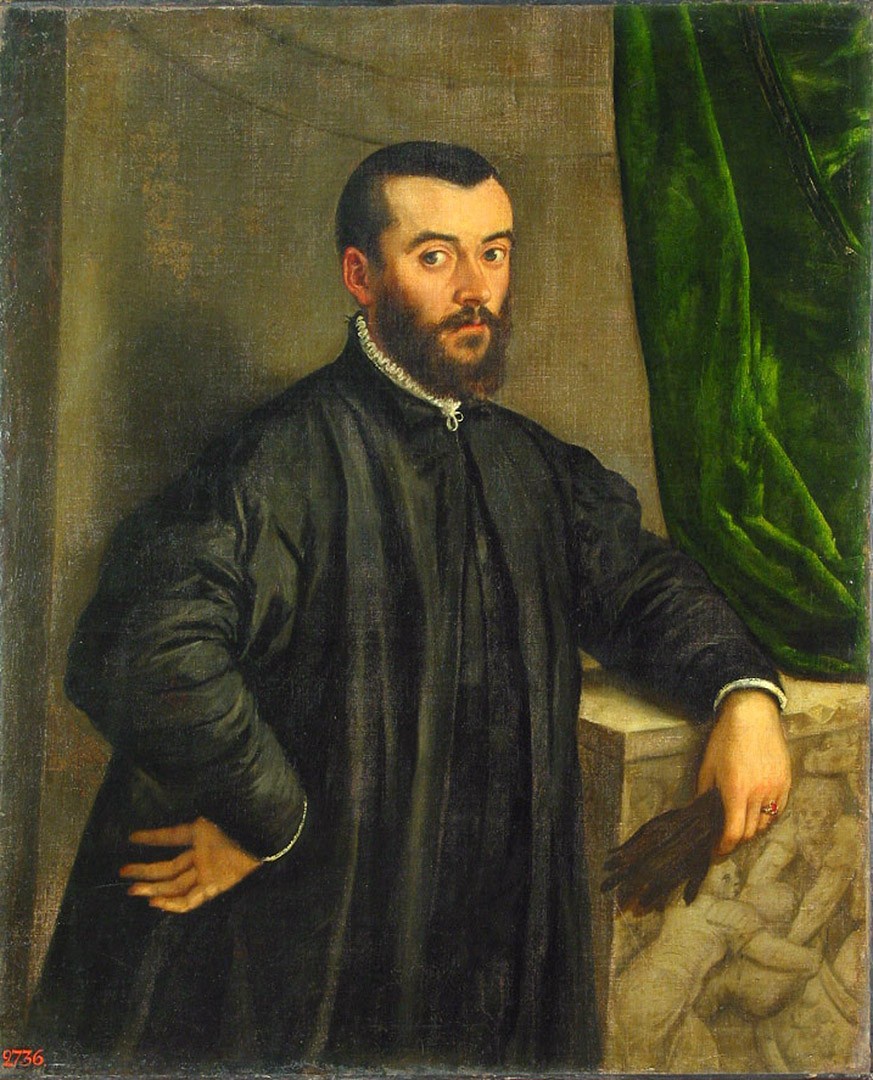
1655 SCHULTES, Johannes [SCULTETUS] (1595 – 1645)
Χειροπλοθήκη seu armamentarium chirurgicum.
Scultetus is famous for his illustrations of surgical procedures and both surgical and dental instruments. With respect to dentistry he describes and illustrates stomatological operations and includes fine illustratio…
GMN 3669.1 · https://historyofmedicine.com/id/6982
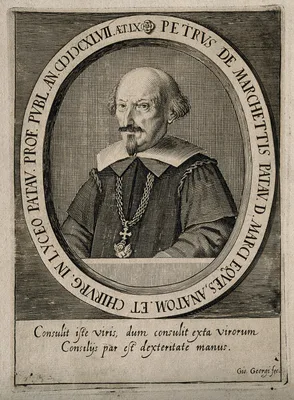
1664 MARCHETTI, Pietro de (1589 – 1673)
Observationum medico-chirurgicarum rariorum sylloge.
Pietro de Marchetti was Professor of Surgery at Padua. His book contains many valuable observations in surgery.\\
GMN 5572 · https://historyofmedicine.com/id/6985
1672 GENGA, Bernardino (1665 – 1734)
Anatomia chirurgica.
First book devoted entirely to surgical anatomy.
GMN 384 · https://historyofmedicine.com/id/591
1676 WISEMAN, Richard (1622 – 1676)
Severall chirurgicall treatises.
Wiseman ranks in surgery as high as does Sydenham in medicine. He made many valuable contributions to the subject; he was the first to describe tuberculosis of the joints (“tumor albus”) and he gave a good account of …
GMN 5573 · https://historyofmedicine.com/id/6989
1679 YONGE, James (1646 – 1721)
Currus triumphalis, è terebinthô. Or an account of the many admirable vertues of oleum terebinthinae. More particularly, of the good effects produced by its application to recent wounds, especially with respect to the hemorrhagies of the veins, and arteries, and the no less pernicious weepings of the nerves, and lymphaducts. Where also, the common methods, and medicaments, used to restrain hemorrhagies, are examined, and divers of them censured. And lastly, A new way of amputation, and a speedier convenient method of curing stumps, than that commonly practised, is with divers other useful matters recommended to the military surgeon.…
Describes how Yonge used turpentine to arrest hemorrhage, and presents the first account of a flap amputation. It also shows that Yonge was familiar with tourniquets. Digital facsimile from Google Books at this link.
GMN 4436 · https://historyofmedicine.com/id/6326
1695 LE CLERC, Charles Gabriel (1644 – 1700)
La chirurgie complète.
This “quiz-compend” passed through eighteen editions. Among other things it mentions the use of vitriol buttons for checking hemorrhage and the mode of manual compression used at the Hôtel-Dieu. English translation, L…
GMN 5574 · https://historyofmedicine.com/id/6991
1703 DEVAUX, Jean (1649 – 1729)
L'art de faire les raports en chirurgie, où l'on ensiegne la pratique, les formules & le stile le plus en usage parmi les chirurgiens commis aux rapports; avec un extrait des arrest, statuts & reglemens faits en consequence.
Digital facsimile from Google Books at this link. (Thanks to Webb Dordick for this reference.)
GMN 14121 · https://historyofmedicine.com/id/16432
1707 DIONIS, Pierre (1643 – 1718)
Cours d’opérations de chirurgie, de demonstrées au Jardin Royal.
Dionis taught operative surgery at the Jardin-du-Roi, Paris, a famous training ground for surgeons. English translation, London, 1710.
GMN 5575 · https://historyofmedicine.com/id/6993
1719 LITTRÉ, Alexis (1658 – 1726)
Observation sur une nouvelle espèce de hernie.
“Littre’s hernia” – so named from his description of diverticulum hernia. Later Richter (No. 3578) described this condition more fully.
GMN 3575 · https://historyofmedicine.com/id/4164
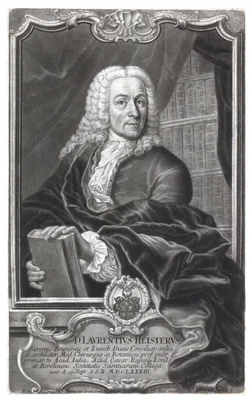
1719 HEISTER, Lorenz (1683 – 1758)
Chirurgie in welcher Alles was zur Wund-Artzney gehöret, nach der neuesten und besten Art gründlich abgehandelt....
Heister was the founder of scientific surgery in Germany. His book contains many interesting illustrations and includes an account of tourniquets used in his time; Heister introduced a spinal brace. This was the most …
GMN 5576 · https://historyofmedicine.com/id/6999
1721 MANGET, Jean-Jacques [Johann Jacob Mangetus] (1652 – 1742)
Bibliotheca chirurgica sive rerum ad artem Machoanicam quoquô spectantium thesaurus absolutissimus quo omnes prorsus humani corporis affectiones chiurgi manum, aut aliam aliquam eiusdem operam exposcentes, ordine alphabetico explicantur. 4 vols.
A compilation of mostly complete surgical treatises, representing what Manget considered an essential surgical library of then-modern as well as classical texts-- a surgical library in 4 large volumes. Digital facsimi…
GMN 11173 · https://historyofmedicine.com/id/13370
1725 BOERHAAVE, Herman (1668 – 1738); VESALIUS, Andreas (1514 – 1564); ALBINUS, Bernhard Siegfried (1697 – 1770)
Opera omnia anatomica & chirurgica. Edited by Herman Boerhaave and Bernhard Siegfried Albinus. 2 vols.
Vesalius's collected works with the famous woodcuts reproduced as copperplate engravings by Jan Wandelaar (1690-1759). Notably Boerhaave and Albinus had this edition published because Vesalius's works still had practi…
GMN 8095 · https://historyofmedicine.com/id/10271
1736 AMYAND, Claudius (1660 – 1740)
Of an inguinal rupture, with a pin in the appendix caeci, incrusted with stone; and some observations on wounds in the guts.
First recorded successful appendectomy. Amyand was Sergeant-Surgeon to George II and first principal surgeon to Westminster Hospital. See also the paper in Surg. Gynec. Obstet., 1953, 97, 643-52, which reproduces part…
GMN 3559 · https://historyofmedicine.com/id/4073
1742 VELSE, Cornelius Henrik
De mutuo intestinorum ingressu.
First recorded successful operation for intussusception in an adult. The paper is also included in Haller’s Disputationes, vol. 1.
GMN 3423 · https://historyofmedicine.com/id/5347
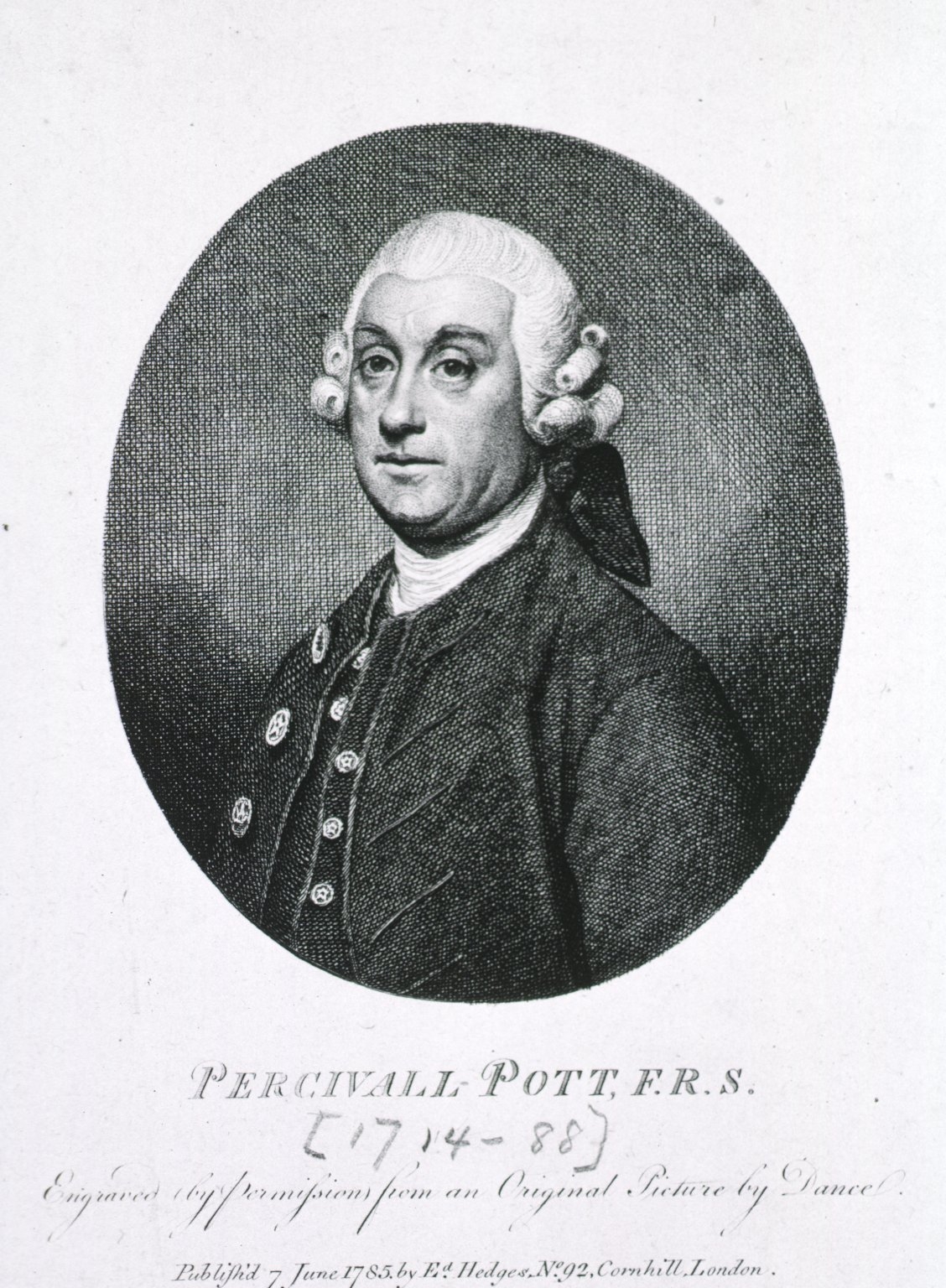
1756 POTT, Percivall (1714 – 1788)
A treatise on ruptures.
Pott was surgeon to St. Bartholomew’s Hospital. Through a fall in the street he was confined to bed for many days, and during that period wrote his classic book on hernia. He refuted many of the old theories concernin…
GMN 3576 · https://historyofmedicine.com/id/4168
1766 SOLDO, Mauro (Soldi)
Descrizione degl'instrumenti, delle macchine, e delle suppellettili raccolte ad uso chirurgico e medico dal P. Don Ippolito Rondinelli...
Catalogue of the private museum of surgical and medical instruments established by Father Ippolito Rondinelli in Ravenna, which Soldo described as “the first museum of medicine and surgery.” Extensively illustrasted. …
GMN 7808 · https://historyofmedicine.com/id/9980
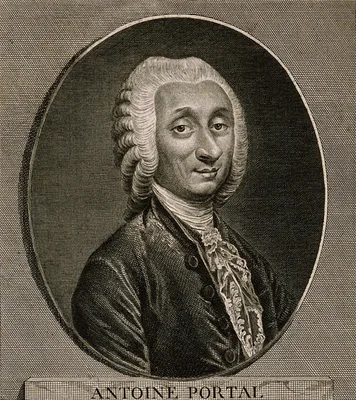
1770 –1773 PORTAL, Antoine (1742 – 1832)
Histoire de l’anatomie et de la chirurgie. 6 vols.
A biobibliographical survey to 1755, including dentistry.
GMN 437.1 · https://historyofmedicine.com/id/1091
1774 PETIT, Jean Louis (1674 – 1750)
Traité des maladies chirurgicales et des opérations qui leur conviennent. 3 vols.
Records (Vol, 1, pp. 153, 160) the first successful operation for mastoiditis, performed by Petit in 1736. “Petit’s hernia” and “triangle” described (vol. 2, pp. 256-58). (See also No. 3357.) A lumbar hernia had previ…
GMN 3357 · https://historyofmedicine.com/id/4731
1774 –1775 HALLER, Albrecht von (1708 – 1777)
Bibliotheca chirurgica. 2 vols
Reprinted, Hildesheim, G. Olms, 1971.
GMN 5789 · https://historyofmedicine.com/id/6862
1774 –1780 PEYRILHE, Bernard (1735 – 1804); DUJARDIN, François (1738 – 1775)
Histoire de la chirurgie depuis son origine jusqu’a nos jours. 2 vols.
Dujardin seems to be the first European to discuss acupuncture within its historical context as an ancient remedy still found to be of practical value. His section on Chinese and Japanese medicine appears on pp. 75-10…
GMN 6374.12 · https://historyofmedicine.com/id/8318
1775 JONES, John [American] (1729 – 1791)
Plain, concise, practical remarks, on the treatment of wounds and fractures; to which is added an appendix, on camp and military hospitals; principally designed for the use of young military surgeons in North America.
The first surgical work written by an American and printed in North America. Jones’s work was the accepted guide to surgical practice during the American Revolutionary War.
GMN 2155 · https://historyofmedicine.com/id/2755
1778 –1779 RICHTER, August Gottlieb (1742 – 1812)
Abhandlung von den Brüchen.
Richter, lecturer on surgery at Göttingen, in his classic treatise on hernia, first described partial enterocele, or “Richter’s hernia” (Chap. 24).
GMN 3578 · https://historyofmedicine.com/id/4178
1778 ABULCASIS (ABU AL-QASIM KHALAF IBN AL-ABBAS AL-ZAHRAWI; أبو القاسم خلف بن العباس الزهراوي), [Albucasis] (936 – 1013); CHANNING, John (1703 – 1775)
De chirurgia. Arabice et Latine cura Johannis Channing. 3 vols.
This parallel Arabic-Latin edition prepared by the apothecary John Channing is the first printed edition in Arabic, and the first modern edition of the text. Digital facsimile of the 1778 edition from Bayerische Staat…
GMN 5550 · https://historyofmedicine.com/id/6849
1778 BELL, Benjamin (1749 – 1806)
A treatise on the theory and management of ulcers.
Important classification of ulcers.
GMN 5578 · https://historyofmedicine.com/id/7002
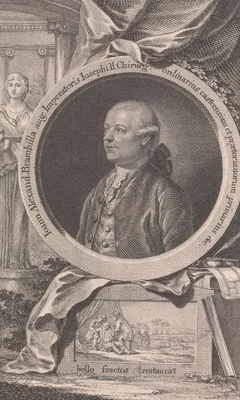
1781 BRAMBILLA, Giovanni Alessandro (1728 – 1800)
Instrumentarium chirurgicum Viennense oder, Wiennerische chirurgische Instrumenten-Sammlung.
Brambilla was a personal physician to Holy Roman Emperor Joseph II and the first director of the Vienna hospital and the Josefinum school for military surgeons (now a medical museum). Brambilla provided a history of s…
GMN 10715 · https://historyofmedicine.com/id/12909
1783 –1788 BELL, Benjamin (1749 – 1806)
A system of surgery. 6 vols.
Bell studied under the Monros at Edinburgh. He was surgeon to the Royal Infirmary, Edinburgh, for 29 years. He improved the methods of amputation, introducing the “triple incision of Bell”. Above is his best work.
GMN 5579 · https://historyofmedicine.com/id/7004
1791 PLAIGNAUD, M.
Observation sur un fongus du sinus maxillaire.
First successful operation on a tumor of the maxillary sinus, 1789.
GMN 3250 · https://historyofmedicine.com/id/3901
1793 GIMBERNAT Y ARBOS, Antonio de (1734 – 1816)
Nuevo método de operar en la hernia crural.
Description of Gimbernat’s operation for strangulated femoral hernia. In the same work he also described the ligament in the crural arch named after him. Gimbernat was a pioneer in ophthalmology, vascular surgery, and…
GMN 3579 · https://historyofmedicine.com/id/4182
1794 HUNTER, John (1728 – 1793)
A treatise on the blood, inflammation, and gun-shot wounds.
It was while serving with the army at Belle Isle during the Seven Years’ War that Hunter collected the material for his epoch-making book on inflammation and gunshot wounds. His studies on inflammation in particular a…
GMN 2283 · https://historyofmedicine.com/id/2900
1798 –1799 BICHAT, Marie François Xavier (1771 – 1802); DESAULT, Pierre-Joseph (1744 – 1795)
Oeuvres chirurgicales de P. J. Desault....ou tableau de sa doctrine & de sa pratique dans le traitement des maladies externes. Ouvrage publié par Xav. Bichat, son èlève. 3 vols.
Desault was one of the first professors at the École Pratique de Chirurgie, Paris. He made many suggestions regarding the treatment of fractures and dislocations and is one of the founders of modern vascular surgery. …
GMN 2927 · https://historyofmedicine.com/id/7007
1801 CAMPER, Petrus (Pieter) (1722 – 1789)
Icones herniarum. Editae a S. T. Soemmerring.
Camper illustrated his own work, and was an outstanding anatomical artist. His illustrations of hernias are of great value.
GMN 3580 · https://historyofmedicine.com/id/4187
1801 SAUCEROTTE, Nicolas (1741 – 1814)
Accroissement singulier en grosseur des os d’un homme âgé de 39 ans. In: Mélanges de chirurgie, 407-11.
Saucerotte described before the Académie de Chirurgie in 1772 a case of what is now known to have been acromegaly. This is the first known clinical description of the disease, and is one of the five cases included in …
GMN 3880 · https://historyofmedicine.com/id/4942
1801 –1808 BELL, John (1763 – 1820)
The principles of surgery. 3 vols.
John Bell, the Scottish anatomist and brother of Charles Bell, is regarded as a founder of surgical anatomy. He was first to ligate the gluteal artery (Vol. I, pp, 421-26), and tied the common carotid and internal ili…
GMN 2926 · https://historyofmedicine.com/id/7011
1803 HEY, William (1736 – 1819)
Practical observations in surgery.
Hey is remembered for “Hey’s saw” and “Hey’s internal derangement of the knee,” a phrase that he coined. He was an outstanding surgeon in his day; he founded and was senior surgeon of the General Infirmary, Leeds. He …
GMN 4308.1 · https://historyofmedicine.com/id/5506
1804 ABERNETHY, John (1764 – 1831)
Surgical observations, containing a classification of tumours, with cases to illustrate the history of each species; - an account of diseases which strikingly resemble the venereal disease; - and various cases illustrative of different surgical subjects.
Abernethy published the first classification of tumors based on pathologic anatomy. "Abernethy is best known for his lectures and writings on surgery and for the first attempt at classification of tumors, some of whic…
GMN 13225 · https://historyofmedicine.com/id/15489
1805 FINE, Pierre (1760 – 1814)
Mémoire et observation sur l’entérotomie.
The first recorded colostomy for intestinal obstruction was performed by Fine in 1797. The patient survived 3.5 months.
GMN 3430 · https://historyofmedicine.com/id/5381
1805 SMITH, Thomas (1785 – 1831)
An essay on wounds of the intestines.
The first serious attempt at repairing intestinal injuries in America, and the first use of dogs for experimental surgery in America.
GMN 3430.1 · https://historyofmedicine.com/id/5384
1806 HESSELBACH, Franz Kaspar (1759 – 1816)
Anatomisch-chirurgische Abhandlung über den Ursprung der Leistenbrüche
Includes description of “Hesselbach’s hernia” and “triangle”. He wrote a further volume on the subject in 1814.
GMN 3582 · https://historyofmedicine.com/id/5360
1807 COOPER, Sir Astley Paston (1768 – 1841)
The anatomy and surgical treatment of inguinal and congenital hernia. London, Cox, 1804. The anatomy and surgical treatment of crural and umbilical hernia.
Cooper’s first book, luxuriously produced, in which he described for the first time the transversalis fascia, with full appreciation of its importance in hernia, as well as the superior pubic ligament with bears his n…
GMN 3581 · https://historyofmedicine.com/id/4191
1807 –1809 BELL, Sir Charles (1774 – 1842)
A system of operative surgery. 2 vols.
Famous as anatomist, physiologist, and neurologist, Charles Bell was also, like his brother John, an eminent surgeon. His artistic talent was even greater than that of his brother. (See No. 5588.)
GMN 5583 · https://historyofmedicine.com/id/7019
1809 SCARPA, Antonio (1752 – 1832)
Sull’ernie. Memorie anatomico-chirurgiche.
This splendidly illustrated work with life-size plates includes the description of “Scarpa’s fascia” (creasteric fascia) and Scarpa’s triangle of the thigh.
GMN 3583 · https://historyofmedicine.com/id/4258
1809 ABERNETHY, John (1764 – 1831)
Surgical observations on the constitutional origin and treatment of local diseases.
A pupil of John Hunter, Abernethy became a leading surgeon in London. He was most industrious, and it is said that not even on his wedding day did he fail to give his usual daily lecture at St. Bartholomew’s Hospital.…
GMN 2928 · https://historyofmedicine.com/id/7021
1809 COOPER, Samuel (1780 – 1848)
A dictionary of practical surgery.
Cooper was surgeon on the field at Waterloo, and was later appointed to the chair of surgery at University College, London. His great dictionary went through seven editions during his lifetime and was translated into …
GMN 5585 · https://historyofmedicine.com/id/7027
1810 MERREM, Daniel Carl Theodor (1790 – 1859)
Animadversiones quaedam chirurgicae experimentis in animalibus factis illustratae.
Experimental excision of the pylorus.
GMN 3431 · https://historyofmedicine.com/id/5387
1812 PARKINSON, John William Keys (1785 – 1838)
Case of diseased appendix vermiformis.
First case of appendicitis reported in English, and the first in which perforation was recognized as the cause of death. John Parkinson was the son of James Parkinson (No. 4690).
GMN 3560 · https://historyofmedicine.com/id/4074
1812 TRAVERS, Benjamin (1783 – 1858)
An inquiry into the process of nature in repairing injuries of the intestines.
Travers’s researches on intestinal sutures recorded the first accurate knowledge on this subject.
GMN 3433 · https://historyofmedicine.com/id/5395
1813 DORSEY, John Syng (1783 – 1818)
Elements of surgery; for the use of students. 2 vols.
The first systematic treatise on surgery written by an American. The work is notable for containing not only Dorsey’s original contributions, but for its publication of the work of Dorsey’s uncle and teacher, the pion…
GMN 5585.1 · https://historyofmedicine.com/id/7030
1816 PHYSICK, Philip Syng (1768 – 1837)
Buck-skin and kid ligatures
Physick, the “Father of American surgery”, graduated at Edinburgh, having been a pupil of John Hunter. He introduced several new procedures in surgery, one of which was the use of absorbable kid and buckskin ligatures…
GMN 5586 · https://historyofmedicine.com/id/8957
1817 CLOQUET, Jules Germain (1790 – 1883)
Recherches anatomiques sur les hernies de l’abdomen.
This is Cloquet’s medical thesis. It was followed by his thesis in competition for head of the anatomy section of the Paris Faculty: Recherches sur les causes et l’anatomie des hernies abdominales. Paris, Méquignon-Ma…
GMN 3585 · https://historyofmedicine.com/id/4267
1818 –1819 COOPER, Sir Astley Paston (1768 – 1841); TRAVERS, Benjamin (1783 – 1858)
Surgical essays. 2 vols.
Cooper, the pupil and great interpreter of Hunter, was the most popular surgeon in London during the Regency. In 1802 he gained the Copley Medal of the Royal Society. Travers was surgeon to St. Thomas’s Hospital, and …
GMN 2941 · https://historyofmedicine.com/id/7037