1809 BURNS, Allan (1781 – 1813)
Observations on some of the most frequent and important diseases of the heart.
Burns described endocarditis and reported three cases of mitral stenosis. He recognized the thrill present in the latter condition and seems to have understood the mechanism of a cardiac murmur. He also described unil…
GMN 2738 · https://historyofmedicine.com/id/8654
1824 AUENBRUGGER, Leopold (1722 – 1809); FORBES, Sir John (1788 – 1861)
Original cases with dissections and observations illustrating the use of the stethoscope and percussion in the diagnosis of diseases of the chest: Also commentaries on the same subjects selected and translated from Auenbrugger, Corvisart, Laennec and others
This is the earliest English work on the stethoscope. It "includes the first English translation of Auenbrugger's book on percussion, selected sections from Laennec's book on auscultation, and detailed reports from 39…
GMN 11599 · https://historyofmedicine.com/id/13798
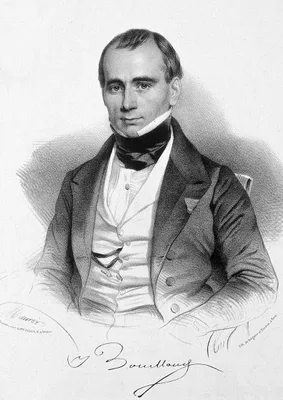
1835 BOUILLAUD, Jean Baptiste (1796 – 1881)
Traité cliniques des maladies du coeur. 2 vols.
Bouillaud applied Laennec's technique of auscultation to diseases of the heart. Vol. 2, page 238: “Bouillaud’s disease” – rheumatic endocarditis. Although not first to note the cardiac manifestations of acute rheumati…
GMN 2749 · https://historyofmedicine.com/id/4633
1843 FAUVEL, Sulpice Antoine (1813 – 1884)
Mémoire sur les signes stethoscopiques du rétrécissement de l’orifice auriculo-ventriculaire gauches du coeur.
First description of the presystolic murmur in mitral stenosis. Partial English translation in No. 2241.
GMN 2754 · https://historyofmedicine.com/id/4647
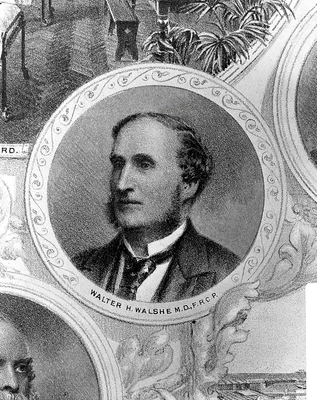
1851 WALSHE, Walter Hayle (1812 – 1892)
A practical treatise on the diseases of the lungs and heart, including the principles of physical diagnosis.
Walshe, physician to University College Hospital, London, was one of the first to recognize the presystolic character of the direct mitral murmur in mitral stenosis.
GMN 2757 · https://historyofmedicine.com/id/4661
1854 VIERORDT, Karl von (1818 – 1884)
Die bildliche Darstellung des menschlichen Arterienpulses.
Vierordt invented a sphygmograph which acted on the principle that indirect estimation of blood-pressure could be accomplished by measuring the counter-pressure necessary to obliterate the arterial pulsation. This was…
GMN 2759 · https://historyofmedicine.com/id/1760
1860 MAREY, Étienne Jules (1830 – 1904)
Recherches sur le pouls au moyen d’un nouvel appareil enregistreur le sphygmographe.
Invention of the modern sphygmograph. Also published in C.R. Acad. Sci. (Paris), 1860, 51, 281-309. Preliminary paper in same journal, 1860, 50, 634-37.
GMN 776 · https://historyofmedicine.com/id/1763
1861 DUROZIEZ, Paul Louis (1826 – 1897)
Du double souffle intermittent crural, comme signe de l’insuffisance aortique.
The double intermittent murmur over the femoral arteries, diagnostic of aortic insufficiency, has become known as “Duroziez’s sign.” Partial English translation in No. 2241.
GMN 2762 · https://historyofmedicine.com/id/4685
1861 GAIRDNER, Sir William Tennant (1824 – 1907)
Short account of cardiac murmurs.
The murmur which Fauvel (No. 2754) had called “presystolic” was described by Gairdner, who called it “auricular-systolic.” This paper is important as being largely responsible for the recognition in Britain of the pre…
GMN 2763 · https://historyofmedicine.com/id/4687
1862 FLINT (ELDER), Austin (1812 – 1886)
On cardiac murmurs.
First description of the “Austin Flint murmur,” present at the apex beat in aortic regurgitation. Reprinted in Med. Classics, 1940, 4, 864-900.
GMN 2764 · https://historyofmedicine.com/id/4689
1863 MAREY, Étienne Jules (1830 – 1904); CHAUVEAU, Jean Baptiste Auguste (1827 – 1917)
Appareils et expériences cardiographiques.
First direct records of the heart impulse by means of a “cardiac sound” and the sphygmograph – recording tambours, which wrote on a moving drum covered with smoked paper.
GMN 816 · https://historyofmedicine.com/id/235
1868 BERNSTEIN, Julius (1839 – 1917)
Über den zeitlichen Verlauf der negativen Schwankung des Nervenstroms.
Bernstein introduced the differential rheotome, and the first electrocardiograms were obtained with it by Marchand in 1877 (No. 823.1).
GMN 819.1 · https://historyofmedicine.com/id/247
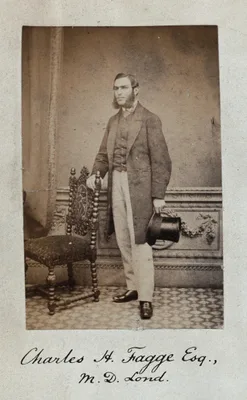
1871 FAGGE, Charles Hilton (1838 – 1883)
On the murmurs attendant on mitral contraction.
Important and exhaustive account of the knowledge of presystolic murmurs. Fagge’s paper also includes many clinical observations relating to the rhythm of heart murmurs and the state of the sounds of the heart in 67 c…
GMN 2771 · https://historyofmedicine.com/id/4711
1877 MARCHAND, Richard
Beiträge zur Kenntniss der Reizwell und Contractionswelle des Herzmuskels.
Marchand obtained the first electrocardiogram. Using the differential rheotome he measured the time course of the potential variations from the frog’s heart.
GMN 823.1 · https://historyofmedicine.com/id/271
1879 ROGER, Henri-Louis (1809 – 1891)
Recherches cliniques sur la communication congénitales des deux coeurs par inocclusion du septum intervenniculare.
Roger drew attention to an important anomaly of the septum, interventricular patency (“maladie de Roger”), demonstrating the presence of a murmur in this condition. This is sometimes called “Roger’s murmur”, although …
GMN 2782 · https://historyofmedicine.com/id/3376
1880 WALDENBURG, Louis (1837 – 1881)
Die Messung des Pulses und des Blutdrucks am Menschen.
Probably the first book published on the messurement blood pressure in mankind. Mostly concerned with normal physiologic conditions, with a small section on fluctuations in illness. Digital facsimile from Google Books…
GMN 11721 · https://historyofmedicine.com/id/13922
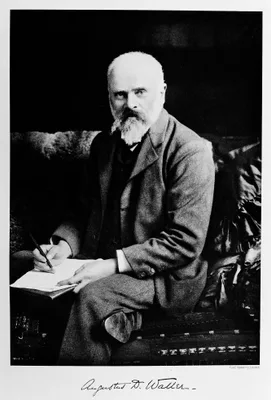
1887 WALLER, Augustus Désiré (1856 – 1922)
A demonstration on man of electromotive changes accompanying the heart’s beat.
Waller was first to use electrodes and leads in demonstrating the action currents of the heart, avoiding the necessity of opening the chest of laboratory animals and preparing the way for present-day clinical electroc…
GMN 833 · https://historyofmedicine.com/id/329
1888 –1889 STEELL, Graham (1851 – 1942)
The murmur of high-pressure in the pulmonary artery.
First description of the pulmonary diastolic murmur – the “Graham Steell murmur.” Reproduced in Willius & Keys, Cardiac Classics, 1941, pp. 680-85.
GMN 2794 · https://historyofmedicine.com/id/3408
1889 POTAIN, Pierre Charles Édouard (1825 – 1901)
Du sphygmomanomètre et de la mésure de la pression artérielle chez l’homme à l’état normale et pathologique.
Potain devised a simple portable air sphygmomanometer for blood-pressure estimation.
GMN 2798 · https://historyofmedicine.com/id/3419
1895 MOSSO, Angelo (1846 – 1910)
Sphygmomanomètre pour mésurer la pression du sang chez l’homme.
A sphygmomanometer for registering the blood-pressure in the finger was invented by Mosso.
GMN 2801 · https://historyofmedicine.com/id/3425
1897 HILL, Sir Leonard Erskine (1866 – 1952); BARNARD, Harold Leslie (1868 – 1908)
A simple and accurate form of sphygmomanometer or arterial pressure gauge contrived for clinical use.
Hill and Barnard made an important modification to the Riva-Rocci sphygmomanometer when they substituted a pressure gauge in place of the mercury manometer used for pressure readings.
GMN 2807 · https://historyofmedicine.com/id/3446
1901 EINTHOVEN, Willem (1860 – 1927)
Un nouveau galvanomètre.
Einthoven directed much of his research to the development and perfection of recording instruments. His most famous work was in connexion with his string galvanometer, a perfection of the instrument invented by J. S. …
GMN 840 · https://historyofmedicine.com/id/598
1902 EINTHOVEN, Willem (1860 – 1927)
Galvanometrische registratie van het menschelijk electrocardiogram IN: Herinneringsbundel Prof. S.S. Rosenstein, pp.101-106.
First description of Einthoven's string galvanometer that recorded electrical changes occurring in the human heart. Includes the first illustration of an EKG (ECG) recording. Modern electrocardiography became a realit…
GMN 842 · https://historyofmedicine.com/id/618
1905 KOROTKOV, Nikolai Sergeievich (1874 – 1920)
On methods of studying blood pressure.
Korotkov introduced the modern method of applying the stethoscope to the brachial artery during blood-pressure examination with Riva-Rocci’s sphygmomanometer, for the purpose of investigating the sounds made by the bl…
GMN 2818 · https://historyofmedicine.com/id/3498
1906 CREMER, Max (1865 – 1935)
Über die direkte Ableitung der Aktionsströme des menschlichen Herzens vom Oesophagus und über das Elektrokardiogramm des Fötus.
Fetal electrocardiogram recorded. Cremer was also the first to record an electrocardiogram with an electrode in the esophagus.
GMN 843.1 · https://historyofmedicine.com/id/624
1906 KRILOFF, Dmitri Dmitrievich (1879 – )
[In Russian:] Estimation of blood-pressure by Korotkov’s auditory method.
Kriloff made extensive observations on the sounds which Korotkov had shown to be emitted by the blood after removal of the Riva-Rocci air-pressure cuff during the blood-pressure measurement.
GMN 2823 · https://historyofmedicine.com/id/3528
1906 EINTHOVEN, Willem (1860 – 1927)
Het telecardiogram.
This paper includes the first published ECG tracing of atrial fibrillation. See W. Bruce Fye, "Tracing atrial fibrillation - 100 years," New Eng. J. Med., 355 (2006) 1412.
GMN 11589 · https://historyofmedicine.com/id/13788
1907 FELLNER, Bruno
Neuerung zur Messung des systolischen und diastolischen Druckes.
Fellner suggested the use of the stethoscope in the measurement of systolic and diastolic pressure.
GMN 2825 · https://historyofmedicine.com/id/3534
1909 SAMOJLOFF, A.
Elektrokardiogramme.
This 37-page pamphlet was the earliest collection of information regarding electrocardiography. It contained "only single lead electrocardiograms, limited to mitral stenosis and hypertrophy of the right and left venti…
GMN 11680 · https://historyofmedicine.com/id/13881
1910 EPPINGER, Hans (1879 – 1946); ROTHBERGER, Carl Julius (1871 – 1945)
Ueber die Folgen der Durchschneidung der Tawaraschen Schenkel der Reizleitungssystems.
First experimental study of the electrocardiographic changes in bundle-branch block. "Later, as professor and director of the internal clinic at the Allgemeines Krankenhaus in Vienna, Eppinger became one of the most n…
GMN 848 · https://historyofmedicine.com/id/638
1910 EPPINGER, Hans (1879 – 1946); STOERK, Oscar (1870 – 1926)
Zur Klinik des Elektrokardiogramms.
First clinical and pathological description of bundle-branch block.
GMN 2832 · https://historyofmedicine.com/id/3554
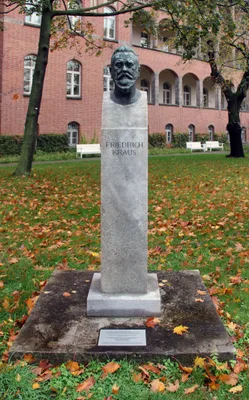
1910 KRAUS, Friedrich (1858 – 1936); NICOLAI, Georg Friedrich (1874 – 1964)
Das Elektrokardiogramm des gesunden and kranken Menschen.
The first comprehensive monograph on electrocardiography in any language.
GMN 11674 · https://historyofmedicine.com/id/13875
1910 JAMES, Walter B.; WILLIAMS, Horatio Burt (1877 – 1955)
The electrocardiogram in clinical medicine: The string galvanometer and the electrocardiogram in health.
The first clinical paper on electrocardiography to appear in an American journal (Burch & DePasquale, A History of Electrocardiography,1990, 163.) James and Williams "published the first ECG recordings in the western …
GMN 12255 · https://historyofmedicine.com/id/14470
1911 LEWIS, Sir Thomas (1881 – 1945)
The mechanism of the heartbeat: With special reference to its clinical pathology.
Sir Thomas Lewis was a pioneer in the application of electrocardiography to clinical medicine. His book was both an exhaustive treatise on the subject for its time, and a valuable bibliographical source. Second editio…
GMN 2851 · https://historyofmedicine.com/id/709
1912 LEWIS, Sir Thomas (1881 – 1945)
Electro-cardiography and its importance in the clinical examination of heart affections.
GMN 2840 · https://historyofmedicine.com/id/3586
1913 LEWIS, Sir Thomas (1881 – 1945)
Clinical electrocardiography.
The first textbook of electrocardiography.
GMN 11679 · https://historyofmedicine.com/id/13880
1918 SMITH, Fred M. (1888 – 1946)
The ligation of coronary arteries with electrocardiographic study.
GMN 852 · https://historyofmedicine.com/id/667
1919 HERRICK, James Bryan (1861 – 1954)
Thrombosis of the coronary arteries.
"...includes electrocardiographic tracings of a 42-year-old physician who died "after coronary obstructive symptoms" and of a dog following experimental ligation of a coronary artery. This finding "led Herrick to conc…
GMN 12248 · https://historyofmedicine.com/id/14463
1920 PARDEE, Harold Ensign Bennett (1886 – 1972)
An electrocardiographic sign of coronary artery obstruction.
First description of the typical changes in the electrocardiogram in coronary thrombosis.
GMN 2852 · https://historyofmedicine.com/id/3633
1920 MANN, Hubert (1891 – 1975)
A method of analyzing the electrocardiogram.
Mann developed the monocardiogram while a fourth-year medical student. This was the first vector loop and the beginning of modern vectorcardiography.
GMN 2853.1 · https://historyofmedicine.com/id/3639
1923 BERBERICH, Josef (1897 – ); HIRSCH, S
Die Röntgenographische Darstellung der Arterien und Venen am lebenden Menschen.
Arteriography. First angiogram of a living patient.
GMN 2916 · https://historyofmedicine.com/id/4895
1924 BROOKS, Barney (1884 – 1952)
Intra-arterial injection of sodium iodide: Preliminary report.
Clinical angiography.
GMN 2916.1 · https://historyofmedicine.com/id/4897
1924 BROOKS, Barney (1884 – 1952); JOSTES, F. A.
A clinical study of diseases of the circulation of the extremities; a description of a new method of examination.
Femoral arteriography.
GMN 2916.2 · https://historyofmedicine.com/id/4898
1928 ROESLER, Hugo (1899 – 1961)
Beiträge zur Lehre von den angeborenen Herzfehlern.
Roesler described the most important roentgenologic sign of aortic coarctation.
GMN 2856.1 · https://historyofmedicine.com/id/3649
1929 SANTOS, Reynaldo dos (1880 – 1970); ET AL
L’artériographie des membres de l’aorte et de ses branches abdominales.
Aortography. With A. C. Lamas and J. Pereira Caldas. Also published in Bull. Soc.méd.chir. Paris, 1929, 55,587-601.
GMN 2859 · https://historyofmedicine.com/id/3656
1931 PEARSE, Herman Elwyn (1899 – ); WARREN, Stafford Leak (1896 – 1981)
The roentgenographic visualization of the arteries of the extremities in peripheral vascular disease.
GMN 2919.1 · https://historyofmedicine.com/id/4906
1931 SANTOS, Reynaldo dos (1880 – 1970); CALDAS, Jose Guilherme Mendes Pereira
Les dérivés du thorium dans l’artériographie des membres.
Thorotrast first used in arteriography.
GMN 2920 · https://historyofmedicine.com/id/4909
1932 WOLFERTH, Charles Christian (1887 – 1965); WOOD, Francis Clark (1901 – 1990)
The electrocardiographic diagnosis of coronary occlusion by the use of chest leads.
Introduction of chest leads.
GMN 2863 · https://historyofmedicine.com/id/4132
1933 TARR, Leonard (1901 – ); ET AL
The circulation time in various clinical conditions determined by the use of sodium dehydrocholate.
Use of decholin sodium for estimation of circulation time. With B. S. Oppenheimer and R. V. Sagar.
GMN 2718 · https://historyofmedicine.com/id/4443
1934 WILSON, Frank Norman (1890 – 1952); ET AL
Electrocardiograms that represent the potential variations of a single electrode.
Unipolar leads. With F. D. Johnston, A. G. MacLeod, and P. S. Barker.
GMN 2864 · https://historyofmedicine.com/id/4137