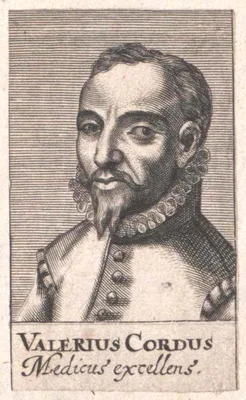
1561 DIOSCORIDES, Pedanius [Πεδάνιος Διοσκουρίδης] (40 – 90); GESNER, Conrad [Konrad Gessner] (1516 – 1565); CORDUS, Valerius (1515 – 1544)
In hoc volumine continentur Valerii Cordi ... Annotationes in Pedacii Dioscoridis Anazarbei De medica materia libros V : longè aliae quàm ante hac sunt evulgatae. Ejusdem Val. Cordi Historiae stirpium Lib. IIII. posthumi, nunc primùm in lucem editi, adjectis etiam stirpium iconibus, & brevissimus annotatiunculis. Sylva, qua rerum fossilium in Germania plurimarum, metallorum, lapidum & stirpium aliquot rariorum notitiam brevissimè persequitur, nunquam hactenus visa. De artificiosis extractionibus liber. Compositiones medicinales aliquot, non vulgares. His accedunt Stocc-Hornii et Nessi in Bernatium Helvetiorum ditione montium, & nascentium in eis stirpium, descriptio Benedicti Aretii ... Item Conradi Gesneri De hortus Germaniae, liber recens, unà cum descriptione tulipae turcarum, chamaecerasi montani, chamaemespili, chamaenerii, & conozoidis ... Omnia summa studio atque industria ... Conr. Gesneri ... collecta, & praefationibus illustrata.
This work not only updated the species listed by Dioscorides, but also listed about 500 new species of plants. Published posthumously, the work was carefully edited by Conrad Gesner. Cordus was the inventor of phytogr…
GMN 1814 · https://historyofmedicine.com/id/2022
1846 BIGELOW, Henry Jacob (1818 – 1890)
Insensibility during surgical operations produced by inhalation.
William T. G. Morton used ether as an anesthetic for the first time on 16 October 1846 during at operation by John Collins Warren to remove a benign angioma under the jaw of a patient at Massachusetts General Hospital…
GMN 5651 · https://historyofmedicine.com/id/7292
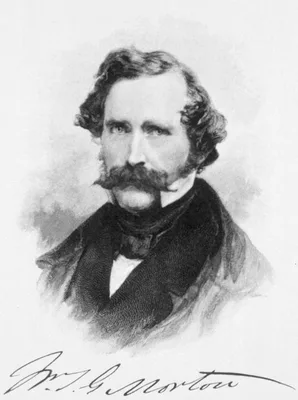
1846 MORTON, William Thomas Green (1819 – 1868)
Circular. Morton’s Letheon.
Unaware of Crawford Long’s results with ether, Morton, having been informed of the anesthetic effects of ether by Charles T. Jackson, promoted its anesthetic effects. To do so he published the above circular, in which…
GMN 5652 · https://historyofmedicine.com/id/7293
1846 MORTON, William Thomas Green (1819 – 1868); JACKSON, Charles Thomas (1805 – 1880)
U. S. Patent No. 4848. The United States of America. To all to whom these Letters Patent shall come.... November 12, 1846.
U.S. Patent No. 4848, issued to Charles T. Jackson and William T. G. Morton on November 12, 1846 for the discovery of sulfuric ether as a surgical anesthetic. This was the first truly significant medical patent ever i…
GMN 7310 · https://historyofmedicine.com/id/9480
1846 BIGELOW, Henry Jacob (1818 – 1890); MORTON, William Thomas Green (1819 – 1868)
Animal magnetism superceded: Discovery of a new hypnopoietic.
The first publication in England of the discovery of ether anesthesia appeared in the "Medical Intelligence" section of the London Medical Gazette on December 18, 1846. Prior to Fulton & Stanton's discovery of this ar…
GMN 11914 · https://historyofmedicine.com/id/14119
1847 MORTON, William Thomas Green (1819 – 1868)
Remarks on the proper mode of administering sulphuric ether by inhalation.
This 44-page pamphlet was the first American manual on the administration of anesthesia. In it Morton announced that his method of producing anesthesia was obtained by the inhalation of sulphuric ether. He subsequentl…
GMN 5653 · https://historyofmedicine.com/id/7294
1847 FLOURENS, Marie Jean Pierre (1794 – 1867)
Note touchant l’action de l’ether sur les centres nerveux.
On 8 March 1847, Flourens announced that chloroform had an anesthetic effect analogous to that of ether. Little notice seems to have been taken of his paper, but later in the year Simpson independently demonstrated th…
GMN 5654 · https://historyofmedicine.com/id/7295
1847 PIROGOV, Nikolai Ivanovich (Pirogoff) (1810 – 1881)
Nouveau procédé pour produire, au moyen de la vapeur d’éther, l’insensibilité chez les individus soumis à des opérations chirurgicales.
Pirogov was the first to practise rectal etherization, suggested by Roux earlier in 1847.
GMN 5655 · https://historyofmedicine.com/id/7296
1847 PIROGOV, Nikolai Ivanovich (Pirogoff) (1810 – 1881)
Recherches pratiques et physiologiques sur l’éthérisation.
Pirogov, the great military surgeon, was with Syme the first in Europe to adopt ether anesthesia, and he left an interesting account of his experiences with it. Digital facsimile from the Hathi Trust at this link.
GMN 5656 · https://historyofmedicine.com/id/7297
1847 ROBINSON, James (1813 – 1862)
A treatise on the inhalation of the vapour of ether, for the prevention of pain in surgical operations; containing a numerous collection of cases in which it has been applied, with the names of the operators; history of the discovery - description of the apparatus - method of preparing the ether - remarks as to the time when the operation should commence, etc., etc., etc.
The first textbook of ether anesthesia, published in March, 1847. Robinson, a British dentist, was the first to use anesthesia in England, after receiving information from Henry Jacob Bigelow and Francis Boott. Digita…
GMN 5657.1 · https://historyofmedicine.com/id/7299
1847 SNOW, John (1813 – 1858)
On the inhalation of the vapour of ether in surgical operations.
Includes an account of Snow’s regulating inhaler, the first to control the amount of ether vapor by the patient. This pamphlet, which appeared in October 1847, was the second treatise on ether anesthesia, after Robins…
GMN 5658 · https://historyofmedicine.com/id/7300
1847 –1848 SYME, James (1799 – 1870)
On the use of ether in the performance of surgical operations.
Syme was, with Pirogov, the first in Europe to adopt ether anesthesia in surgical operations.
GMN 5659 · https://historyofmedicine.com/id/7301
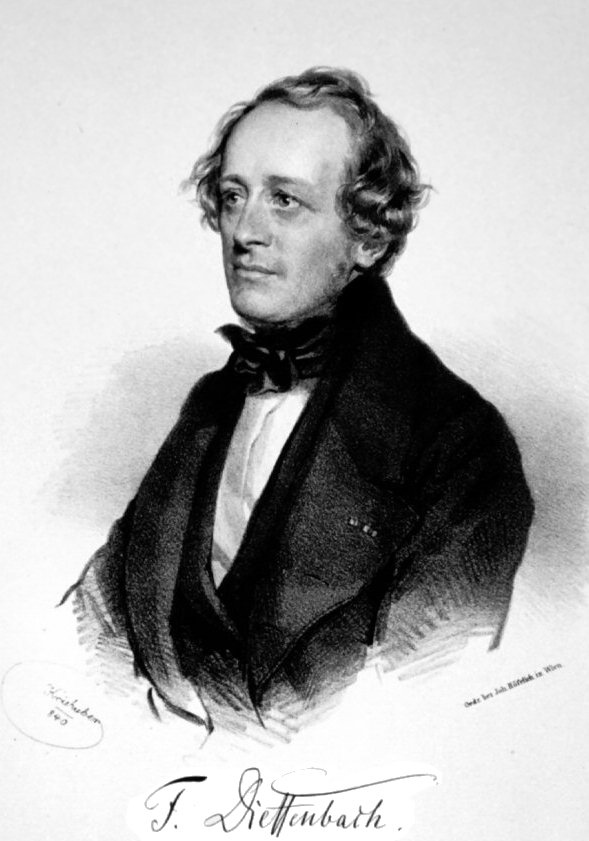
1847 DIEFFENBACH, Johann Friedrich (1792 – 1847)
Die Aether gegen den Schmerz.
First application of ether anesthesia for plastic operations. Dieffenbach made his first use of the anesthetic in reconstructing a nose. He modified Morton’s inhaler. Dieffenbach’s work helped bring about the early ac…
GMN 5659.1 · https://historyofmedicine.com/id/7302
1847 WELLS, Horace (1815 – 1848)
A history of the discovery of the application of nitrous oxide gas, ether, and other vapours, to surgical operations.
In 1844 Wells, a Hartford dentist, successfully used nitrous oxide as a dental anesthetic. To publicize his discovery, he arranged a demonstration at Harvard Medical School in January 1845, but this proved a fiasco. W…
GMN 5660 · https://historyofmedicine.com/id/7303
1847 JACKSON, Charles Thomas (1805 – 1880)
Première Lettre. Boston, le 13 november 1846.
Jackson, a physician, geologist and chemist in Boston, wrote this letter to Élie de Beaumont in Paris on November 13, 1846, the day after he and William T. G. Morton jointly received U.S. Patent No. 4848 for Improveme…
GMN 7249 · https://historyofmedicine.com/id/9418
1847 BOOTT, Francis (1792 – 1863)
Surgical operations performed during insensibility, produced by the inhalation of sulphuric ether.
The first use of ether as an anesthetic in Britain (for a dental procedure) was conducted in Boott's house at 24 Gower Street on 19 December 1846. Boott issued the second announcement of ether anesthesia published in …
GMN 7882 · https://historyofmedicine.com/id/10054
1847 HAYWARD, George (1791 – 1863)
Some account of the first use of sulphuric ether by inhalation in surgical practice. [Read before the Boston Society for Medical Improvement, April 12, 1847.]
Hayward's case report of the first major operation performed under ether anesthesia, which he performed at the Massachusetts General Hospital on November 7, 1846, three weeks after Warren's first operation using ether…
GMN 11913 · https://historyofmedicine.com/id/14118
1847 LONGET, François Achille (1811 – 1871)
Experiences relatives aux effets de l'inhalation de l'ether sulfurique sur le systême nerveux. (Mémoire lu à l'Académie Royale de Medicine)
The first scientific analysis of the effects of ether anesthesis. Though ether anesthesia was invented in America, its inventors and early users were either scientifically untrained like Morton, or men of practical sc…
GMN 12870 · https://historyofmedicine.com/id/15117
1847 SNOW, John (1813 – 1858)
On the inhalation of the vapour of ether.
Appearing in March, 1847, this was Snow's first publication on anesthesia. It contains the first description and illustration of his regulating inhaler, the first such device to control the amount of ether vapor recei…
GMN 12954 · https://historyofmedicine.com/id/15201
1848 BIGELOW, Henry Jacob (1818 – 1890)
Ether and chloroform: a compendium of their history, surgical use, dangers and discovery.
Bigelow’s speedy publication of Morton’s discovery (No. 5651), and his subsequent advocacy of ether as an anesthetic assured its adoption throughout the civilized world. The above work deals with the priority claims o…
GMN 5730 · https://historyofmedicine.com/id/6486
1848 CHANNING, Walter (1786 – 1876)
A treatise on etherization in childbirth.
Channing was an early advocate of anesthesia in obstetrics. In his book, and in several earlier papers, he brought the importance of this branch of anesthesia into the foreground.
GMN 5661 · https://historyofmedicine.com/id/7304
1848 SNOW, John (1813 – 1858)
On the inhalation of chloroform and ether. With description of an apparatus.
Snow’s chloroform inhaler.
GMN 5663 · https://historyofmedicine.com/id/7310
1848 WARREN, John Collins (1778 – 1856)
Etherization: With surgical remarks.
Warren performed the first surgical operation under anesthesia at Massachusetts General Hospital on October 16, 1846. This work presents his experience with anesthesia in the year following. Digital facsimile from U.S…
GMN 11727 · https://historyofmedicine.com/id/13928
1849 LONG, Crawford Williamson (1815 – 1878)
An account of the first use of sulphuric ether by inhalation as an anaesthetic in surgical operations.
There is no doubt that Long was the first successfully to use ether vapor as an anesthetic. This was on 30 March 1842, at Jefferson, Georgia. Unfortunately he did not publish his results until others, notably Morton, …
GMN 5664 · https://historyofmedicine.com/id/7313
1858 RICHARDSON, Sir Benjamin Ward (1828 – 1896); SNOW, John (1813 – 1858)
On chloroform and other anaesthetics: Their action and administration. Edited, with a memoir of the author, by Benjamin W. Richardson.
Snow, the first specialist in anesthesiology, delivered Queen Victoria with the aid of chloroform in 1853 and 1857. This work was edited for publication after Snow's premature death by Richardson, who included a biogr…
GMN 5666 · https://historyofmedicine.com/id/8959
1861 JACKSON, Charles Thomas (1805 – 1880)
A manual of etherization: Containing directions for the employment of ether, chloroform, and other anaesthetic agents, by inhalation, in surgical operations, Intended for military and naval surgeons, and all who may be exposed to surgical operations, with Instructions for the preparation of ether and chloroform, and for testing them for Impurities. comprising, also, a brief history of the discovery of anaesthesia.
Jackson's most detailed exposition of anesthesia, including a summary of the early history of its discovery, written for American Civil War physicians and surgeons. Digital facsimile from the Internet Archive at this …
GMN 7867 · https://historyofmedicine.com/id/10039
1893 HEWITT, Sir Frederic William (1857 – 1916)
Anaesthetics and their administration.
Hewitt, anesthetist to Edward VII, did much to develop the use of ether, and advanced our knowledge of the pharmacology of anesthetics. In 1892 he introduced the first practical gas and oxygen apparatus.
GMN 5682 · https://historyofmedicine.com/id/7382
1908 OMBRÉDANNE, Louis (1871 – 1956)
Un appareil pour l’anesthésie par l’éther.
Ombrédanne ether inhaler.
GMN 5693.1 · https://historyofmedicine.com/id/7433
1913 GWATHMEY, James Tayloe (1865 – 1944)
Oil-ether anaesthesia.
Gwathmey produced anesthesia by injection into the rectum of liquid ether with olive oil dissolved in it (synergistic anesthesia). Faulconer & Keys report that by 1930 Gwathmey was able to report 20,000 successful cas…
GMN 5699 · https://historyofmedicine.com/id/7450
1913 KELLY, Sir Robert Ernest (1879 – 1944)
Intratracheal anaesthesia.
Kelly’s intratracheal ether apparatus.
GMN 5699.2 · https://historyofmedicine.com/id/7456
1914 GWATHMEY, James Tayloe (1865 – 1944)
Anesthesia.
Gwathmey was one of the first physicians in the United States to specialize exclusively in anesthesiology. This work includes (p. 334) a description of his nitrous oxide-oxygen-ether apparatus.
GMN 5699.1 · https://historyofmedicine.com/id/8961
1917 –1918 BOYLE, Henry Edmund Gaskin (1875 – 1941)
Nitrous oxide-oxygen-ether outfit.
Boyle’s continous-flow anesthetic machine.
GMN 5700 · https://historyofmedicine.com/id/7462
1926 MCKESSON, Elmer Isaac (1881 – 1935)
Some physical factors in the administration of gaseous ether.
McKesson introduced the intermittent flow method.
GMN 5707.1 · https://historyofmedicine.com/id/6416
1928 BROWNE, Sir Denis (1892 – 1942)
Anaesthesia for tonsillectomy and removal of adenoids.
Denis Browne ether inhaler.
GMN 5709.1 · https://historyofmedicine.com/id/6422

![DIOSCORIDES, Pedanius [Πεδάνιος Διοσκουρίδης] (40 – 90)](/media/portraits/2028)