1823 BUCKLAND, William (1784 – 1856)
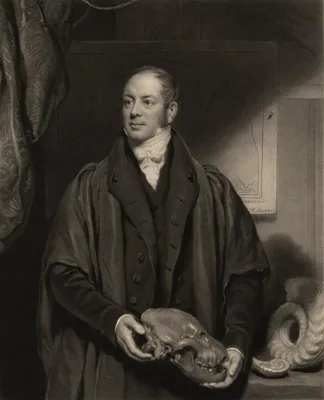
Reliquiae diluvianae; or, observations on the organic remains contained in caves, fissures, and diluvial gravel, and on other geological phenomena, attesting the action of an universal deluge.
Buckland’s elaborately illustrated Reliquiae diluvianae (Relics of the Flood) describes his geological and paleontological researches of the early 1820s, including his investigations of the Kirkdale and Paviland caves…
GMN 7254 · https://historyofmedicine.com/id/9423
1833 –1834 SCHMERLING, Phillipe-Charles (1791 – 1836)
Recherches sur les ossemens fossiles découvertes dans les cavernes de la province de Liège. 2 vols. and atlas.
A physician from Delft, Schmerling found extensive human remains and artifacts associated with the remains of extinct animals in the caverns around Liège. These human remains were distinctively different anatomically …
GMN 203.8 · https://historyofmedicine.com/id/3638
1857 SCHAAFHAUSEN, Hermann (1816 – 1893); FUHLROTT, Johann Carl (1804 – 1877)
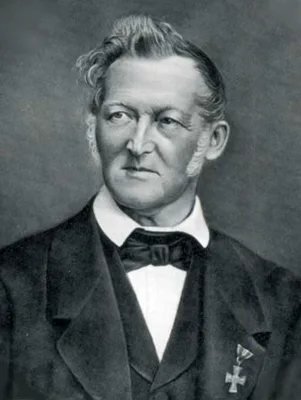
[On the Feldhofer Neanderthal.]
The first account of the Neanderthal remains (Neanderthal 1), discovered in 1856 in the the Feldhofer cave of the Neander valley. The remains, which consist of a partial skull, pelvis and assorted long bones, were sen…
GMN 7250 · https://historyofmedicine.com/id/9419
1858 SCHAAFHAUSEN, Hermann (1816 – 1893)
Zur Kenntniss der ältesten Rassenschädel.
The first comprehensive description of the Neanderthal skull, following Schaaffhausen’s and Fuhlrott’s preliminary announcements of the discovery in the Verhandlungen des naturhistorischen Vereines der preussischen Rh…
GMN 204 · https://historyofmedicine.com/id/3844
1859 FUHLROTT, Johann Carl (1804 – 1877)
Menschliche Ueberreste aus einer Felsengrotte des Düssenthals. Ein Beitrag zur Frage über die Existenz fossiler Menschen.
Fuhlrott’s first detailed account of the “Neanderthal 1” skeleton discovered in 1856 in the Kleine Feldhofer Grotte, located in the Düssel River gorge in southwestern Germany.
GMN 7251 · https://historyofmedicine.com/id/9420
1863 HUXLEY, Thomas Henry (1825 – 1895)
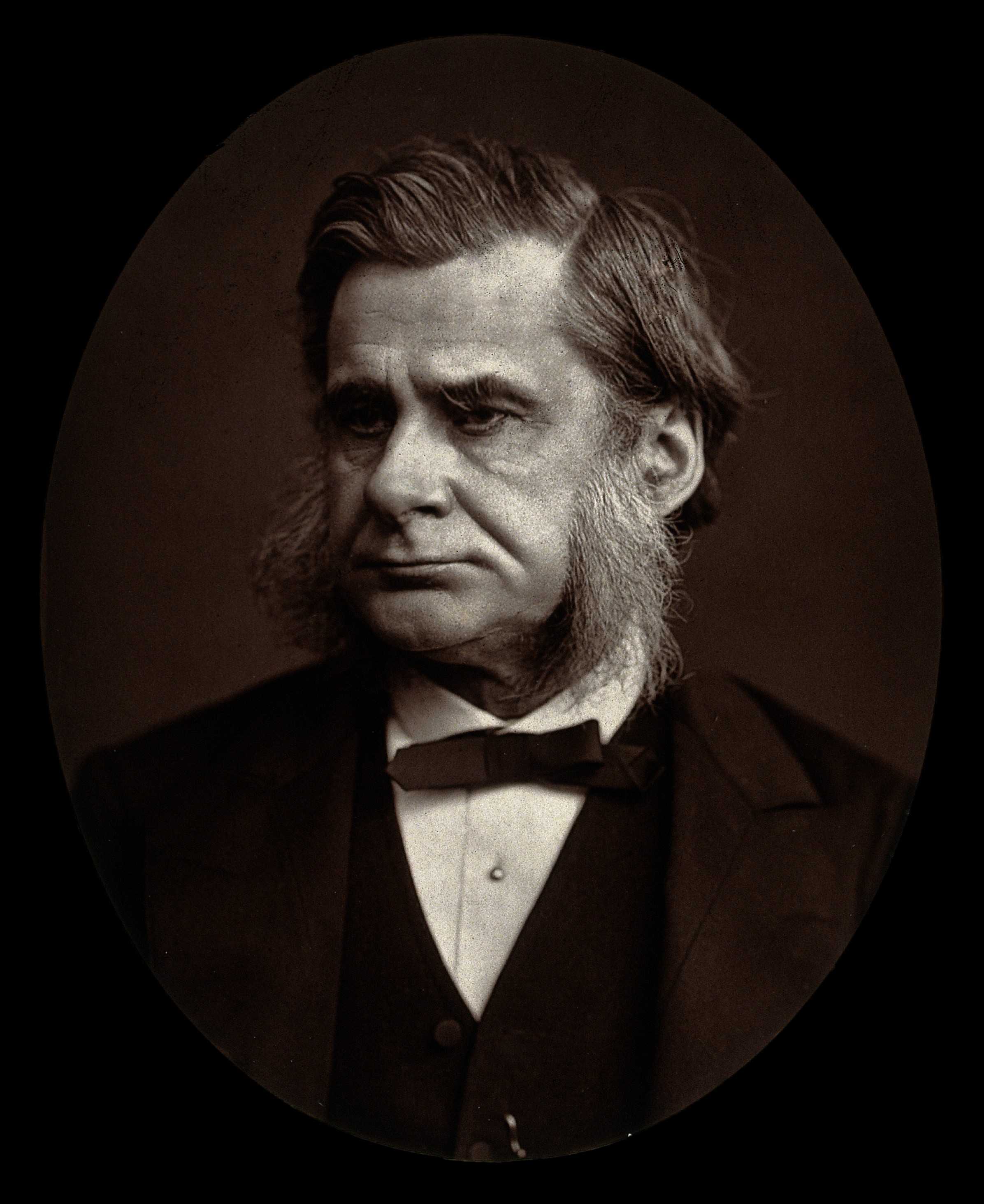
Evidence as to man’s place in nature.
Huxley showed that in the visible characters man differs less from the higher apes than do the latter from lower members of the same order of primates. He also provided the first thorough and detailed comparative desc…
GMN 165 · https://historyofmedicine.com/id/3242
1863 LYELL, Sir Charles (1797 – 1875)
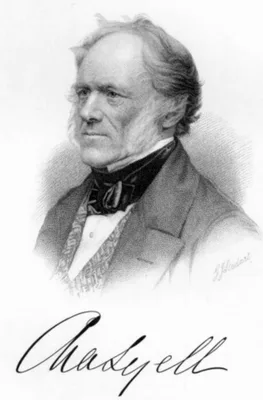
The geological evidences of the antiquity of man with remarks on theories of the origin of species by variation.
Lyell’s summary discussion of the evidence for human antiquity “introduced a wide readership to the new view and to the facts that supported it, thus laying the synthetic foundation for future work” (Grayson). This wo…
GMN 204.1 · https://historyofmedicine.com/id/3847
1864 KING, William (1809 – 1886)
The reputed fossil man of the Neanderthal.
King believed that the Feldhofer Neanderthal skull discovered by Fuhrott and Schaafhausen differed significantly from all known ancient and modern human crania. In this paper he proposed the name Homo neanderthalensis…
GMN 14042 · https://historyofmedicine.com/id/16350
1868 LARTET, Louis (1840 – 1899)
Mémoire sur une sépulture des anciens troglodytes du Périgord.
In March 1868, railway workers clearing away debris from a rock shelter known locally as the Abri de Crô-Magnon (shelter of Crô-Magnon) at Les Eyzies, Dordogne, noticed stone tools and pieces of skeleton imbedded in t…
GMN 7252 · https://historyofmedicine.com/id/9421
1894 DUBOIS, Marie Eugène François Thomas (1858 – 1940)
Pithecanthropus erectus. Eine menschenähnliche Uebergangsform aus Java.
Privately issued first report on Homo erectus. In 1891 Dubois discovered remains of what he described as "a species in between humans and apes" at Trinil, Java. He called his finds Pithecanthropus erectus ("ape-human …
GMN 210 · https://historyofmedicine.com/id/3848
1908 SCHOETENSACK, Otto (1850 – 1912)
Der Unterkiefer des Homo heidelbergensis aus den Sanden von Mauer bei Heidelberg. Ein Beitrag zur Paläontologie des Menschens.
First report on the Mauer jaw discovered by Schoetensack in a sandpit or quarry in the environs of Heidelberg. This was the first fossil specimen unearthed of an extinct hominin species which Schoetensack named Homo h…
GMN 7253 · https://historyofmedicine.com/id/9422
1913 SMITH, Sir Grafton Elliot (1871 – 1937); DAWSON, Charles (1864 – 1916); WOODWARD, Arthur Smith (1864 – 1944)
On the discovery of a palaeolithic skull and mandible in a flint-bearing gravel overlying the Wealden (Hastings Beds) at Piltdown, Fletching (Sussex). With appendix by Grafton Elliot Smith.
Order of authorship in the original publication: Dawson, Woodward. The first "scientific" report on “Piltdown man” (Eoanthropus dawsoni,) one of the longest-lasting and most influential hoaxes ever perpetrated in scie…
GMN 211 · https://historyofmedicine.com/id/3866
1922 SMITH, Sir Grafton Elliot (1871 – 1937)
The Rhodesian skull.
Description of the skull found at Broken Hill, Rhodesia, in 1921.
GMN 212 · https://historyofmedicine.com/id/3875
1922 GREGORY, William King (1897 – 1970)
The origin and evolution of the human dentition.
Reprinted with revisions and new index from J. dent. Res., 1920, 2, 89-175, 215-426, 604-717; 1921, 3, 87-228.
GMN 3691.1 · https://historyofmedicine.com/id/5728
1925 DART, Raymond Arthur (1893 – 1988)
Australopithecus africanus: The man-ape of South Africa.
First report on Dart's discovery in 1924 of the first member of the genus Australopithecus, the first hominin found in Africa. In their 150th anniversary issue published on November 4, 2019 the editors of Nature inclu…
GMN 211.1 · https://historyofmedicine.com/id/3871
1927 BLACK, Davidson (1884 – 1934)
The lower molar hominid tooth from the Chou Kou Tien deposit.
In this report on a single hominid tooth found by Swedish archeologist Birger Bohlin at the Zhoukoudian site in 1927 Black named a new genus and species of hominid, Sinanthropus pekinensis. He characterized the specim…
GMN 7255 · https://historyofmedicine.com/id/9424
1928 TILNEY, Frederick (1875 – 1938); RILEY, Henry Alsop (1887 – 1966)
The brain from ape to man: A contribution to the study of the evolution and development of the human brain by Frederick Tilney. With chapters on the reconstruction of the gray matter in the primate brain stem by Henry Alsop Riley. 2 vols.
Classic study of the evolution of the central nervous system in the higher mammals. Digital facsimile from the Internet Archive at this link.
GMN 350 · https://historyofmedicine.com/id/269
1931 SMITH, Sir Grafton Elliot (1871 – 1937)
Sinanthropus – Peking Man, its discovery and significance.
Elliot Smith visited Peking to view the skull of Sinanthropus pekinensis, discovered by W. C. Pei on December 2, 1929. A preliminary description by Pei is to be found in Bull. geol. Soc. China, 1929, 8, 3.
GMN 213 · https://historyofmedicine.com/id/3877
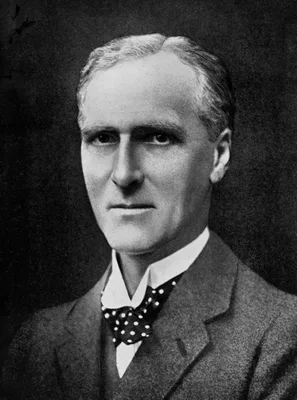
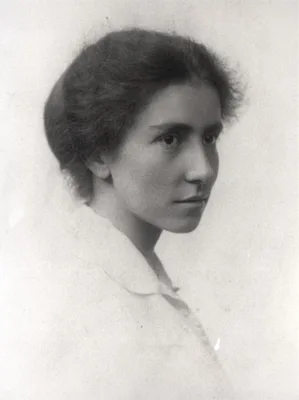
1937 –1939 KEITH, Sir Arthur (1866 – 1955); GARROD, Dorothy Annie Elizabeth (1892 – 1968); BATE, Dorothea Minola Alice (1878 – 1951); MCCOWN, Theodore Doney (1908 – 1969)
The stone age of Mount Carmel. Volume I: Excavations at the Wady el-Mughara. Volume II: The fossil remains from the Lavalloiso-Mousterian.
Garrod carried out her landmark excavations of the el-Wad, el-Tabun and es-Skhul caves on the hills of Mount Carmel, close to Wadi el-Mugharah (Valley of the Caves) between 1929 and 1934. Her monograph on the subject …
GMN 7259 · https://historyofmedicine.com/id/9428
1943 WEIDENREICH, Franz (1873 – 1948)
The skull of Sinanthropus pekinensis: A comparative study on a primitive hominid skull.
Digital facsimile from the Internet Archive at this link.
GMN 214 · https://historyofmedicine.com/id/8936
1946 BROOM, Robert (1866 – 1951); SCHEPERS, Gerrit Willem Hendrik (1914 – )
Pretoria: The South African fossil ape-men. The Australopithecinae. Part I. The occurrence and general structure of the South African ape-men.
With this comprehensive report Broom presented his case to the scientific establishment that Australopithecus probably represented the stock from which mankind had evolved.
GMN 214.1 · https://historyofmedicine.com/id/3948
1950 UNDERWOOD, Edgar Ashworth (1899 – 1980)
Catalogue of an exhibition illustrating prehistoric man in health and sickness. With an introduction by E. Ashworth Underwood.
GMN 13912 · https://historyofmedicine.com/id/16206
1961 LEAKEY, Louis Seymour Bazett (1903 – 1972); ET AL
Age of Bed I, Olduvai Gorge, Tanganyika.
Introduction of the potassium-argon dating method to paleoanthropology, showing that lava at the base of the site of Olduvai Gorge was about 1.8 million years old, and proving that fossils, Australopithecus (Zinjanthr…
GMN 214.2 · https://historyofmedicine.com/id/8937
1976 JOHANSON, Donald Carl (1943 – ); TAIEB, Maurice (1935 – )
Plio-Pleistocene hominid discoveries in Hadar, Ethiopia.
Report on the Afar fossils (formally classified and named Australopithiecus afaranesis in 1998) representing a minimum of 35 and a maximum of 65 individuals, all about 3,000,000 years old. The most famous of these, AL…
GMN 214.3 · https://historyofmedicine.com/id/8938
2002 –2005 SCHWARTZ, Jeffrey Hugh (1948 – ); TATTERSALL, Ian (1945 – ); HOLLOWAY, Ralph Leslie Jr. (1935 – ); BROADFIELD, Douglas C.; YUAN, Michael S.
The human fossil record. 4 vols.
Vol. 1: Terminology and Craniodental Morphology of Genus Homo (Europe). Vol. 2: Craniodental morphology of Genus Homo (Africa and Asia). Vol. 3: Brain endocasts—the paleoneurological evidence. Vol. 4: Crandiodental mo…
GMN 11243 · https://historyofmedicine.com/id/13440
2003 SPOOR, Fred; HUBLIN, Jean-Jacques (1953 – ); ZONNEFELD, Frans W.
The bony labyrinth of Neanderthals.
Computed tomography of the inner ear of 20 Neanderthal specimens directed by Spoor showed that the Neanderthal semicircular canal is subtly distinct in size, shape, and orientation from that of modern humans. With Mar…
GMN 7261 · https://historyofmedicine.com/id/9430
2006 SCHWARTZ, Jeffrey Hugh (1948 – )
Race and the odd history of human paleontology.
Abstract: "Although the late 17th century witnessed the recognition of fossils as the remains of extinct organisms—because they could be incorporated into the creation story embodied in the Great Chain of Being—accept…
GMN 14041 · https://historyofmedicine.com/id/16349
2009 WHITE, Timothy Douglas (1950 – ); ASFAW, Berhane (1954 – ); HAILE-SELASSIE, Yohannes (1961 – ); BEYENE, Yonas; ET AL
Ardipithecus ramidus and the paleobiology of early hominids.
The authors provide evidence that Ardipithecus may be the beginning of the evolutionary pathway that eventually led to hominids. This pathway was distinct from the evolutionary pathway that led to extant African apes.…
GMN 14083 · https://historyofmedicine.com/id/16394
2018 PÄÄBO, Svante (1955 – ); SLON, Viviane; MAFESSONI, Fabrizio; VERNOT, Benjamin; ET AL
The genome of the offspring of a Neanderthal mother and a Denisovan father.
Paleogenomic study of a single bone fragment from a female hominin found in the Denisova Cave in the Altai mountains of Russia provided "direct evidence for genetic mixture between Neanderthals and Denisovans on at le…
GMN 14099 · https://historyofmedicine.com/id/16410
2020 PÄÄBO, Svante (1955 – ); ZEBERG, Hugo
The major genetic risk factor for severe COVID-19 is inherited from Neanderthals.
Expanding on previous findings by a genome wide association study of severe COVID-19, specifically with respiratory failure which had found that a gene cluster residing on chromosome 3 had a significant association wi…
GMN 14098 · https://historyofmedicine.com/id/16409