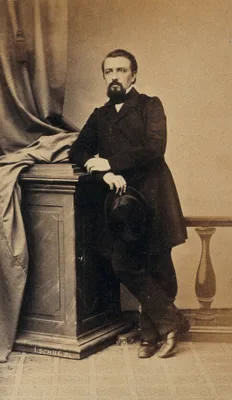
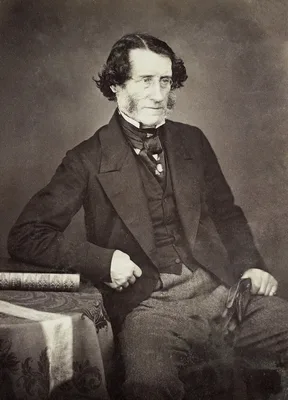
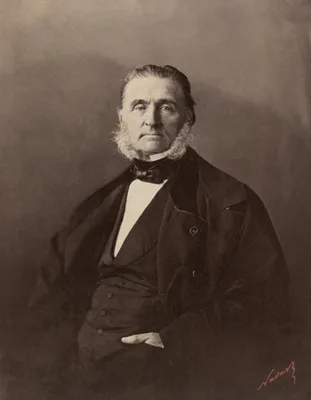
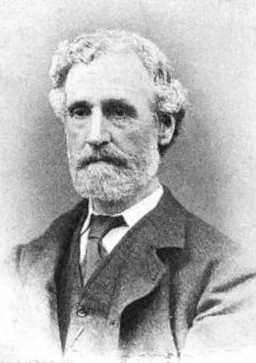
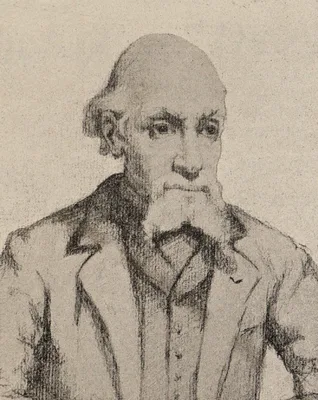
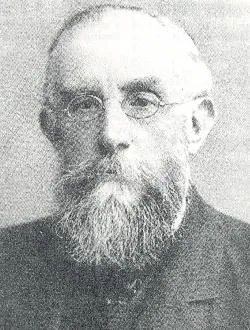
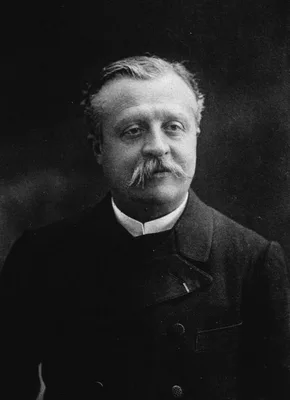
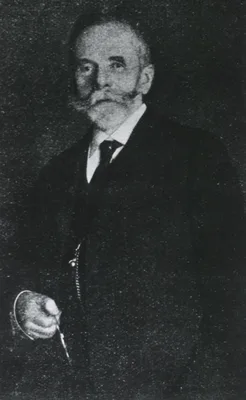
1863 EULENBURG, Moritz Michael (1811 – 1877)
Hochgradige Dislocation der Scapula.
First description of congenital high-scapula “Sprengel’s deformity”; see also No. 4359.
GMN 4332 · https://historyofmedicine.com/id/5563
1863 HENKE, Philipp Jakob Wilhelm von (1834 – 1896)
Contractur des Metatarsus.
Congenital metatarsus varus described.
GMN 4333 · https://historyofmedicine.com/id/5564
1863 FRIEDREICH, Nikolaus (1825 – 1882)
Ueber degenerative Atrophie der spinalen Hinterstränge.
Friedreich was the first to describe a form of ataxia (“Friedreich’s ataxia”), hereditary, attended with impairment of speech, lateral curvature of the spine, and with paralysis of the muscles of the lower limbs. The …
GMN 4696 · https://historyofmedicine.com/id/8889
1865 BABINGTON, Benjamin Guy (1794 – 1866)
Hereditary epistaxis.
GMN 3064.2 · https://historyofmedicine.com/id/3717
1865 TROUSSEAU, Armand (1801 – 1867)
Glycosurie, diabète sucré. In his Clinique médicale de l’Hôtel-Dieu, 2me. éd., 2, 663-98.
First description of hemochromatosis.
GMN 3915 · https://historyofmedicine.com/id/5031
1865 SMITH, Sir Thomas (1833 – 1909)
Skull-cap showing congenital deficiencies of bone.
GMN 6359 · https://historyofmedicine.com/id/8258
1866 MENDEL, Gregor Johann (1822 – 1884)
Versuche über Pflanzen-Hybriden.
Discovery of the Mendelian ratios, the most significant single achievement in the history of genetics. The story of how Mendel published his paper in this relatively obscure journal only to have his discovery ignored …
GMN 222 · https://historyofmedicine.com/id/4395
1866 DOWN, John Langdon Haydon (1828 – 1896)
Observations on an ethnic classification of idiots.
Langdon Down suggested that the physiognomical features of certain defectives enabled them to be arranged in ethnic groups; of these he differentiated Mongolian, Ethiopian, Caucasian, and American Indian. Such an ethn…
GMN 4936 · https://historyofmedicine.com/id/6184
1868 HAECKEL, Ernest Heinrich Philipp August (1834 – 1919)
Natürliche Schöpfungsgeschichte. Gemeinverständlich wissenschaftliche Vorträge über die Entwickelungslehre im Allgemeinen und diejenige von Darwin, Goethe und Lamarck im Besonderen, über die Anwendung derselben auf den Ursprung des Menschen . . .
Haeckel constructed the first of the now commonplace ancestral trees, depicting the evolution of life from the simplest organisms through 21 stages of development to modern man – the 22nd and final stage. Within this …
GMN 224 · https://historyofmedicine.com/id/4402
1868 DARWIN, Charles Robert (1809 – 1882)
The variation of animals and plants under domestication. 2 vols.
Darwin carried out numerous investigations with pigeons and various plants. He recognized continuous and discontinuous variation; he concluded that crossing tends to keep populations uniform.
GMN 224.1 · https://historyofmedicine.com/id/4405
1868 ROTHMUND, August von (1830 – 1906)
Ueber Cataracten in Verbindung mit einer eigenthümlichen Haut-de-generation.
Poikiloderma congenitale (Rothmund).
GMN 4056.1 · https://historyofmedicine.com/id/5416
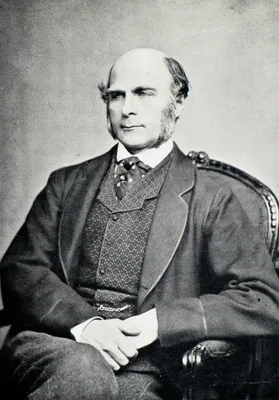
1869 GALTON, Sir Francis (1822 – 1911)
Hereditary genius.
Galton investigated the families of great men and suggested that genius was hereditary, and thus founded the science of Eugenics, although he did not coin the word until 1883 (see No. 230). Karl Pearson’s, The life, l…
GMN 226 · https://historyofmedicine.com/id/4408
1869 FORT, Joseph-Auguste Aristide (1835 – 1920)
Des difformités congénitales et acquises des doigts et des moyens d’y remédier. Thèse présentée au concours pour l’agrégation (section de chirurgie).
This exceptionally long and comprehensive (246pp., 39 text illustrations) thesis was the first French work on hand surgery. Digital facsimile from Google Books at this link.
GMN 11144 · https://historyofmedicine.com/id/13341
1871 VANLAIR, Constant François (1839 – 1914); MASIUS, Jean-Baptiste-Nicolas-Voltaire (1836 – 1912)
De la microcythémie
Vanlair and Masius were the first to suggest the concept of hereditary hemolytic anemia. Their paper was republished in book form, Brussels, 1871.
GMN 3766.1 · https://historyofmedicine.com/id/4648
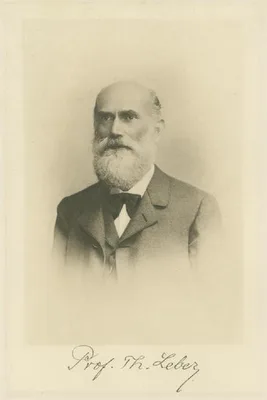
1871 LEBER, Theodor (1840 – 1917)
Ueber hereditäre und congenital-angelegte Sehnervenleiden.
First description of hereditary optic atrophy, “Leber’s optic atrophy”.
GMN 5906 · https://historyofmedicine.com/id/7420
1872 HUNTINGTON, George (1850 – 1916)
On chorea.
The classic description by Huntington of the chronic degenerative hereditary type of chorea led to the eponym “Huntington’s chorea”. Earlier accounts of the disease were given by John Elliotson (Lancet, 1832, 1, 163),…
GMN 4699 · https://historyofmedicine.com/id/985
1874 HOLMGREN, Alarik Frithiof (1831 – 1897)
Om den medfödda, färgblindhetens diagnostic och teori.
Holmgren introduced the wool-skein test for the diagnosis of color-blindness.
GMN 5911 · https://historyofmedicine.com/id/6791
1875 ROKITANSKY, Carl Freiherr von (1804 – 1878)
Die Defecte der Scheidewände des Herzens.
Rokitansky’s memoir on defects of the septum of the heart was his last work, and possibly his greatest. It represented 14 years’ study of the subject.
GMN 2778 · https://historyofmedicine.com/id/4739
1876 THOMSEN, Asmus Julius Thomas (1815 – 1896)
Tonische Krämpfe in willkürlich beweglichen Muskeln in Folge von ererbter psychischer Disposition (Ataxia muscularis?).
Thomsen suffered from muscle weakness and cramps, an issue that all his sons inherited. Realizing that this was a hereditary disease, Thomsen managed to trace the disease for six generations, and found over 20 cases o…
GMN 4744 · https://historyofmedicine.com/id/1336
1876 –1877 MOON, Henry (1845 – 1892)
On irregular and defective tooth development.
“Moon’s molars”, the first molars in congenital syphilitics.
GMN 2391 · https://historyofmedicine.com/id/3320
1876 LEGG, John Wickham (1843 – 1921)
A case of haemophilia complicated with multiple naevi.
First description of multiple hereditary telangiectasis (“Rendu–Osler–Weber disease”).
GMN 2707 · https://historyofmedicine.com/id/4422
1876 –1877 HOLMGREN, Alarik Frithiof (1831 – 1897)
Om färgblindheten i dess förhallande till jernvägstrafiken och sjöväsendet.
A serious railway accident in Sweden in 1875 was believed by Holmgren to be due to color-blindness, and resulted in the above important paper dealing with the condition and its relation to railway and maritime traffic…
GMN 5916 · https://historyofmedicine.com/id/6815
1876 DARWIN, Charles Robert (1809 – 1882)
The effects of cross and self fertilisation in the vegetable kingdom.
Darwin's report on over 12 years of experimentation with cross and self-fertilization on 57 species. In these experiments Darwin discovered and demonstrated the concept of hybrid vigor or heterosis.
GMN 8911 · https://historyofmedicine.com/id/11089
1877 DUROZIEZ, Paul Louis (1826 – 1897)
Du rétrécissement mitral pur.
First description of congenital mitral stenosis, “Duroziez’s disease.”
GMN 2780 · https://historyofmedicine.com/id/4743
1878 SQUIRE, Alexander John Balmanno (1836 – 1908)
On the treatment of psoriasis by an ointment of chrysophanic acid.
Introduction of chrysarobin in dermatology.
GMN 4075.1 · https://historyofmedicine.com/id/5512
1879 THOMSON, William (1833 – 1907)
On astigmatism as a cause for persistent headache and other nervous symptoms.
Thomson was a pioneer in the study of refraction. He was much interested in color-blindness and modified Holmgren’s wool-skein test. Himself affected with hypermetropia, he made important investigations on this condit…
GMN 5917 · https://historyofmedicine.com/id/6819
1880 BOURNEVILLE, Désiré-Magloire (1840 – 1909)
Contribution à l’étude de l’idiotàie.
“Bourneville’s disease”, tuberous sclerosis, epiloia (p. 81). Digital facsimile from biuSante.parisdescartes.fr at this link. For the history of the understanding of this disease see the remarkable Wikipedia Timeline …
GMN 4700 · https://historyofmedicine.com/id/987
1880 –1881 TAY, Waren (1843 – 1927)
Symmetrical changes in the region of the yellow spot in each eye of an infant.
Tay was the first to describe amaurotic familial idiocy, his paper dealing mainly with the ocular manifestations. The condition later became known as “Tay-Sachs’s disease” (see also No. 4705).
GMN 5918 · https://historyofmedicine.com/id/6822
1880 –1882 GUÉRIN, Jules
Recherches sur les difformités congénitales chez les monstres, le foetus et l'enfant.
Published as Vol. 1 of Oeuvres de Docteur Jules Guerin, of which this work was all published. Digital facsimile from Google Books at this link.
GMN 11153 · https://historyofmedicine.com/id/13350
1882 GAUCHER, Philippe Charles Ernest (1854 – 1918)
De l’epithélioma primitif de la rate; hypertrophie idiopathique de la rate sans leucémie.
“Gaucher’s disease” – familial splenic anemia. Digital facsimile from wellcomecollection.org at this link.
GMN 3127 · https://historyofmedicine.com/id/3917
1882 QUINCKE, Heinrich Irenaeus (1842 – 1922)
Ueber akutes umschriebenes Hautödem.
Hereditary angioedema is also known as Quincke’s edema, from the latter’s excellent description of it, but he was preceded by several other writers, including Donati (No. 4011.2) and Milton (No. 4070). It is also call…
GMN 4081 · https://historyofmedicine.com/id/5569
1882 –1883 WINSLOW, Ralph (1868 – 1924)
"A study of the malformations, variations, and anomalies of the circulatory apparatus in man," with a brief consideration of some of the principles governing their production.
A pioneering study of the embryology of the cardiovascular system and its relationship to congenital heart disease.
GMN 11737 · https://historyofmedicine.com/id/13938
1883 –1884 STRÜMPELL, Ernst Adolf Gustav Gottfried (1853 – 1925)
Lehrbuch der speciellen Pathologie und Therapie der inneren Krankheiten. 2 vols.
Strümpell gave an excellent description of ankylosing spondylitis (“Strümpell’s disease”, the “spondylose rhizomélique” of Pierre Marie, No. 4368) on p. 152 of his Lehrbuch. See No. 2229. He published an important pap…
GMN 2229 · https://historyofmedicine.com/id/3786
1883 ROUX, Wilhelm (1850 – 1924)
Überdie Bedeutungder Kerntheilungsfiguren.
Roux investigated why the nucleus undergoes the precise division of mitosis while the rest of the cell undergoes a rather crude division when one cell splits into two. He argued that mitosis ensures a precise halving …
GMN 229 · https://historyofmedicine.com/id/8327
1883 GALTON, Sir Francis (1822 – 1911)
Inquiries into human faculty and its development.
Galton, cousin of Charles Darwin, founded the science of Eugenics. In his important Inquiries he showed mathematically “the results of his experiments on the relations between the powers of visual imagery and of abstr…
GMN 230 · https://historyofmedicine.com/id/8330
1884 STRASBURGER, Eduard Adolf (1844 – 1912)
Neue Untersuchungen über den Befruchtungsvorgang bei den Phanerogamen als Gründlage für eine Theorie der Zeugung.
Like Roux, Strasburger hypothesized that the cell nucleus contained the material basis of heredity, and developed the idea with evidence from microscopical observations.
GMN 229.1 · https://historyofmedicine.com/id/8329
1884 BELL, Alexander Graham (1847 – 1922)
Memoir upon the formation of a deaf variety of the human race.
Bell determined that deafness was an inheritable trait and that deaf individuals had a tendency to marry other deaf individuals. As a eugenicist Bell considered this a problem because he thought it risked the developm…
GMN 13063 · https://historyofmedicine.com/id/15315
1885 KÖLLIKER, Rudolph Albert von (1817 – 1905)
Die Bedeutung der Zellenkerne für die Vorgänge der Vererbung.
Along with Roux, Kölliker stated that hereditary characters were transmitted by the cell nucleus.
GMN 231 · https://historyofmedicine.com/id/8332
1886 STRÜMPELL, Ernst Adolf Gustav Gottfried (1853 – 1925)
Ueber eine bestimmte Form der primären combinirten Systemerkrankungen des Rückenmarks.
“Strümpell’s disease” – hereditary spastic spinal paralysis, previously described by Erb and by Charcot.
GMN 4704 · https://historyofmedicine.com/id/1128
1886 TOOTH, Howard Henry (1856 – 1925)
The peroneal type of progressive muscular atrophy. Thesis for the degree of M.D. in the University of Cambridge.
Tooth described peroneal muscular atrophym a hereditary motor and sensory neuropathy of the peripheral nervous system, independently of, and in the same year as, Charcot and Marie. Known as Charcot-Marie-Tooth (CMT) d…
GMN 4750 · https://historyofmedicine.com/id/1353
1886 FOURNIER, Jean Alfred (1832 – 1915)
La syphilis héréditaire tardive.
Fournier, one of the greatest syphilologists, did more than any other person to develop the knowledge regarding congenital syphilis. Through his writings, the importance of syphilis as a cause of degenerative diseases…
GMN 2393 · https://historyofmedicine.com/id/3329
1886 TREVES, Sir Frederick (1853 – 1923)
A case of haemophilia: pedigree through five generations.
True hemophilia in a female. The family was the subject of several later investigations, the last being reported in Lancet, 1973, 2,734.
GMN 3067.1 · https://historyofmedicine.com/id/3721
1886 HUTCHINSON, Sir Jonathan (1828 – 1913)
Congenital absence of hair and mammary glands with atrophic condition of the skin and its appendages in a boy whose mother had been almost wholly bald from alopecia areata from the age of six.
First description of progeria.
GMN 3790 · https://historyofmedicine.com/id/4710
1887 SACHS, Bernard (1858 – 1944)
On arrested cerebral development, with special reference to its cortical pathology.
Sachs described the cerebral changes in amaurotic familial idiocy. Earlier, Tay (No. 5918) had recorded the ocular manifestations of this condition, which became known as “Tay-Sachs’s disease”. Two further papers on t…
GMN 4705 · https://historyofmedicine.com/id/1129
1887 –1888 HIRSCHSPRUNG, Harald (1830 – 1916)
Stuhlträgheit Neuegeborener in Folge von Dilatation und Hypertrophie des Colons.
Hirschsprung’s diseases (congenital megacolon).
GMN 3489 · https://historyofmedicine.com/id/3886
1887 WHITE, James Clarke (1833 – 1916)
Dermatitis venenata: An account of the action of external irritants upon the skin.
White, a pupil of Hebra, was an outstanding personality in American dermatology; he held the first chair in that subject in the U.S.A. The eponym “White’s disease” refers to his description of keratosis follicularis i…
GMN 4093 · https://historyofmedicine.com/id/5601
1888 FALLOT, Étienne Louis Arthur (1850 – 1911)
Contribution à l’anatomie pathologique de la maladie bleu (cyanose cardiaque).
The “tetralogy of Fallot.” He gave an important, but not the first, account of this condition (see Nos. 2726.1 & 2761). Abstract translation in Willius & Keys, Cardiac classics, 1941, pp. 689-90.
GMN 2792 · https://historyofmedicine.com/id/3401
1888 HIRSCHSPRUNG, Harald (1830 – 1916)
Fälle von angeborener Pylorusstenose, beobachtet bei Säuglingen.
Hirschsprung first made the medical world aware of congenital hypertrophic pyloric stenosis as a distinct clinical entity. In this paper he made no suggestions concerning therapy.
GMN 3489.1 · https://historyofmedicine.com/id/3888
1888 BOVERI, Theodor (1862 – 1915)
Zellen-Studien.
Boveri gave decisive proof of the maintenance of chromosomal individuality.
GMN 231.1 · https://historyofmedicine.com/id/8334
1888 OSLER, Sir William (1849 – 1919)
Hereditary angio-neurotic oedema.
Osler was the first in the English-speaking world to describe what is now called hereditary angioedema. In this paper he presented "an interesting study of the heredity of a case, with a genealogical table" (Golden & …
GMN 11271 · https://historyofmedicine.com/id/13468