1536 MASSA, Niccoló (1489 – 1569)
Liber introductorius anatomiae sive dissectionis corporis humani; in quo quam plurima membra, operationes, & utilitates tam ab antiquis, quam a modernis praetermissa manifestantur.
A practical manual for dissection, showing how to carry out an anatomy from the first incision onwards. Massa based his work on his experience gained from numerous dissections that he had undertaken in the hospital of…
GMN 1536 · https://historyofmedicine.com/id/2862
1573 VAROLIO, Costanzo (1543 – 1575)
De nervis opticis nonnulisque aliis praeter communem opinionem in humano capite observatis.
Varolio described a new method of dissection which enabled him to observe and describe the pons for the first time. By this new method Varolio was able to make some contributions to the knowledge of the course and ter…
GMN 1377.2 · https://historyofmedicine.com/id/1782
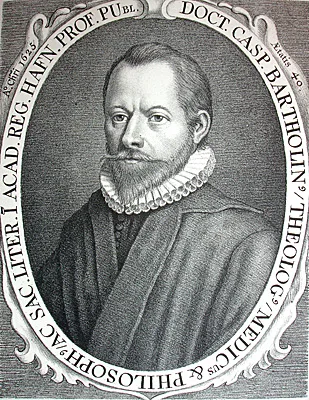
1641 BARTHOLIN, Thomas (1616 – 1680); LE BÖE, Franz de [FRANCISCUS SYLVIUS] (1614 – 1672); BARTHOLIN, Caspar Senior (1585 – 1629)
Institutiones anatomicae, novis recentiorum opinionibus & observationibus, quarum innumerae hactenus editae non sunt, figurisque auctae ab auctoris filio Thoma Bartholino.
In this revision of his father’s anatomical treatise, Thomas Bartholin included the first depiction of the fissure of Sylvius, the lateral cerebral fissure, and the only part of the surface of the cerebral hemispheres…
GMN 1377.3 · https://historyofmedicine.com/id/1791
1664 WILLIS, Thomas (1621 – 1675)
Cerebri anatome: cui accessit nervorum descriptio et usus.
The most complete and accurate account of the nervous system which had hitherto appeared, and the work that coined the term, “neurology". In its preparation Willis was helped by his students Richard Lower and Thomas M…
GMN 1378 · https://historyofmedicine.com/id/1789
1666 BLASIUS, Gerard "Gerrit" Leendertszoon [Blaes] (162 – 1682)
Anatome medullae spinalis, et nervorum.
The first separate work on the spinal cord. Blasius “illustrated the separate origin of the anterior and posterior roots, the dorsal root ganglia and the differentiation between the gray and white matter of the spinal…
GMN 1354.9 · https://historyofmedicine.com/id/1626
1669 STENO, Nicolas [Niels Steensen, Nicholaus Stenonis] (1638 – 1686)
Discours sur l’anatomie du cerveau.
In this remarkably prescient argument for, and critique of, anatomical research into brain function Stensen opposed Descartes (No. 574) arguing that it was idle to speculate about cerebral function when so little was …
GMN 1378.1 · https://historyofmedicine.com/id/1783
1684 VIEUSSENS, Raymond (1641 – 1715)
Neurographia universalis.
Vieussens, professor at Montpellier, was the first to describe the centrum ovale correctly. The publication of the above work threw new light on the subject of the configuration and structure of the brain, spinal cord…
GMN 1379 · https://historyofmedicine.com/id/1784
1684 WILLIS, Thomas (1621 – 1675); PORDAGE, Samuel (1633 – 1691)
Dr. Willis's practice of physick.
The only complete edition of Willis's works in English, translated by the poet Samuel Pordage. It contains the translations of all his works except his Affectionum quae dicuntur hystericae (1671). The collection inclu…
GMN 1311 · https://historyofmedicine.com/id/10280
1686 BOHN, Johannes (1640 – 1718)
Circulus anatomico-physiologicus.
Bohn's approach was mechanistic in that he grave predominately physical interpretations of vital processes. He experimented on the decapitated frog, declaring the reflex phenomena to be entirely material and mechanica…
GMN 1355 · https://historyofmedicine.com/id/1631
1695 RIDLEY, Humphrey (1653 – 1708)
The anatomy of the brain.
The first book on the brain in the English language, including the first account of the circular venous sinus which Ridley names, and the first English account of a pineal tumor. In it Ridley gives the first account o…
GMN 1379.1 · https://historyofmedicine.com/id/1785
1705 PACCHIONI, Antonio (1665 – 1726)
Dissertatio epistolaris ad Lucam Schroeckium de glandulis conglobatis durae meningis humanae.
Includes a description and illustration of the Pacchionian bodies of the arachnoid tissue under the dura, producing by pressure slight depressions (“Pacchionian depressions”). See also Pacchioni’s De durae meningis fa…
GMN 1380 · https://historyofmedicine.com/id/1786
1710 POURFOUR DU PETIT, François (1664 – 1741)
Lettres d’un médecin des hôpitaux du Roy… contient un nouveau système du cerveau, etc.
Theory of contralateral innervation.
GMN 1356 · https://historyofmedicine.com/id/1641
1714 EUSTACHI, Bartolomeo [EUSTACHIUS] (1510 – 1574)
Tabulae anatomicae.
A romantic history attaches to this fine collection of plates, drawn by Eustachius himself and completed in 1552. They remained unprinted and forgotten in the Vatican Library until discovered in the early 18th century…
GMN 1312 · https://historyofmedicine.com/id/631
1719 HENSING, Johann Thomas (1683 – 1726)
Cerebri examen chemicum, ex eodemqve phosphorum singularem omnia inflammabilia accendentem dissertatione academica.
First account of the chemical composition of the brain. Hensing discovered the presence of phosphorus. Annotated English translation with biography and historical analysis, by D.B. Tower. New York, Raven Press, [1983].
GMN 1380.1 · https://historyofmedicine.com/id/1793
1727 POURFOUR DU PETIT, François (1664 – 1741)
Mémoire dans lequel il est démontré que les nerfs intercostaux fournissent des rameaux que portent des esprits dans les yeux.
By cutting the intercostal nerves in the neck, du Petit found that disturbances occurred in the eyes and face of the same side; this disproved earlier views of the cerebral origin of the intercostal nerves.
GMN 1313 · https://historyofmedicine.com/id/1213
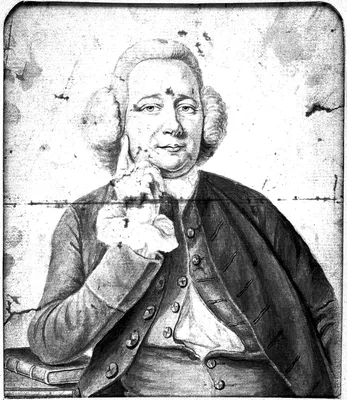
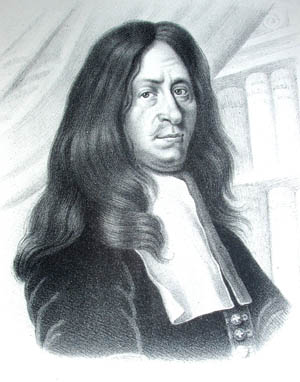
1732 WINSLOW, Jacques-Bénigne [Jacob Benignus Winsløw] (1669 – 1760)
Exposition anatomique de la structure du corps humain.
The foramen between the greater and lesser sacs of the peritoneum (described on pages 352-65), is named after Winslow. His Exposition is distinguished as being the first book on descriptive anatomy to discard physiolo…
GMN 1314 · https://historyofmedicine.com/id/664
1748 MECKEL, THE ELDER, Johann Friedrich (1724 – 1774)
Tractatus anatomico-physiologicus de quinto pare nervorum cerebri.
Meckel’s graduation thesis contains the first really detailed account of the trigeminal nerve’s distribution (along with a meticulous treatment of the earlier literature), and in it he describes for the first time the…
GMN 1249 · https://historyofmedicine.com/id/2074
1764 COTUGNO, Domenico [COTUNNIUS] (1736 – 1822)
De ischiade nervosa commentarius.
Cotugno published a classic description of sciatica, which is useful even today. He recognized two types – arthritic and nervous; the latter has been called “Cotugno’s disease”, and his book is confined to that type. …
GMN 1382 · https://historyofmedicine.com/id/8632
1765 JOHNSTONE, James (1730 – 1802)
Essay on the use of the ganglions of the nerves.
See also his supplementary papers on the subject, in Phil. Trans., (1767), 1768, 57, 118-31; (1770), 1771, 60, 30-35. Revised edition in book form, Shrewsbury, 1771.
GMN 1250 · https://historyofmedicine.com/id/2081
1765 HIRSCH, Antonius Balthazar Raymundus (1744 – 1778)
Pars quinti nervorum encephali disquisitio anatomica.
The “Gasserian ganglion”, already described by Santorini and others, was named after Johann Ludwig Gasser (fl. 1757-65), Professor of Anatomy at Vienna, by his pupil Hirsch. Also published in Ludwig, C. F., Scriptores…
GMN 1251 · https://historyofmedicine.com/id/2089
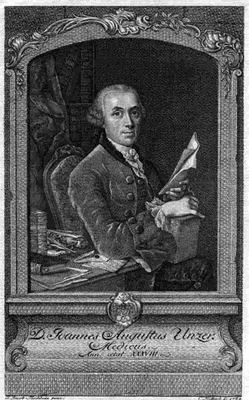
1771 UNZER, Johann Augustus (1727 – 1799)
Erste Gründe einer Physiologie der eigentlichen thierischen Natur thierischer Körper.
Unzer was probably the first to employ the work “reflex” in connection with sensory–motor reactions. T. Laycock translated his book into English for the Sydenham Society in 1851.
GMN 1357 · https://historyofmedicine.com/id/1649
1776 MALACARNE, Michaele Vincenze Giacinto (1744 – 1816)
Nuova esposizione della vera struttura del cervelletto umano.
The first detailed account of the anatomy of the cerebellum, which introduced the terms, “tonsil”, “pyramid”, “lingula”, and “uvula”. Reprinted in his Encefalotomia a sia nuova diimostrazione anatomica di tutte le par…
GMN 1382.1 · https://historyofmedicine.com/id/1801
1777 WRISBERG, Heinrich August (1739 – 1808)
Observationes anatomicae de quinto pare nervorum encephali.
Wrisberg, Professor of Anatomy at Göttingen, is remembered for his discovery of the nervus intermedius (“nerve of Wrisberg”), described in the above treatise.
GMN 1252 · https://historyofmedicine.com/id/2093
1778 SOEMMERRING, Samuel Thomas von (1755 – 1830)
Dissertatio inauguralis anatomica de basi encephali et originibus nervorum cranio egredientium libri quinque.
The first accurate enumeration of the 12 cranial nerves, superseding that of Willis (No. 1378). Soemmerring is notable for his accuracy in anatomical illustration. This was his thesis. The same publisher issued an edi…
GMN 1383 · https://historyofmedicine.com/id/1808
1778 SAUCEROTTE, Louis Sebastian (1741 – 1814)
Mémoire sur les contre-coups dans les lésions de la tête [1768].
“One of the first achievements of modern brain physiology” (Neuburger). Saucerotte carried out surgical experiments on dogs which convinced him that the anterior part of the cerebrum innervated the lower limbs and the…
GMN 1382.2 · https://historyofmedicine.com/id/2634
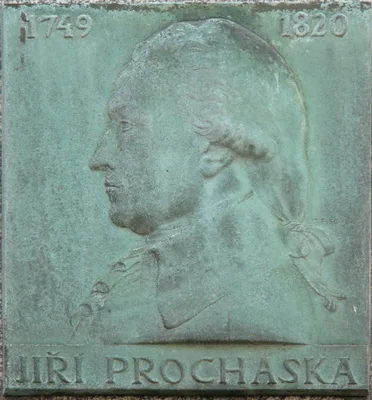
1780 –1784 PROCHASKA, Georg (1749 – 1820)
Adnotationum academicarum. Fasciculus tertius. III. De functionibus systematis nervosi. 3 pts.
Prochaska introduced the idea of a “sensorium commune” in the central nervous system, a consistent and comprehensive theory of reflex action. English translation, London, Sydenham Society, 1851.
GMN 1386 · https://historyofmedicine.com/id/1902
1782 GENNARI, Francesco (1750 – 1797)
De peculiari structura cerebri, nonnulisque ejus morbis.
Gennari was the first to demonstrate the laminar structure of the cerebral cortex when he discovered the line of Gennari, a macroscopically white band in the cerebral cortex of the occipital lobe. This he observed on …
GMN 1384 · https://historyofmedicine.com/id/1812
1783 MONRO, Alexander, Secundus (1733 – 1817)
Observations on the structure and functions of the nervous system.
Monro discovered the communication between the lateral ventricles of the human brain with each other and with the third ventricle, the “foramen of Monro”. Alexander secundus was the greatest of the three Monros.
GMN 1385 · https://historyofmedicine.com/id/1823
1793 FOURCROY, Antoine François, comte (1755 – 1809)
Examen chimique du cerveau de plusieurs animaux.
Fourcroy, French physician and chemist, made important researches on the chemistry of the brain. He noted albumen (protein) as a principal constituent.
GMN 1386.1 · https://historyofmedicine.com/id/1906
1794 SCARPA, Antonio (1752 – 1832)
Tabulae nevrologicae, ad illustrandum historiam anatomicam cardiacorum nervorum, noni nervorum cerebri, glossopharyngaei et pharyngaei ex octavo cerebri.
This elegantly illustrated anatomical atlas is regarded as Scarpa’s greatest work. The result of 20 years of research, it includes the first proper delineation of the glossopharyngeal, vagus, hypoglossal, and cardiac …
GMN 1253 · https://historyofmedicine.com/id/2100
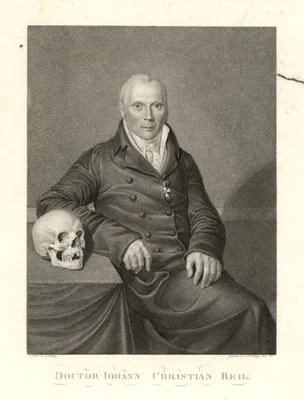
1796 REIL, Johann Christian (1759 – 1813)
Exercitationum anatomicarum fasciculus primus. De structura nervorum, tribus tabulis aeneis illustratus [All published].
Description of the “island of Reil”. This was the first part of the surface of the cerebral hemispheres to be given a name since 1641 (No. 1377.3). See also Reil’s follow-up paper in Arch. Physiol. (Halle), 1809, 9, 1…
GMN 1387 · https://historyofmedicine.com/id/1913
1801 –1803 ROUX, Philibert Joseph (1780 – 1854); BICHAT, Marie François Xavier (1771 – 1802); BUISSON, Mathieu-François-Régis (1776 – 1806)
Traité d’anatomie descriptive. 5 vols.
Bichat was the creator of descriptive anatomy. He introduced the terms “animal” and “vegetative” system. This was his last work, unfinished at his death. Vol. 4 was prepared by Bichat's student and cousin, Mathieu-Fra…
GMN 1315 · https://historyofmedicine.com/id/10106
1809 ROLANDO, Luigi (1773 – 1831)
Saggio sopra la vera struttura del cervello dell’uomo e degl’animali e sopra le funzioni del sistema nervoso.
Includes description of “Rolando’s substance”, “tubercle”, and “funiculus”. Rolando described ablation experiments for brain localization similar to Flourens (No. 1391). They were largely unknown until Magendie publis…
GMN 1388 · https://historyofmedicine.com/id/1920
1810 –1819 GALL, Franz Joseph (1758 – 1828); SPURZHEIM, Johann Caspar (1776 – 1832)
Anatomie et physiologie du système nerveux en général, et du cerveau en particulier. 4 vols. and atlas.
Introduced the theory of localization of cerebral function, although in a somewhat fantastic form. This pioneer attempt to map out the cerebral cortex according to function gave rise to the pseudo-science of phrenolog…
GMN 1389 · https://historyofmedicine.com/id/1922
1811 VAUQUELIN, Louis Nicolas (1763 – 1829)
Analyse de la matière cérèbrale de l’homme et de quelques animaux.
First complete chemical analysis of the nervous system.
GMN 1389.1 · https://historyofmedicine.com/id/1925
1811 BELL, Sir Charles (1774 – 1842)
Idea of a new anatomy of the brain.
Contains first reference to experimental work on the motor functions of the ventral spinal nerve-roots, without, however, establishing the sensory functions of the dorsal roots. This very rare privately printed pamphl…
GMN 1254 · https://historyofmedicine.com/id/2116
1812 LE GALLOIS, Julien Jean César (Legallois) (1770 – 1814)
Expériences sur le principe de la vie.
Le Gallois described the action of the vagus nerve on respiration. He showed that bilateral section of the vagus can produce fatal bronchopneumonia. The above work includes (p. 37) his location of the respiratory cent…
GMN 1389.2 · https://historyofmedicine.com/id/143
1817 WEBER, Ernst Heinrich (1795 – 1878)
Anatomia comparata nervi sympathici.
GMN 1316 · https://historyofmedicine.com/id/1256
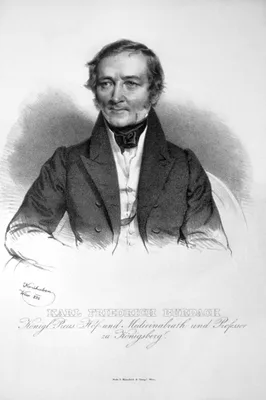
1819 –1826 BURDACH, Karl Friedrich (1776 – 1847)
Vom Baue und Leben des Gehirns. 3 vols.
Includes description of “Burdach’s column”, the posterior column of the spinal cord. This work is also “an unrivalled source of historical information on macroscopical neuroanatomy” (Meyer).
GMN 1358 · https://historyofmedicine.com/id/1661
1820 SWAN, Joseph (1791 – 1874)
A dissertation on the treatment of morbid local affections of nerves.
An early discussion of peripheral nerve injuries, tumors, and inflammation of nerves, including issues of pain and healing. Swan was among the first of the 19th-century surgeons to argue that divided nerves that are s…
GMN 7596 · https://historyofmedicine.com/id/9768
1821 BELL, Sir Charles (1774 – 1842)
On the nerves; giving an account of some experiments on their structure and functions, which lead to a new arrangement of the system.
“Bell’s palsy”. The facial paralysis ensuing upon lesion of the motor nerve of the face is described here for the first time. See also his later paper, with more detailed description, in the same journal, 1829, 119, 3…
GMN 1255 · https://historyofmedicine.com/id/381
1822 –1823 MAYO, Herbert (1796 – 1852)
Anatomical and physiological commentaries. Numbers I & II [All published].
Mayo discovered and described the functions of the Vth and VIIth cranial nerves on pp. 107-120 of Number I, and did much towards the clarification of the idea of reflex action. Reprinted, Metuchen, N.J., Scarecrow Pre…
GMN 1390 · https://historyofmedicine.com/id/1943
1822 MAGENDIE, François (1783 – 1855)
Expériences sur les fonctions des racines des nerfs rachidiens.
Magendie definitely discovered that the anterior root is motor and that the dorsal root is sensory, although Romberg, Flourens, Sherrington, and others credited the discovery to Charles Bell. In this paper Magendie an…
GMN 1256 · https://historyofmedicine.com/id/2122
1822 MAGENDIE, François (1783 – 1855)
Expériences sur les fonctions des racines des nerfs qui naissent de la moelle épinière.
Further experiments, including, most probably, “the first use of strychnine as part of a study of the localization of function in the nervous system as well as being a very early example of the rational use of a known…
GMN 1256.1 · https://historyofmedicine.com/id/2127
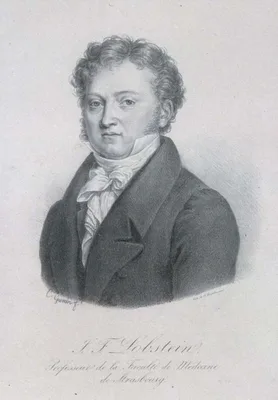
1823 LOBSTEIN, Jean Georges Chrétien Frédéric Martin (1777 – 1835)
De nervi sympathetici humani fabrica usu et morbis.
Includes description of “Lobstein’s ganglion”, an accessory ganglion of the sympathetic nerve above the diaphragm. English translation, 1831.
GMN 1317 · https://historyofmedicine.com/id/1264
1823 FLOURENS, Marie Jean Pierre (1794 – 1867)
Recherches physiques sur les propriétés et les fonctions du système nerveux dans les animaux vertébrés.
Flourens removed the cerebrum and cerebellum in pigeons, showing maintenance of reflexes with loss of cerebration in the former case and disturbance of equilibrium in the latter case. Thus he demonstrated that the cer…
GMN 1391 · https://historyofmedicine.com/id/1947
1825 MAGENDIE, François (1783 – 1855)
Mémoire sur un liquide qui se trouve dans le crâne et le canal vertebral de l’homme et des animaux mammifères.
First clear description of the cerebrospinal fluid.
GMN 1392 · https://historyofmedicine.com/id/1952
1825 ROLANDO, Luigi (1773 – 1831)
Osservazioni sul cervelletto.
Rolando was the first to investigate the functions of the cerebellum. His name is perpetuated in the “fissure of Rolando”, so named by F. Leuret, Anatomic comparée, 1839-57, whose attention had been drawn to it previo…
GMN 1393 · https://historyofmedicine.com/id/1957
1826 MÜLLER, Johannes Peter (1801 – 1858)
Zur vergleichenden Physiologie des Gesichtssinnes des Menschen und der Thiere.
Includes Müller’s law of specific nerve energies. For an English translation, see his Elements of physiology, transl. W. Baly, London, 1838, vol. 1, pp. 766-67. Includes (p. 73) his explanation of the color sensations…
GMN 1257 · https://historyofmedicine.com/id/2130
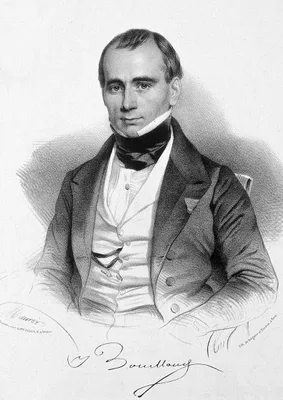
1827 BOUILLAUD, Jean Baptiste (1796 – 1881)
Recherches expérimentales tendant à prouver que le cervelet préside aux actes de la station et de la progression, et non à l’instinct de la propagation.
Bouillaud identified the anterior lobes as the speech center. Refuting Gall, he showed that the brain controls equilibration, station, and progression. Title of second paper varies. His earlier Traité clinique et phys…
GMN 1395 · https://historyofmedicine.com/id/1967

![WINSLOW, Jacques-Bénigne [Jacob Benignus Winsløw] (1669 – 1760)](/media/portraits/708)