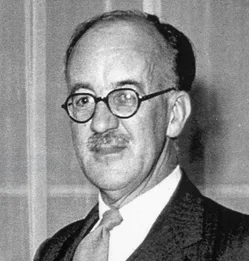
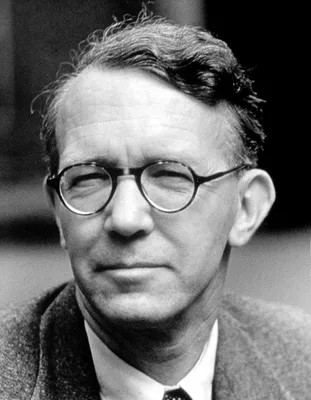
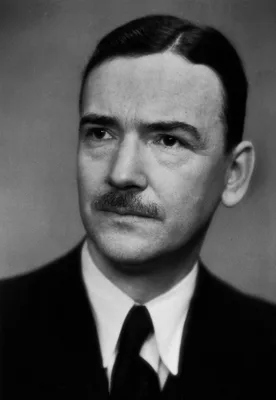
1904 ELLIOTT, Thomas Renton (1877 – 1961)
On the action of adrenalin.
The first intimation of the chemical mediation of nerve impulses was given in Elliott’s suggestion that when a sympathetic nerve impulse arrives at a smooth-muscle cell it liberates adrenaline, which acts as a chemica…
GMN 1336 · https://historyofmedicine.com/id/1440
1905 –1906 HOWELL, William Henry (1860 – 1945)
Vagus inhibition of the heart in its relation to the inorganic salts of the blood.
Howell suggested that nerve impulses act indirectly by increasing the amount of diffusible potassium compounds in the heart tissue.
GMN 1337 · https://historyofmedicine.com/id/1446
1906 HUNT, Reid (1870 – 1948); TAVEAU, René de Mortemer (1876 – )
On the physiological action of certain cholin derivatives and new methods for detecting cholin.
Discovery of the remarkable hypotensive effect of acetylcholine.
GMN 1338 · https://historyofmedicine.com/id/1457
1908 –1909 DIXON, Walter Ernest (1871 – 1931); HAMILL, Philip (1883 – 1959)
The mode of action of specific substances with special reference to secretin.
These workers drew attention to the similarity between the effects of nerve stimulation and certain drugs, especially muscarine, on the heart.
GMN 1339 · https://historyofmedicine.com/id/1461
c. 1914 DALE, Sir Henry Hallett (1875 – 1968)
The action of certain esters and ethers of choline, and their relation to muscarine.
Demonstration of the inhibitory action of acetylcholine on the heart. In 1936 Dale shared the Nobel Prize in Physiology or Medicine with Otto Loewi (No. 1343) "for their studies in the chemical mediation of nervous im…
GMN 1340 · https://historyofmedicine.com/id/1465
1914 EWINS, Arthur James (1882 – 1957)
Acetylcholine, a new active principle of ergot.
Isolation of acetylcholine in ergot.
GMN 1341 · https://historyofmedicine.com/id/1470
1918 HUNT, Reid (1870 – 1948)
Vasodilator reactions.
Showed that tissues are more sensitive to acetylcholine after treatment with eserine (physostigmine).
GMN 1342 · https://historyofmedicine.com/id/1475
1921 –1922 LOEWI, Otto (1873 – 1961)
Ueber humorale Uebertragbarkeit der Herznervenwirkung.
Loewi’s important experiments firmly established the theory of chemical intermediaries in nervous reactions. In 1936 Loewi shared the Nobel Prize in Physiology or Medicine with Dale "for discoveries related to chemica…
GMN 1343 · https://historyofmedicine.com/id/1486
1924 LOEWI, Otto (1873 – 1961); NAVRATIL, E
Ueber humorale Uebertragbarkeit der Herznervenwirkung
Established the presence of cholinesterase and that in vitro eserine inhibited this esterase.
GMN 1344 · https://historyofmedicine.com/id/8641
1929 DALE, Sir Henry Hallett (1875 – 1968); DUDLEY, Harold Ward (1887 – 1935)
The presence of histamine and acetylcholine in the spleen of the ox and the horse.
Isolation of acetylcholine from ox and horse spleen.
GMN 1345 · https://historyofmedicine.com/id/1518
1931 CANNON, Walter Bradford (1871 – 1945); BACQ, Zénon (1903 – 1983)
Studies on conditions of activity in endocrine organs. xxvi. A hormone produced by sympathetic action on smooth muscle.
Cannon and Bacq suggested the name “sympathin” for a substance which they considered to be liberated into the blood stream following nerve stimulation and which acted in the same manner as sympathetic impulses. See al…
GMN 1346 · https://historyofmedicine.com/id/1524
1931 ENGELHART, Erich
Der humorale Wirkungsmechanismus der Oculomotoriusreizung.
GMN 1347 · https://historyofmedicine.com/id/1529
1932 GIBBS, Owen Stanley (1898 – ); SZELÖCZEY, J
Die humorale Übertragung der Chorda tympani-Reizung.
Production of acetylcholine on stimulation of the chorda tympani nerve.
GMN 1348 · https://historyofmedicine.com/id/1534
1933 BAIN, William Alexander (1905 – 1971)
The mode of action of vasodilator and vasoconstrictor nerves.
GMN 1349 · https://historyofmedicine.com/id/1537
1933 CANNON, Walter Bradford (1871 – 1945); ROSENBLUETH, Arturo Stearns (1900 – 1970)
Studies on conditions of activity in endocrine organs, xxix. Sympathin E and sympathin I.
Adrenaline and sympathin were suggested to be unidentical substances, and Cannon and Rosenblueth proposed the terms “sympathin E” and “sympathin I”.
GMN 1350 · https://historyofmedicine.com/id/1543
1933 KIBJAKOW, A. W.
Ueber humorale Uebertragung der Erregung von einem Neuron suf das andere.
Kibjakow showed that some substance in a muscle perfusate is able to contract muscle during stimulation of nerve.
GMN 1351 · https://historyofmedicine.com/id/1547
1934 FELDBERG, Wilhelm Siegmund (1900 – 1993); GADDUM, Sir John Henry (1900 – 1965)
The chemical transmitter at synapses in a sympathetic ganglion.
These workers produced evidence that a chemical agent (acetylcholine) appears in the transfer of nerve impulses from neuron to neuron in sympathetic ganglia.
GMN 1352 · https://historyofmedicine.com/id/1551
1936 DALE, Sir Henry Hallett (1875 – 1968); FELDBERG, Wilhelm Siegmund (1900 – 1993); BROWN, Sir George Lindor (1903 – 1971)
Reactions of the normal mammalian muscle to acetylcholine and to eserine.
GMN 1353 · https://historyofmedicine.com/id/1557
1937 CANNON, Walter Bradford (1871 – 1945); ROSENBLUETH, Arturo Stearns (1900 – 1970)
Autonomic neuro-effector systems.
The authors hypothesized the existence of two sympathins, one excitatory and the other inhibitory, now known as epinephrine and norepinephrine. See Nos. 1144 & 1350.
GMN 1354 · https://historyofmedicine.com/id/1566
1946 EULER, Ulf Svante Hansson von (1905 – 1983)
A specific sympathomimetic ergone in adrenergic nerve fibres (sympathin) and its relations to adrenaline and nor-adrenaline.
Noradrenaline shown to be the predominant transmitter of the effects of sympathetic nerve impulses. In 1970 Euler shared the Nobel Prize in Physiology or Medicine with Katz and Axelrod "for their discoveries concernin…
GMN 1354.1 · https://historyofmedicine.com/id/1612
1952 KATZ, Sir Bernard (1911 – 2003)
Different forms of signalling employed by the nervous system.
In 1970 Katz shared the Nobel Prize in Physiology or Medicine with Ulf von Euler and J. Axelrod "for their discoveries concerning the humoral transmitters in the nerve terminals and the mechanism for their storage, re…
GMN 1354.2 · https://historyofmedicine.com/id/1619