1536 MASSA, Niccoló (1489 – 1569)
Liber introductorius anatomiae sive dissectionis corporis humani; in quo quam plurima membra, operationes, & utilitates tam ab antiquis, quam a modernis praetermissa manifestantur.
A practical manual for dissection, showing how to carry out an anatomy from the first incision onwards. Massa based his work on his experience gained from numerous dissections that he had undertaken in the hospital of…
GMN 1536 · https://historyofmedicine.com/id/2862
1573 VAROLIO, Costanzo (1543 – 1575)
De nervis opticis nonnulisque aliis praeter communem opinionem in humano capite observatis.
Varolio described a new method of dissection which enabled him to observe and describe the pons for the first time. By this new method Varolio was able to make some contributions to the knowledge of the course and ter…
GMN 1377.2 · https://historyofmedicine.com/id/1782
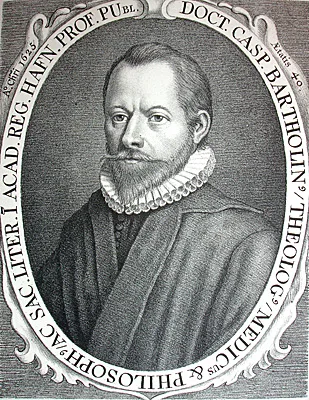
1641 BARTHOLIN, Thomas (1616 – 1680); LE BÖE, Franz de [FRANCISCUS SYLVIUS] (1614 – 1672); BARTHOLIN, Caspar Senior (1585 – 1629)
Institutiones anatomicae, novis recentiorum opinionibus & observationibus, quarum innumerae hactenus editae non sunt, figurisque auctae ab auctoris filio Thoma Bartholino.
In this revision of his father’s anatomical treatise, Thomas Bartholin included the first depiction of the fissure of Sylvius, the lateral cerebral fissure, and the only part of the surface of the cerebral hemispheres…
GMN 1377.3 · https://historyofmedicine.com/id/1791
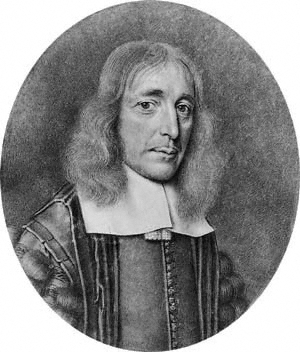
1664 WILLIS, Thomas (1621 – 1675)
Cerebri anatome: cui accessit nervorum descriptio et usus.
The most complete and accurate account of the nervous system which had hitherto appeared, and the work that coined the term, “neurology". In its preparation Willis was helped by his students Richard Lower and Thomas M…
GMN 1378 · https://historyofmedicine.com/id/1789
1669 STENO, Nicolas [Niels Steensen, Nicholaus Stenonis] (1638 – 1686)
Discours sur l’anatomie du cerveau.
In this remarkably prescient argument for, and critique of, anatomical research into brain function Stensen opposed Descartes (No. 574) arguing that it was idle to speculate about cerebral function when so little was …
GMN 1378.1 · https://historyofmedicine.com/id/1783
1684 VIEUSSENS, Raymond (1641 – 1715)
Neurographia universalis.
Vieussens, professor at Montpellier, was the first to describe the centrum ovale correctly. The publication of the above work threw new light on the subject of the configuration and structure of the brain, spinal cord…
GMN 1379 · https://historyofmedicine.com/id/1784
1695 RIDLEY, Humphrey (1653 – 1708)
The anatomy of the brain.
The first book on the brain in the English language, including the first account of the circular venous sinus which Ridley names, and the first English account of a pineal tumor. In it Ridley gives the first account o…
GMN 1379.1 · https://historyofmedicine.com/id/1785
1705 PACCHIONI, Antonio (1665 – 1726)
Dissertatio epistolaris ad Lucam Schroeckium de glandulis conglobatis durae meningis humanae.
Includes a description and illustration of the Pacchionian bodies of the arachnoid tissue under the dura, producing by pressure slight depressions (“Pacchionian depressions”). See also Pacchioni’s De durae meningis fa…
GMN 1380 · https://historyofmedicine.com/id/1786
1719 HENSING, Johann Thomas (1683 – 1726)
Cerebri examen chemicum, ex eodemqve phosphorum singularem omnia inflammabilia accendentem dissertatione academica.
First account of the chemical composition of the brain. Hensing discovered the presence of phosphorus. Annotated English translation with biography and historical analysis, by D.B. Tower. New York, Raven Press, [1983].
GMN 1380.1 · https://historyofmedicine.com/id/1793
1764 COTUGNO, Domenico [COTUNNIUS] (1736 – 1822)
De ischiade nervosa commentarius.
Cotugno published a classic description of sciatica, which is useful even today. He recognized two types – arthritic and nervous; the latter has been called “Cotugno’s disease”, and his book is confined to that type. …
GMN 1382 · https://historyofmedicine.com/id/8632
1776 MALACARNE, Michaele Vincenze Giacinto (1744 – 1816)
Nuova esposizione della vera struttura del cervelletto umano.
The first detailed account of the anatomy of the cerebellum, which introduced the terms, “tonsil”, “pyramid”, “lingula”, and “uvula”. Reprinted in his Encefalotomia a sia nuova diimostrazione anatomica di tutte le par…
GMN 1382.1 · https://historyofmedicine.com/id/1801
1778 SOEMMERRING, Samuel Thomas von (1755 – 1830)
Dissertatio inauguralis anatomica de basi encephali et originibus nervorum cranio egredientium libri quinque.
The first accurate enumeration of the 12 cranial nerves, superseding that of Willis (No. 1378). Soemmerring is notable for his accuracy in anatomical illustration. This was his thesis. The same publisher issued an edi…
GMN 1383 · https://historyofmedicine.com/id/1808
1778 SAUCEROTTE, Louis Sebastian (1741 – 1814)
Mémoire sur les contre-coups dans les lésions de la tête [1768].
“One of the first achievements of modern brain physiology” (Neuburger). Saucerotte carried out surgical experiments on dogs which convinced him that the anterior part of the cerebrum innervated the lower limbs and the…
GMN 1382.2 · https://historyofmedicine.com/id/2634
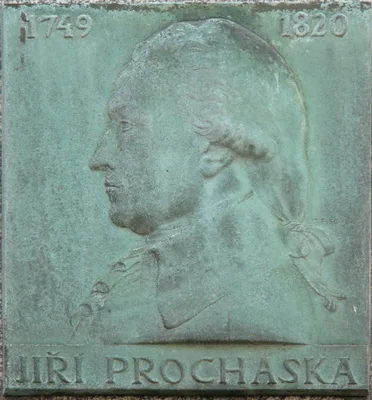
1780 –1784 PROCHASKA, Georg (1749 – 1820)
Adnotationum academicarum. Fasciculus tertius. III. De functionibus systematis nervosi. 3 pts.
Prochaska introduced the idea of a “sensorium commune” in the central nervous system, a consistent and comprehensive theory of reflex action. English translation, London, Sydenham Society, 1851.
GMN 1386 · https://historyofmedicine.com/id/1902
1782 GENNARI, Francesco (1750 – 1797)
De peculiari structura cerebri, nonnulisque ejus morbis.
Gennari was the first to demonstrate the laminar structure of the cerebral cortex when he discovered the line of Gennari, a macroscopically white band in the cerebral cortex of the occipital lobe. This he observed on …
GMN 1384 · https://historyofmedicine.com/id/1812
1783 MONRO, Alexander, Secundus (1733 – 1817)
Observations on the structure and functions of the nervous system.
Monro discovered the communication between the lateral ventricles of the human brain with each other and with the third ventricle, the “foramen of Monro”. Alexander secundus was the greatest of the three Monros.
GMN 1385 · https://historyofmedicine.com/id/1823
1793 FOURCROY, Antoine François, comte (1755 – 1809)
Examen chimique du cerveau de plusieurs animaux.
Fourcroy, French physician and chemist, made important researches on the chemistry of the brain. He noted albumen (protein) as a principal constituent.
GMN 1386.1 · https://historyofmedicine.com/id/1906
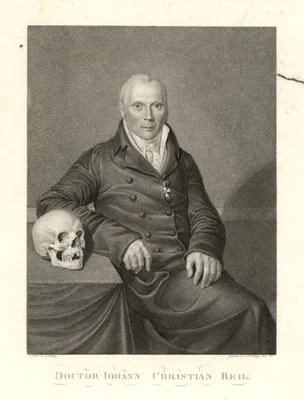
1796 REIL, Johann Christian (1759 – 1813)
Exercitationum anatomicarum fasciculus primus. De structura nervorum, tribus tabulis aeneis illustratus [All published].
Description of the “island of Reil”. This was the first part of the surface of the cerebral hemispheres to be given a name since 1641 (No. 1377.3). See also Reil’s follow-up paper in Arch. Physiol. (Halle), 1809, 9, 1…
GMN 1387 · https://historyofmedicine.com/id/1913
1809 ROLANDO, Luigi (1773 – 1831)
Saggio sopra la vera struttura del cervello dell’uomo e degl’animali e sopra le funzioni del sistema nervoso.
Includes description of “Rolando’s substance”, “tubercle”, and “funiculus”. Rolando described ablation experiments for brain localization similar to Flourens (No. 1391). They were largely unknown until Magendie publis…
GMN 1388 · https://historyofmedicine.com/id/1920
1810 –1819 GALL, Franz Joseph (1758 – 1828); SPURZHEIM, Johann Caspar (1776 – 1832)
Anatomie et physiologie du système nerveux en général, et du cerveau en particulier. 4 vols. and atlas.
Introduced the theory of localization of cerebral function, although in a somewhat fantastic form. This pioneer attempt to map out the cerebral cortex according to function gave rise to the pseudo-science of phrenolog…
GMN 1389 · https://historyofmedicine.com/id/1922
1811 VAUQUELIN, Louis Nicolas (1763 – 1829)
Analyse de la matière cérèbrale de l’homme et de quelques animaux.
First complete chemical analysis of the nervous system.
GMN 1389.1 · https://historyofmedicine.com/id/1925
1812 LE GALLOIS, Julien Jean César (Legallois) (1770 – 1814)
Expériences sur le principe de la vie.
Le Gallois described the action of the vagus nerve on respiration. He showed that bilateral section of the vagus can produce fatal bronchopneumonia. The above work includes (p. 37) his location of the respiratory cent…
GMN 1389.2 · https://historyofmedicine.com/id/143
1822 –1823 MAYO, Herbert (1796 – 1852)
Anatomical and physiological commentaries. Numbers I & II [All published].
Mayo discovered and described the functions of the Vth and VIIth cranial nerves on pp. 107-120 of Number I, and did much towards the clarification of the idea of reflex action. Reprinted, Metuchen, N.J., Scarecrow Pre…
GMN 1390 · https://historyofmedicine.com/id/1943
1823 FLOURENS, Marie Jean Pierre (1794 – 1867)
Recherches physiques sur les propriétés et les fonctions du système nerveux dans les animaux vertébrés.
Flourens removed the cerebrum and cerebellum in pigeons, showing maintenance of reflexes with loss of cerebration in the former case and disturbance of equilibrium in the latter case. Thus he demonstrated that the cer…
GMN 1391 · https://historyofmedicine.com/id/1947
1825 MAGENDIE, François (1783 – 1855)
Mémoire sur un liquide qui se trouve dans le crâne et le canal vertebral de l’homme et des animaux mammifères.
First clear description of the cerebrospinal fluid.
GMN 1392 · https://historyofmedicine.com/id/1952
1825 ROLANDO, Luigi (1773 – 1831)
Osservazioni sul cervelletto.
Rolando was the first to investigate the functions of the cerebellum. His name is perpetuated in the “fissure of Rolando”, so named by F. Leuret, Anatomic comparée, 1839-57, whose attention had been drawn to it previo…
GMN 1393 · https://historyofmedicine.com/id/1957
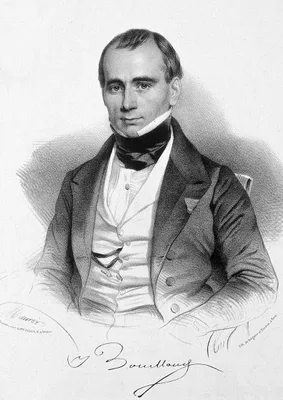
1827 BOUILLAUD, Jean Baptiste (1796 – 1881)
Recherches expérimentales tendant à prouver que le cervelet préside aux actes de la station et de la progression, et non à l’instinct de la propagation.
Bouillaud identified the anterior lobes as the speech center. Refuting Gall, he showed that the brain controls equilibration, station, and progression. Title of second paper varies. His earlier Traité clinique et phys…
GMN 1395 · https://historyofmedicine.com/id/1967
1829 ROLANDO, Luigi (1773 – 1831)
Della struttura degli emisferi cerebrali.
GMN 1394 · https://historyofmedicine.com/id/1962
1837 PURKYNĔ, Jan Evangelista [PURKINJE] (1787 – 1869)
Neueste Untersuchungen aus der Nerven-und Hirnanatomie.
Description of the “flask-shaped ganglionic bodies” known as “Purkinje cells”. Reprinted in his Opera Omnia, 1939, 3, 47-9. Also published in Oken’s Isis, 1838, pp. 582-84.
GMN 1396 · https://historyofmedicine.com/id/1980
1839 –1857 LEURET, François (1797 – 1851); GRATIOLET, Louis Pierre (1815 – 1865)
Anatomie comparée du système nerveux. 2 vols. and atlas.
The first comprehensive systematic investigation of the mammalian brain. Leuret wrote vol. 1 without Gratiolet, who later became his collaborator, publishing vol. 2 and the atlas after Leuret’s death.
GMN 1396.01 · https://historyofmedicine.com/id/1988
1840 BAILLARGER, Jules Gabriel François (1809 – 1890)
Recherches sur la structure de la couche cortical des circonvolutions du cerveau.
Baillarger demonstrated that the cortex is made up of layers and that fibers connect the cortex with the internal white matter. English translation in von Bonin, Some papers on the cerebral cortex, Springfield: Charle…
GMN 1396.1 · https://historyofmedicine.com/id/1991
1842 MAGENDIE, François (1783 – 1855)
Recherches physiologiques et cliniques sur le liquide céphalo-rachidien ou cérébro-spinal. 1 vol. and atlas.
“Foramen of Magendie” described.
GMN 1397 · https://historyofmedicine.com/id/1993
1853 FAIVRE, Ernest (1827 – 1879)
Des granulations méningiennes. Thèse pour le doctorat en médecine.
Digital facsimile from wellcomecollection.org at this link. See also his paper in Ann. Sci. nat., 1853, 20, 321-33 (Zool.).
GMN 1398 · https://historyofmedicine.com/id/1996
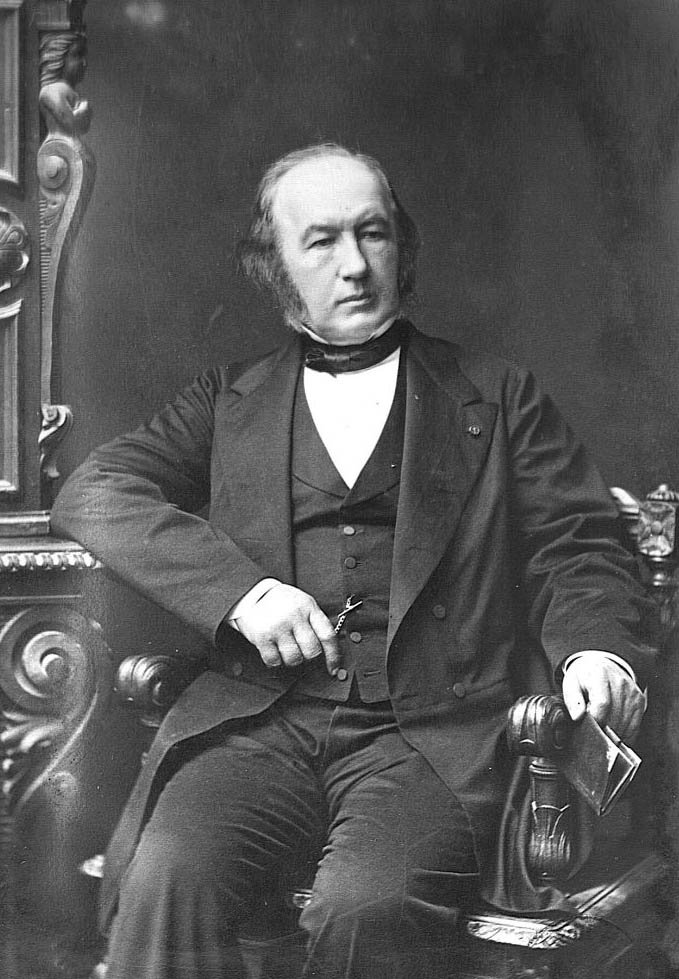
1858 BERNARD, Claude (1813 – 1878)
Leçons sur la physiologie et la pathologie du système nerveux. 2 vols.
GMN 1399 · https://historyofmedicine.com/id/2000
1861 BROCA, Pierre Paul (1824 – 1880)
Remarques sur le siège de la faculté du langage articulé, suivie d’une observation d’aphémie (perte de la parole).
Broca claimed the third left frontal convolution of the brain as the center of articulate speech – a point now disputed. He was first to trephine for a cerebral abscess diagnosed by this theory of localization of func…
GMN 1400 · https://historyofmedicine.com/id/2005
1861 DALTON, John Call (1825 – 1889)
On the cerebellum, as the centre of co-ordination of the voluntary movements.
GMN 1401 · https://historyofmedicine.com/id/2010
1863 AUBURTIN, Simon Alexandre Ernest (1825 – 1893)
Considérations sur les localisations cérébrales et en particulier sur le siège de la faculté du langage articulé.
Auburtin did much to establish the principle of cerebral localization. He demonstrated on a patient whose frontal lobe was exposed following a gunshot wound that merely touching the uninjured lobe with a spatula would…
GMN 1401.1 · https://historyofmedicine.com/id/2018
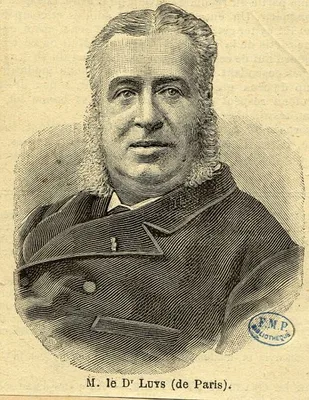
1865 LUYS, Jules Bernard (1828 – 1897)
Recherches sur le système nerveux cérébro-spinal; sa structure, ses fonctions, et ses maladies. 1 vol. and atlas.
The beginning of knowledge of thalamic function. This work contains Luys’s descriptions of the two structures which bear his name: the subthalamic nucleus and the center median of the thalamus.
GMN 1402 · https://historyofmedicine.com/id/2030
1867 MEYNERT, Theodor Hermann (1833 – 1892)
Der Bau der Gross-Hirnrinde und seine örtlichen Verschiedenheiten, nebst einem pathologisch-anatomischen Corollarium.
Meynert noticed regional variations in the histological structure of different parts of the gray matter in the cerebral hemispheres. He is credited with beginning the study of cytoarchitecture. Meynert described the f…
GMN 1403 · https://historyofmedicine.com/id/2035
1869 MITCHELL, Silas Weir (1829 – 1914)
Researches on the physiology of the cerebellum.
Mitchell, leading American neurologist of his time, performed over 350 experiments upon the cerebellum. He emphasized its co-ordinating function, first postulated by Flourens, and he proposed his “augmentor” theory of…
GMN 1404 · https://historyofmedicine.com/id/2043
1870 FRITSCH, Gustav Theodor (1838 – 1891); HITZIG, Eduard (1838 – 1907)
Ueber die elektrische Erregbarkeit des Grosshirns.
These workers showed that electrical stimulation of the frontal cortex in various experimental animals caused movements of the extremities of the opposite side of the body, thus proving the existence of a motor area i…
GMN 1405 · https://historyofmedicine.com/id/2049
1870 GUDDEN, Bernhard Aloys von (1824 – 1886)
Experimentaluntersuchungen über das peripherische und centrale Nervensystem.
Modern study of the functions of the thalamus began with the important investigations of Gudden. He is remembered eponymically by “Gudden’s commissure” and “Gudden’s atrophy” – specific thalamic nuclei degenerate when…
GMN 1406 · https://historyofmedicine.com/id/2052
1873 LUYS, Jules Bernard (1828 – 1897)
Iconographie photographique des centres nerveux.
Contains 70 photographs of brain sections taken by Luys himself, with 64 lithographed schemas based on his drawings. Luys undertook this work when the evidence of his lithographs published in 1865 (No. 4012) was dispu…
GMN 1406.01 · https://historyofmedicine.com/id/2066
1873 FERRIER, Sir David (1843 – 1928)
Experimental researches in cerebral physiology and pathology.
Using a variety of experimental animals, Ferrier demonstrated that various neurologic functions were controlled by separate parts of the cerebrum and that damage or loss of that part created an irrevocable and particu…
GMN 7803 · https://historyofmedicine.com/id/9975
1874 BARTHOLOW, Roberts (1831 – 1904)
Investigations into the functions of the human brain.
Bartholow confirmed in man the findings of Fritsch and Hitzig (No. 1405) that electrical stimulus of the cortex on one side stimulated muscles on the other side of the body.
GMN 1406.1 · https://historyofmedicine.com/id/2070
1874 BETZ, Vladimir Alexeyevich (1834 – 1894)
Anatomischer Nachweis zweier Gehirncentra.
Discovery of the giant pyramidal cells of the motor cortex.
GMN 1407 · https://historyofmedicine.com/id/2072
1874 HITZIG, Eduard (1838 – 1907)
Untersuchungen über das Gehirn.
Hitzig accurately defined the limits of the motor area in the cerebral cortex of the dog and the monkey.
GMN 1408 · https://historyofmedicine.com/id/2075
1875 CATON, Richard (1842 – 1926)
The electric currents of the brain.
Caton succeeded in leading off action potentials from the brains of animals, a first step towards the development of the electroencephalograph. See also Brit. med. J., 1877, 1, Suppl. 62-75.
GMN 1408.1 · https://historyofmedicine.com/id/2077
1875 –1876 RETZIUS, Magnus Gustaf (1842 – 1919); KEY, Axel (1832 – 1901)
Studien in der Anatomie des Nervensystems und des Bindegewebes. Erste Hälfte und zweite Hälfte, erste und zweite Abtheilung. 2 vols.
One of the most strikingly beautiful neuroanatomies ever published, with exquisite reproductions of the color dye injection experiments. The authors confirmed the existence of the foramina of Magendie and Luschka, and…
GMN 1408.2 · https://historyofmedicine.com/id/2079
1876 FERRIER, Sir David (1843 – 1928)
The functions of the brain.
Ferrier may be said to have laid the foundations of our knowledge concerning the localization of cerebral function. His book includes his earlier work published in the West Riding Lunatic Asylum Reports. Digital facsi…
GMN 1409 · https://historyofmedicine.com/id/2082