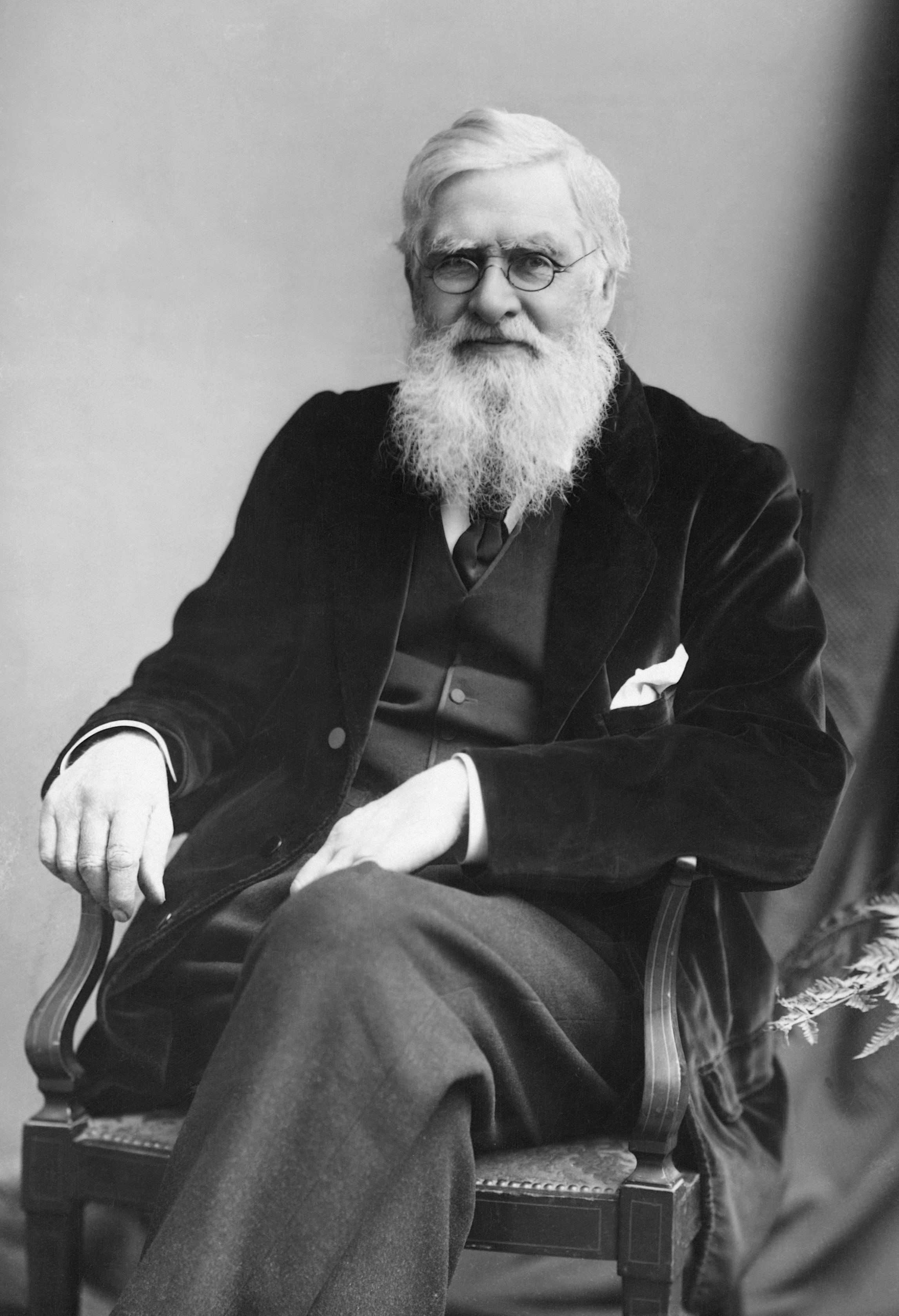
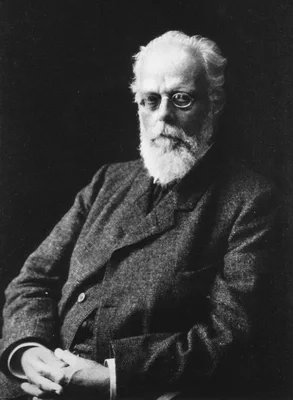
1889 WALLACE, Alfred Russel (1823 – 1913); WEISMANN, August Friedrich Leopold (1834 – 1914)
The action of natural selection in producing old age, decay, and death. In Essays upon heredity and kindred biological problems by August Weismann; authorized translation edited by Edward B. Poulton, Selmar Schönland and Arthur E. Shipley, Chapter 1, "The duration of life," page 23.
Wallace proposed the first evolutionary theory of aging. He stated that if too many people lived for a long time they would compete for resources needed for other members of the species that were of reproduction age. …
GMN 14344 · https://historyofmedicine.com/id/16674
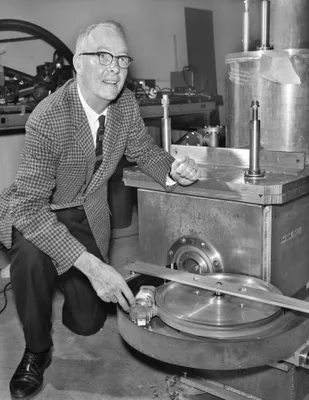
1979 ALVAREZ, Luis Walter (1911 – 1988); ALVAREZ, Walter (1940 – ); ASARO, Frank (1927 – 2014); MICHEL, Helen Vaughan (1932 – )
Experimental evidence in support of an extra-terrestrial trigger for the Cretaceous-Tertiary extinctions. (Abstract).
Iridium is a very rare element in the Earth's crust, but is found in anomalously high concentrations (around 1000 times greater than normal) in a thin worldwide layer of clay marking the boundary between the Cretaceou…
GMN 14206 · https://historyofmedicine.com/id/16522
1980 ALVAREZ, Luis Walter (1911 – 1988); ALVAREZ, Walter (1940 – ); ASARO, Frank (1927 – 2014); MICHEL, Helen Vaughan (1932 – )
Extraterrestrial cause for the Cretaceous-Tertiary extinction.
Following up on No. 14206, the authors stated that the same excess iridium areas were found in two different areas of W. Europe and in New Zealand, and posited that “the anomalous iridium concentrations at the C [reta…
GMN 14207 · https://historyofmedicine.com/id/16523
1991 HILDEBRAND, Alan Russell (1955 – ); PENFIELD, Glen T.; KRING, David A. (1961 – ); CAMARGO-ZANOGUERA, Antonio; ET AL
Chicxulub Crater: A possible Cretaceous/Tertiary boundary impact crater on the Yucatán Peninsula, Mexico.
Eleven years after publication of No. 14207, Alan Hildebrand, working with Luis and Walter Alvarez, proposed that the Chicxulub Crater, discovered by Antonio-Camargo-Zanoguera and Glen T. Penfield during the 1970s, wa…
GMN 14208 · https://historyofmedicine.com/id/16524
2006 SHUBIN, Neil H. (1960 – ); DAESCHLER, Edward B.; JENKINS, Farish Alston (1940 – 2012)
The pectoral fin of Tiktaalik roseae and the origin of the tetrapod limb.
In 2004 Shubin, Daeschler and Jenkins discovered the first well-preserved Tiktaalik fossils in on Ellesmere Island in Nunavut, Canada. Tiktaalik is a non-tetrapod member of Osteichthyes (bony fish) from the late Devon…
GMN 14084 · https://historyofmedicine.com/id/16395
2006 SHUBIN, Neil H. (1960 – ); DAESCHLER, Edward B.; JENKINS, Farish Alston (1940 – 2012)
A Devonian tetrapod-like fish and the evolution of the tetrapod body plan.
The authors showed that: 1) This transitional species had a set of features representing a major departure from the pattern in more primitive sarcopterygian fishes. 2) They presented data to indicate that Tiktaalik li…
GMN 14085 · https://historyofmedicine.com/id/16396
2022 KORZH, Vladimir P.; GASANOV, Eugene V.
Genetics of atavism.
Abstract: "Atavisms have attracted people’s attention for a long time. First, atavisms excited their imagination and created fertile ground for myths and superstitions. With the development of science, atavisms became…
GMN 14107 · https://historyofmedicine.com/id/16418