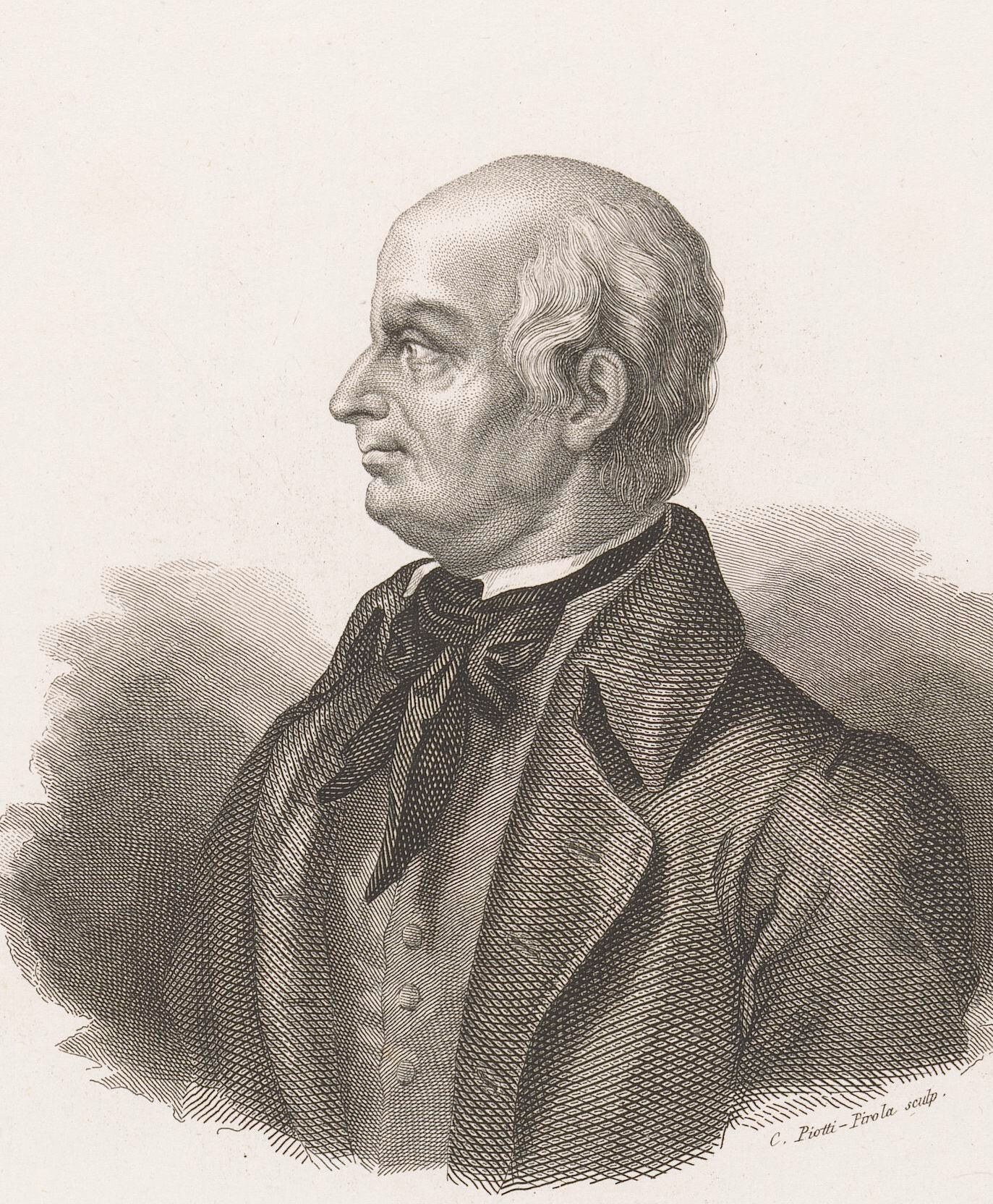
1780 SPALLANZANI, Lazzaro (1729 – 1799)
Dissertazioni di fisica animale e vegetable. 2 vols.
In the first patrt of this work, Della digestione dissertazione prima Spallanzani confirmed earlier doctrines of the solvent property of the gastric juice and discovered the action of the saliva in digestion. He state…
GMN 981 · https://historyofmedicine.com/id/628
1787 DENMAN, Thomas (1733 – 1815)
A collection of engravings, tending to illustrate the generation and parturition of animals, and of the human species.
An idiosyncratic collection of rarely reproduced images with explanatory commentaries in English and French, concerning reproduction and obstetric complications in animals and humans. Topics include: The Funis of a nu…
GMN 12163 · https://historyofmedicine.com/id/14373
1843 BARRY, Martin (1802 – 1855)
Spermatozoa observed within the mammiferous ovum.
Barry was the first to observe the spermatozoon within the ovum.
GMN 484.1 · https://historyofmedicine.com/id/1396
1876 HERTWIG, Wilhelm August Oscar (1849 – 1922)
Beiträge zur Kenntnis der Bildung, Befruchtung und Theilung des thierischen Eies.
Demonstration that the spermatozoon enters the ovum and that fertilization occurs by the union of the nuclei of the male and female sex cells. Hertwig also established that the transfer of hereditary material is part …
GMN 495 · https://historyofmedicine.com/id/1433
1891 HENKING, Hermann (1858 – 1942)
Untersuchungen über den ersten Entwicklungsvorgänge in den Eiern der Insekten. II. Ueber Spermatogenese und deren Beziehung zur Eientwicklung bei Pyrrhocoris apterus.
In his study of the testicles of the firebug (Pyrrhocoris) Henking noticed that one chromosome did not take part in meiosis. He named this X element because its strange behavior made him unsure whether it was genuinel…
GMN 517.1 · https://historyofmedicine.com/id/1596
1902 MCCLUNG, Clarence Erwin (1870 – 1946)
The accessory chromosome; sex determination.
McClung showed that the accessory chromosomes are the determinants of sex.
GMN 518 · https://historyofmedicine.com/id/1602
1908 BRYCE, Thomas Hastie (1862 – 1946); TEACHER, John Hammond (1869 – 1930)
Contributions to the study of the early development and imbedding of the human ovum. An early ovum imbedded in the decidua.
The “Bryce-Teacher ovum”, age estimated at 13-14 days.
GMN 523 · https://historyofmedicine.com/id/1652
1913 LILLIE, Frank Rattray (1870 – 1947)
The mechanism of fertilization.
GMN 527.1 · https://historyofmedicine.com/id/1679
1916 LILLIE, Frank Rattray (1870 – 1947)
The theory of the free-martin.
Lillie found that sex steroids in the blood controlled differentiation. "Free-martins, sterile female cows born without sex organs, were a perplexing issue for cattle ranchers. Lillie found that free-martins formed wh…
GMN 11854 · https://historyofmedicine.com/id/14058
1920 GOLDSCHMIDT, Richard Benedict (1878 – 1958)
Mechanismus und Physiologie der Geschlechtsbestimmung.
Translated into English William J. Dakin as The Mechanism and Physiology of Sex Determination (London: Methuen & Co., 1923). Digital facsimile of the 1920 edition from Google Books at this link. Digital facsimile of t…
GMN 529 · https://historyofmedicine.com/id/1684
1924 MOORE, Carl Richard (1892 – 1955); QUICK, William J.
The scrotum as a temperature regulator for the testes.
Moore and Quick established that the scrotal sac, and its ability to expand or contract, helps to regulate the temperature of the testes. Through this mechanism it enables sperm production and supports the viability o…
GMN 14195 · https://historyofmedicine.com/id/16511
1929 FRANK, Robert Tilden (1875 – 1949)
The female sex hormone. Part I: Biology, pharmacology and chemistry. Part II: Clinical investigations based on the female sex hormone blood test.
The first handbook on female sex hormones. Digital facsimile from the Hathi Trust at this link.
GMN 7186 · https://historyofmedicine.com/id/9353
1934 EULER, Ulf Svante Hansson von (1905 – 1983)
Zur Kenntnis der pharmakologischen Wirkungen der Natursekreten und Extrakten männlicher accessorischer Geschlechtsdrüsen.
Prostaglandins. Von Euler reported that a lipid fraction of human seminal fluid had potent activities on smooth muscle, hence the name. Later, prostaglandins were found to be widely distributed in mammalian tissues an…
GMN 1924.3 · https://historyofmedicine.com/id/2715
1942 ROCK, John A. (1890 – 1984); HERTIG, Arthur Tremain (1904 – 1990)
Some aspects of early human development.
Report of the youngest normal implanted fertilized human ovum, fertilization age about 7 1/2 days. Hertig and Rock published a more detailed study in Contr. Embryol. Carneg. Instn. 1945, 31, 65-84.
GMN 532 · https://historyofmedicine.com/id/1696
1949 BARR, Murray Llewellyn (1908 – 1995); BERTRAM, Ewart George (1923 – )
A morphological distinction between neurones of the male and female, and the behaviour of the nucleolar satellite during accelerated nucleoprotein synthesis.
The Barr body, " the inactive X chromosome in a female somatic cell,[2] rendered inactive in a process called lyonization, in those species in which sex is determined by the presence of the Y (including humans) or W c…
GMN 255.5 · https://historyofmedicine.com/id/8694
1953 BARR, Murray Llewellyn (1908 – 1995); MOORE, Keith Leon (1925 – ); GRAHAM, Margaret A.
The detection of chromosomal sex in hermaphrodites from a skin biopsy.
Sex chromatin demonstrated in humans.
GMN 256.2 · https://historyofmedicine.com/id/8699
2011 CAMBRIDGE UNIVERSITY LIBRARY
Books & babies: Communicating reproduction.
http://www.lib.cam.ac.uk/exhibitions/Babies/index.html "The London underground displays posters for fertility clinics, directed at both women and men. Picture books teach children the facts of life. We are always read…
GMN 10549 · https://historyofmedicine.com/id/12742