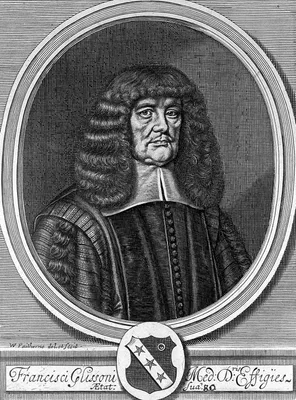
1650 GLISSON, Francis (1597 – 1677); BATE, George (1608 – 1668); REGEMORTER, Ahasuerus (Assuerus Regimorter) (1614 – 1650)
De rachitide sive morbo puerili, qui vulgo The Rickets dicitur tractatus.
Although anticipated by Whistler and others in the description of infantile rickets, Glisson’s account was the fullest that had till then appeared. He was first (Chap. 22) to describe infantile scurvy. Glisson’s book …
GMN 3729 · https://historyofmedicine.com/id/4509
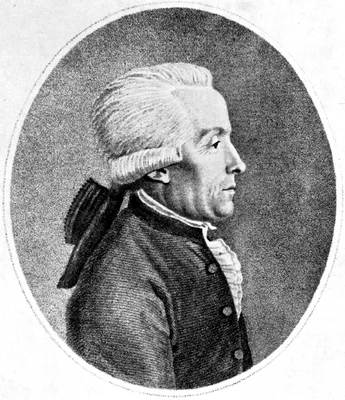
1788 VENEL, Jean-André (1740 – 1791)
Description de plusieurs nouveaux moyens mécaniques propres à prevénir, borner et même corriger dans certains cas les courbures latérales et la torsion de l’épine du dos.
Venel stressed the necessity for prolonged periods of recumbency, rather than exercise, in the correction of spinal curvature. He invented a corset and extension bed for treating spinal deformities. His extension bed …
GMN 4305 · https://historyofmedicine.com/id/5479
1813 BAYNTON, Thomas (1761 – 1820)
An account of a successful method of treating diseases of the spine.
By his advocacy of absolute rest in the horizontal position without the aid of caustics and setons, Baynton can be said to have introduced the modern treatment of spinal caries in England. The book is dedicated to Edw…
GMN 4309 · https://historyofmedicine.com/id/5509
1827 HARRISON, Edward (1766 – 1838)
Pathological and practical observations on spinal diseases: illustrated with cases and engravings. Also, An inquiry into the origin and cure of distorted limbs.
Harrison founded the first infirmary for spinal diseases in London. See Weiner & Silver, "Edward Harrison and the treatment of spinal deformities in the nineteenth century," J. R. Coll. Phys. Edinb., 38 (2006) 265-71.…
GMN 13539 · https://historyofmedicine.com/id/15816
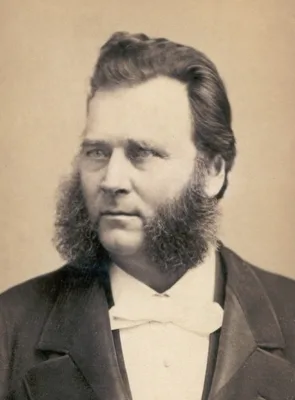
1876 SAYRE, Lewis Albert (1820 – 1900)
Report on Pott’s disease, or caries of the spine; treated by extension, and the plaster of Paris bandage.
Sayre was the first to use plaster of Paris as a support for the spinal column in scoliosis and Pott’s disease. His name is eponymically linked with Sayre’s jacket, a plaster of Paris jacket applied while the patient …
GMN 4344 · https://historyofmedicine.com/id/5714
1877 SAYRE, Lewis Albert (1820 – 1900)
Spinal disease and spinal curvature, their treatment by suspension and the use of the plaster of Paris bandage.
Sayre’s monograph on his methods of treating tuberculosis of the spine and scoliosis is the first American surgical textbook to contain actual mounted photographs, some of which are remarkable for their artistic quali…
GMN 4344.1 · https://historyofmedicine.com/id/5717
1890 BRADFORD, Edward Hickling (1848 – 1926); LOVETT, Robert Williamson (1859 – 1924)
Treatise on orthopedic surgery.
Includes a description of the “Bradford frame”, used in the treatment of spinal disorders.
GMN 4353 · https://historyofmedicine.com/id/5763
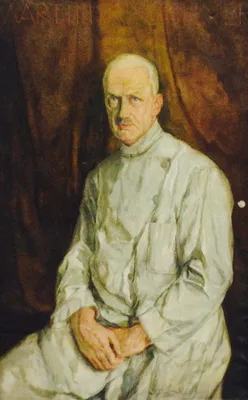
1891 HADRA, Berthold Ernest (1842 – 1903)
Wiring of the vertebrae as a means of immobilization in fracture and Pott’s disease.
“In a case of fracture-dislocation of the cervical spine (C 6-7) he [Hadra] performed open reduction, twisting metal wires around the spinous processes to stabilize the injured sector” (Bick). This is the first report…
GMN 4359.1 · https://historyofmedicine.com/id/5800
1891 HADRA, Berthold Ernest (1842 – 1903)
Wiring the spinal processes in Pott’s disease.
First spinal fusion.
GMN 4359.2 · https://historyofmedicine.com/id/5802
1909 KIRSCHNER, Martin (1879 – 1942)
Ueber Nagelextension.
Kirschner wire, for skeletal traction, and for stabilization of bone fragments or joint immobilization.
GMN 4378 · https://historyofmedicine.com/id/5887
1911 GOLDTHWAIT, Joel Ernest (1866 – 1961)
The lumbo-sacral articulation. An explanation of many cases of “lumbago”, “sciatica” and paraplegia.
Goldthwait suggested that lumbago and sciatica might be due to intervertebral disc injury.
GMN 4383 · https://historyofmedicine.com/id/5898
1911 HIBBS, Russell Aubra (1869 – 1932)
An operation for progressive spinal deformities.
Spinal fusion first used for the treatment of scoliosis.
GMN 4383.1 · https://historyofmedicine.com/id/5902
1911 TEACHER, John Hammond (1869 – 1930); MIDDLETON, George Stevenson (1854 – 1928)
Injury of the spinal cord due to rupture of an intervertebral disc during muscular effort.
Report of a case of “sciatica” due to rupture of an intervertebral disc.
GMN 4384 · https://historyofmedicine.com/id/5908
1911 ALBEE, Fred Houdlett (1876 – 1945)
Transplantation of a portion of the tibia into the spine for Pott’s disease. A preliminary report.
The beginning of bone graft surgery as a planned, carefully designed procedure. Albee was the first to employ living bone grafts as internal splints. See No. 5757.
GMN 4384.1 · https://historyofmedicine.com/id/5912
1934 MIXTER, William Jason (1880 – 1958); BARR, Joseph Seaton (1901 – 1963)
Rupture of the intervertebral disc with involvement of the spinal canal.
Demonstration of the causal role of intervertebral disc herniation in sciatica.
GMN 4435 · https://historyofmedicine.com/id/6294
1962 HARRINGTON, Paul Randall (1911 – 1980)
Treatment of scoliosis: Correction and internal fixation by spine instrumentation.
The “Harrington rod” system for scoliosis and spine fracture surgery.
GMN 4405.2 · https://historyofmedicine.com/id/6109