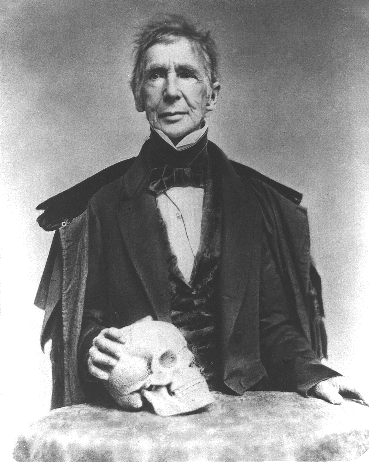
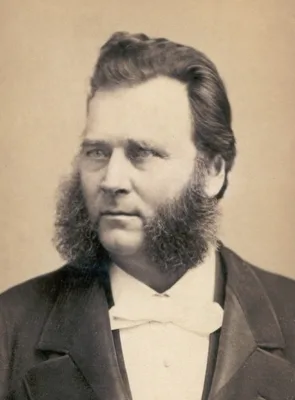
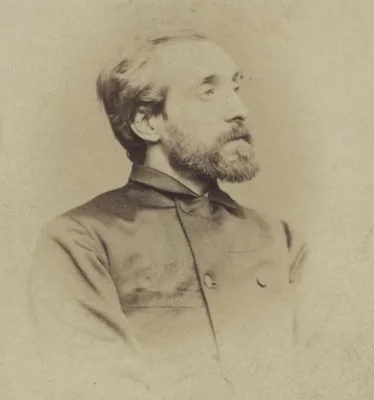
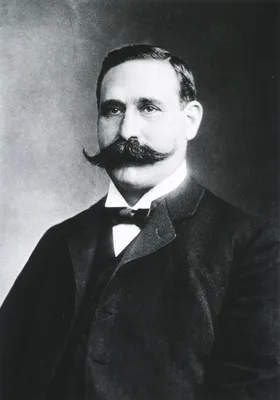
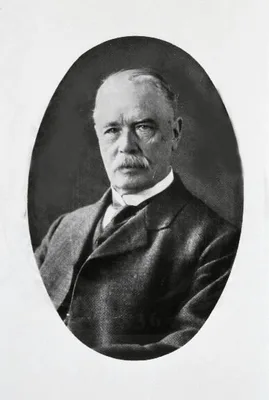
1825 LOWELL, Charles (1793 – 1858)
Report of the trial of an action: Charles Lowell against John Faxon and Micajah Hawks, doctors of medicine, defendants, for malpractice in the capacity of physicians and surgeons: At the Supreme Judicial Court of Maine, holden at Machias for the county of Washington, June term, 1824, before the Hon. Nathan Weston, Jun., justice of the court.
A detailed narrative on the trial based on the transcript. Digital facsimile from the U.S. National Library of Medicine at this link.
GMN 11730 · https://historyofmedicine.com/id/13931
1826 WARREN, John Collins (1778 – 1856)
A letter to the Hon. Isaac Parker, chief justice of the Supreme court of the state of Massachusetts, containing remarks on the dislocation of the hip joint, occasioned by the publication of a trial which took place at Machias, in the state of Maine, June, 1824. By John C. Warren. With an appendix of documents from the trial necessary to illustrate the history of the case.
This work, illustrated with 5 plates, contains several clear and minute descriptions of dislocation of the hip joint. In the course of the monograph Warrenproved the possibility of a type of dislocation that was denie…
GMN 11728 · https://historyofmedicine.com/id/13929
1853 BRASHEAR, Walter (1776 – 1860)
Amputations.
The first successful amputation of the hip-joint was performed by Brashear in 1806 at Bardstown, Kentucky; he first amputated the thigh through its middle third, and tied off the bleeding vessels; then he made a long …
GMN 4462 · https://historyofmedicine.com/id/67
1855 SAYRE, Lewis Albert (1820 – 1900)
Exsection of the head of the femur and removal of the upper rim of the acetabulum, for morbus coxarius, with perfect recovery.
Resection of the hip for ankylosis.
GMN 4331 · https://historyofmedicine.com/id/5562
1869 BIGELOW, Henry Jacob (1818 – 1890)
The mechanism of dislocation and fracture of the hip. With the reduction of the dislocations by the flexion method.
Bigelow was the first to describe in detail the mechanism of the iliofemoral (Bigelow’s) ligament, and to show its importance in the reduction of dislocation by the flexion method.
GMN 4424 · https://historyofmedicine.com/id/6232
1875 THOMAS, Hugh Owen (1834 – 1891)
Diseases of the hip, knee and ankle joints, with their deformities, treated by a new and efficient method.
Thomas splint. Enlarged second edition, 1876. See No. 4348.
GMN 4340 · https://historyofmedicine.com/id/5693
1890 HOFFA, Albert (1859 – 1908)
Zur operativen Behandlung der angeborenen Hüftgelenksverrenkungen.
Hoffa’s method of operative treatment of congenital dislocation of the hip-joint.
GMN 4355 · https://historyofmedicine.com/id/5771
1895 LORENZ, Adolf (1854 – 1946)
The operative treatment of congenital dislocation of the hip-joint.
Lorenz suggested a bloodless method for closed reduction of congenital dislocation of the hip-joint – the “Hoffa–Lorenz” method.
GMN 4365 · https://historyofmedicine.com/id/5828
1895 TRENDELENBURG, Friedrich (1844 – 1924)
Ueber den Gang bei angeborener Hüftgelenksluxation.
“Trendelenburg’s sign” of congenital dislocation of the hip-joint.
GMN 4428 · https://historyofmedicine.com/id/6259
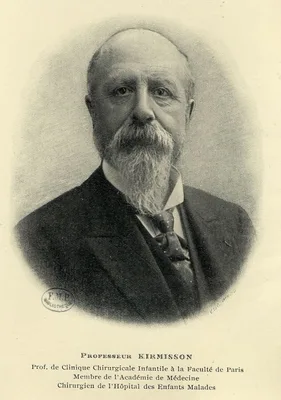
1898 KIRMISSON, Édouard François (1848 – 1927)
Traité des maladies chirurgicales d'origine congénitale.
The first book entirely devoted to the surgical treatment of congenital abnormalities. The work also contains pp. 593-698 an exposition of Kirmisson's staged reduction of congenital dislocations of the hip, and discus…
GMN 10269 · https://historyofmedicine.com/id/12460
1910 SPAULDING, James Alfred (1846 – 1938)
Lowell vs. Faxon and Hawkes: A celebrated malpractice suit in Maine.
Digital facsimile from Google Books at this link.
GMN 11729 · https://historyofmedicine.com/id/13930
1924 WHITMAN, Royal (1857 – 1946)
The reconstruction operation for arthritis deformans of the hip-joint.
The first sustained attempt to relieve osteoarthrosis of the hip by surgical means other than fusion.
GMN 4392.1 · https://historyofmedicine.com/id/5972
1935 PAUWELS, Friedrich (1885 – 1980)
Der Schenkelhalsbruch, Ein mechanische Problem.
Pioneering study of the biomechanics of the hip joint.
GMN 4400.5 · https://historyofmedicine.com/id/6031
1935 PUTTI, Vittorio (1880 – 1940)
Anatomia della lussazione congenita dell'anca.
Putti made many contributions to the understanding of congenital dislocation of the hip, a condition which was then endemic in Northern Italy.
GMN 7798 · https://historyofmedicine.com/id/9970
1939 SMITH-PETERSEN, Marius Nygaard (1886 – 1953)
Arthroplasty of the hip. A new method.
Vitallium cup arthroplasty.
GMN 4403 · https://historyofmedicine.com/id/6045
1950 JUDET, Jean (1905 – 1995); JUDET, Robert Louis (1909 – 1980)
The use of an artificial femoral head for arthroplasty of the hip joint.
Judet acrylic prosthesis.
GMN 4405 · https://historyofmedicine.com/id/6091
1961 CHARNLEY, Sir John (1911 – 1982)
Arthroplasty of the hip: a new operation.
Total hip replacement; Charnley arthroplasty.
GMN 4405.1 · https://historyofmedicine.com/id/6100
1973 PAUWELS, Friedrich (1885 – 1980)
Atlas zur Biomechanik der Gesunden und kranken Hüfte,
Translated into English by Ronald J. Furlong and Paul Maquet as Biomechanics of the normal and diseased hip. Theoretical foundation, technique and results of treatment: An atlas. Berlin: Springer-Verlag, 1976.
GMN 12648 · https://historyofmedicine.com/id/14889