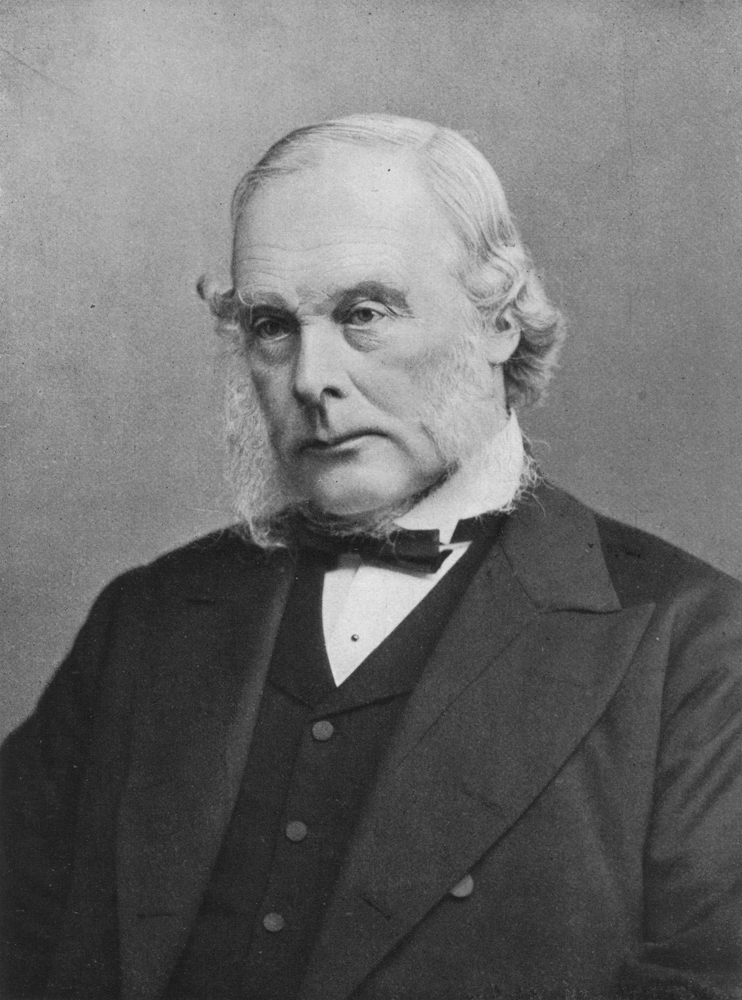
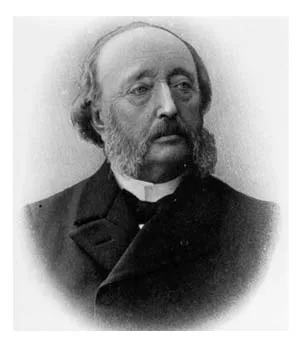
1828 DELPECH, Jacques Mathieu (1777 – 1832)
De l’orthomorphie. 2 vols. and atlas.
Delpech, Professor of Surgery at Montpellier, published a comprehensive treatise on deformities of the bones and joints. He established the tuberculous nature of Pott’s disease. Delpech did more than any other man tow…
GMN 4315 · https://historyofmedicine.com/id/5526
1828 RICHTER, Adolph Leopold (1798 – 1876)
Theoretisch-praktische Handbuch der Lehre von den Bruchen und Verrenkungen der Knochen. 1 vol. and atlas.
The remarkable atlas accompanying this work illustrates in remarkable detail all of the various types of dressings, splints and apparatus used in the treatment of fractures at the time.
GMN 4414.1 · https://historyofmedicine.com/id/6189
1829 –1830 HUTCHINSON, Alexander Copland
Removal of the arm, scapula and clavicle.
Records the first interscapulo-thoracic amputation, performed by Ralph Cuming (d. 1808), a naval surgeon, in 1808.
GMN 4455 · https://historyofmedicine.com/id/61
1829 SYME, James (1799 – 1870)
Three cases in which the elbow-joint was successfully excised.
GMN 4454 · https://historyofmedicine.com/id/134
1830 ROUX, Philibert Joseph (1780 – 1854)
Résection des os.
Among the French surgeons of the 19th century, Roux was second in importance only to Dupuytren. He performed staphylorrhaphy in 1819 and sutured the ruptured female peritoneum in 1832; he is also remembered on account…
GMN 4456 · https://historyofmedicine.com/id/62
1830 GROSS, Samuel David (1805 – 1884)
The anatomy, physiology, and diseases of the bones and joints.
The first American treatise on orthopedics. In his autobiography Gross wrote that, “The title was unfortunate; it should have been A practical treatise on fractures and dislocations, with an account of the diseases of…
GMN 4316.1 · https://historyofmedicine.com/id/5530
1831 SYME, James (1799 – 1870)
Treatise on the excision of diseased joints.
Syme, teacher and father-in-law of Lister, was one of the greatest of the Scottish surgeons. He is remembered for his method of amputation at the ankle (see No. 4459), for his speedy adoption of anesthesia and antisep…
GMN 4457 · https://historyofmedicine.com/id/63
1831 DUPUYTREN, Guillaume, Le Baron (1777 – 1835)
De la rétraction des doigts par suite d’une affection de l’aponévrose palmaire, opération chirurgicale qui convient dans ce cas.
Dupuytren devised an operation for the treatment of contracture of the palmar fascia (“Dupuytren’s contracture”). Reprinted, with translation, in Med. Classics, 1939, 4, 127-50. The condition was first mentioned by Pl…
GMN 4317 · https://historyofmedicine.com/id/5532
1833 STROMEYER, Georg Friedrich Ludwig (1804 – 1876)
Die Durchschneidung der Achillessehne, als Heilmethode des Klumpfusses, durch zwei Fälle erläutert.
Successful tenotomy for clubfoot established the reputation of Stromeyer as an orthopedic surgeon.
GMN 4320 · https://historyofmedicine.com/id/5537
1838 STROMEYER, Georg Friedrich Ludwig (1804 – 1876)
Beiträge zur operativen Orthopädik.
Stromeyer is the founder of modern surgery of the locomotor system. He advocated and practised subcutaneous tenotomy for all deformities of the body arising from muscular defects.
GMN 4321 · https://historyofmedicine.com/id/5538
1838 BARTON, John Rhea (1794 – 1871)
Views and treatment of an important injury of the wrist.
“Barton’s fracture” of the radius.
GMN 4415 · https://historyofmedicine.com/id/6192
1838 WHITE, Anthony (1782 – 1849)
Excision of the head of the femur for disease of the hip-joint. IN: S. COOPER: A dictionary of practical surgery. 7th ed., pp. 272-73
White was the first to perform this operation, April 1821.
GMN 4458 · https://historyofmedicine.com/id/8864
1839 DUPUYTREN, Guillaume, Le Baron (1777 – 1835)
Leçons orales de clinique chirurgicale. 2me. éd. Tom. 3.
Pp. 455-61: Dupuytren was the first to treat wry neck by subcutaneous section of the sternomastoid muscle. This he did on 16 Jan, 1822. The operation was first reported in C. Averill: Short treatise on operative surge…
GMN 4322 · https://historyofmedicine.com/id/5539
1839 LITTLE, William John (1810 – 1894)
On the nature of club-foot and analogous distortions.
Little suffered from club-foot himself. This is the greatest English classic on the subject. See No. 4329.
GMN 4322.1 · https://historyofmedicine.com/id/5540
1839 BROWN, John Ball (1784 – 1862)
Operations on club-feet.
Brown was the first surgeon in the United States to specialize in orthopedics, founding the Orthopedic Infirmary of the City of Boston (soon renamed the Boston Orthopedic Institution) in 1838. Brown was also the first…
GMN 4322.2 · https://historyofmedicine.com/id/5541
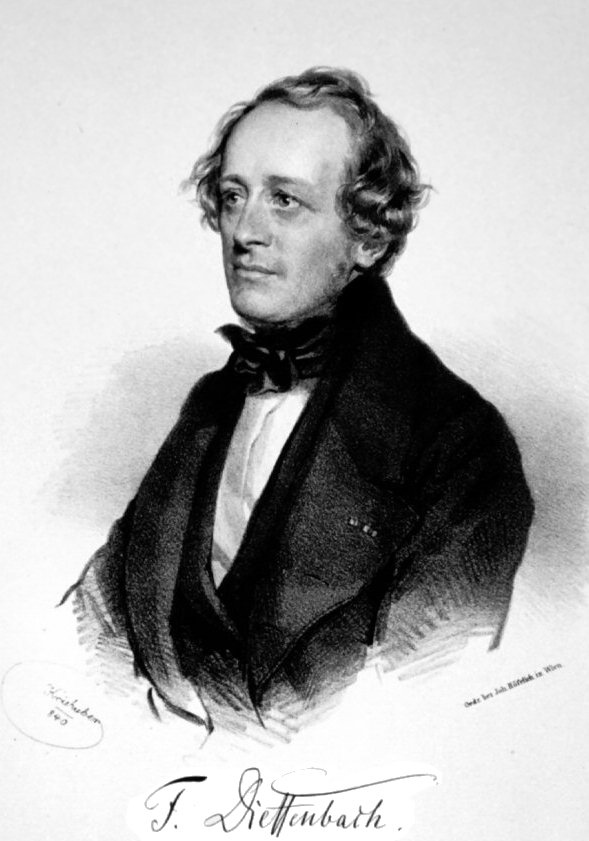
1841 DIEFFENBACH, Johann Friedrich (1792 – 1847)
Ueber die Durchschneidung der Sehnen und Muskeln.
Report on 140 cases of tenotomy for treatment of club-foot.
GMN 4323 · https://historyofmedicine.com/id/5542
1842 –1843 FERGUSSON, Sir William (1808 – 1877)
Excision of a portion of the scapula.
First description of operation for partial excision of scapula.
GMN 4323.1 · https://historyofmedicine.com/id/5544
1842 HEINE, Jacob (Jakob) (1799 – 1879)
Ueber spontane und congenitale Luxationen.
GMN 4416 · https://historyofmedicine.com/id/6193
1843 SYME, James (1799 – 1870)
Amputation at the ankle-joint.
“Syme’s amputation” at the ankle joint, an operation first successfully performed by him on 8 Sept, 1842.
GMN 4459 · https://historyofmedicine.com/id/64
1845 BUCK, Gurdon (1807 – 1877)
The knee-joint anchylosed at a right angle – restored nearly to a straight position after the excision of a wedge-shaped portion of bone, consisting of the patella, condyles and articular surface of the tibia.
Buck’s operation, “one of the more spectacular surgical feats by an American surgeon in the first half of the nineteenth century” (Rutkow). The paper is reprinted in Med. Classics, 1939, 3, 791-99.
GMN 4324 · https://historyofmedicine.com/id/5547
1845 –1848 DIEFFENBACH, Johann Friedrich (1792 – 1847)
Die operative Chirurgie. 2 vols.
Dieffenbach’s most comprehensive work, covering in addition to reconstructive procedures, virtually all other types of procedures including amputations, paracentesis, laparotomy, hysterectomy, dental extractions, etc.
GMN 5598.1 · https://historyofmedicine.com/id/7090
1847 –1855 MALGAIGNE, Joseph François (1806 – 1865)
Traité des fractures et des luxations. 2 vols. and atlas.
This was Malgaigne’s greatest work. His description of bilateral vertical fracture of the pelvis (“Malgaigne’s fracture”) is in vol. 1, pp. 650-56. English translation of the first volume on fractures, Philadelphia, 1…
GMN 4417 · https://historyofmedicine.com/id/6197
1847 SMITH, Robert William (1807 – 1873)
A treatise on fractures in the vicinity of joints and on certain forms of accidental and congenital dislocations.
The first important work on fractures by an Irish author. It includes the description of “Smith’s fracture”. In his chapter “On fractures of the bones of the forearm in the vicinity of the wrist joint” Smith corrected…
GMN 4417.1 · https://historyofmedicine.com/id/6199
1849 MACKENZIE, Richard James (1821 – 1854)
On amputation at the ankle-joint by internal lateral flap.
“Mackenzie’s operation”, a modification of Syme’s amputation (No. 4459). Mackenzie volunteered for service in the Crimean War and died of Asiatic cholera near Sebastopol.
GMN 4460 · https://historyofmedicine.com/id/65
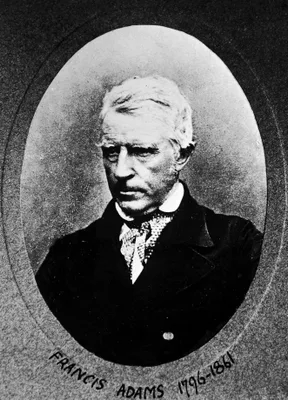
1849 HIPPOCRATES, [Ἱπποκράτης; Hippocrates of Kos] (-460 – -370); ADAMS, Francis (1796 – 1861)
The genuine works of Hippocrates. Translated from the Greek with a preliminary discourse and annotations by Francis Adams. 2 vols.
Francis Adams, surgeon of Banchory, Scotland, prepared this partial translation to acquaint his contemporaries with “the opinions of an author, whom I verily believe to be the highest exemplar of professional excellen…
GMN 14 · https://historyofmedicine.com/id/914
1850 LANGENBECK, Bernard Rudolf Conrad von (1810 – 1887)
Grosses Enchondrom (Gallertknorpel-Geschwulst) des Schulterblattes; Exstirpation des ganzen Schulterblattes mit Ausnahme des Processus coracoides am 6 Febr.; Tod am 7 Febr.
Complete excision of the scapula.
GMN 4326.1 · https://historyofmedicine.com/id/5559
1851 –1852 REID, William Wharry (1799 – 1866)
Dislocation of the femur on the dorsum ilii, reducible without pulleys, or any other mechanical power, three cases.
Reduction of dislocation without manipulation. Reid demonstrated the futility of attempting to reduce a dorsal dislocation of the hip by forcible longitudinal traction with pulleys.
GMN 4418 · https://historyofmedicine.com/id/6203
1852 BIGELOW, Henry Jacob (1818 – 1890)
Resection of the head of the femur.
First excision of the hip-joint in America. Unfortunately the one-page article provides no details.
GMN 4461 · https://historyofmedicine.com/id/66
1853 BRASHEAR, Walter (1776 – 1860)
Amputations.
The first successful amputation of the hip-joint was performed by Brashear in 1806 at Bardstown, Kentucky; he first amputated the thigh through its middle third, and tied off the bleeding vessels; then he made a long …
GMN 4462 · https://historyofmedicine.com/id/67
1853 MCCREARY, Charles (1785 – 1826)
Exsection of the clavicle.
J. H. Johnson (New Orleans med. surg. J., 1850, 6, 474-76) stated that McCreary performed the first resection of the clavicle in the United States on 4 May, 1811. Valentine Mott reported the operation in 1828. See No.…
GMN 4463 · https://historyofmedicine.com/id/68
1854 PIROGOV, Nikolai Ivanovich (Pirogoff) (1810 – 1881)
Kostno-plasticheskoye udlineniye kostei goleni pri vilushtshenii stopi. [Osteoplastic elongation of the bones of the leg in amputation of the foot.]
Pirogov’s method of complete osteoplastic amputation of the foot. German translation, Leipzig, 1854.
GMN 4465 · https://historyofmedicine.com/id/137
1854 BRAINARD, Daniel (1812 – 1866)
Essay on a new method of treating ununited fractures and certain deformities of the osseous system.
Experimenting on animals and cadavers, Brainard developed a special bone drill or “perforator” introduced subcutaneously to perforate the bone ends, simulating a recent fracture, and thus stimulating callus formation.
GMN 4418.1 · https://historyofmedicine.com/id/6206
1854 HEYFELDER, Johann Ferdinand Martin (1798 – 1869)
Ueber Resectionen und Amputationen.
GMN 4464 · https://historyofmedicine.com/id/8865
1855 HAMILTON, Frank Hastings (1813 – 1886)
Deformities after fractures.
Hamilton was a medical inspector of the U.S. Army and later became Professor of Surgery at Bellevue Hospital. See No. 4420.
GMN 1742 · https://historyofmedicine.com/id/3101
1855 SAYRE, Lewis Albert (1820 – 1900)
Exsection of the head of the femur and removal of the upper rim of the acetabulum, for morbus coxarius, with perfect recovery.
Resection of the hip for ankylosis.
GMN 4331 · https://historyofmedicine.com/id/5562
1857 GRITTI, Rocco (1828 – 1920)
Dell’amputazione del femore al terzo inferiore e della disarticulazione del ginocchio.
Gritti’s amputation of the thigh was later improved by Stokes (see No. 4470).
GMN 4466 · https://historyofmedicine.com/id/69
1858 TEALE, Thomas Pridgin (1800 – 1867)
On amputation by a long and a short rectangular flap.
Teale’s method of amputation.
GMN 4467 · https://historyofmedicine.com/id/70
1860 –1862 BUCK, Gurdon (1807 – 1877)
New treatment for fractures of the femur.
Buck’s extension apparatus, an improved method of treating fractures of the femur. Reprinted in Med. Classics, 1939, 3, 764-82.
GMN 4419 · https://historyofmedicine.com/id/6209
1860 HAMILTON, Frank Hastings (1813 – 1886)
A practical treatise on fractures and dislocations.
The first comprehensive treatise in English on the treatment of fractures and dislocations. See No. 1742.
GMN 4420 · https://historyofmedicine.com/id/6212
1860 PERRIN, Maurice (1826 – 1889)
Luxation traumatique suivie de luxation volontaire du fémur droit.
“Perrin–Ferraton disease” of the hip, later more fully dealt with by L. Ferraton, Rev. Orthop. (Paris), 1905, 2 sér., 6, 45-51.
GMN 4421 · https://historyofmedicine.com/id/6215
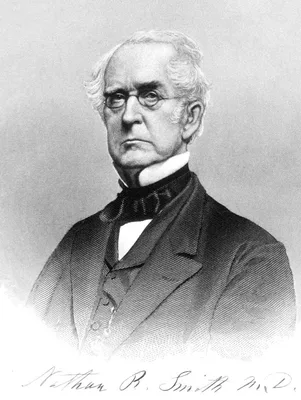
1860 SMITH, Nathan Ryno (1797 – 1877)
A new instrument for the treatment of fractures of the lower extremity.
Smith devised an anterior or suspensatory splint for use in the treatment of fractures of the femur. The apparatus was heavily used during the U.S. Civil War and was especially valuable in treating compound fractures.
GMN 4422 · https://historyofmedicine.com/id/6217
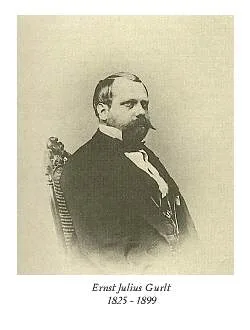
1862 –1865 GURLT, Ernst Julius (1825 – 1899)
Handbuch der Lehre von den Knochenbruchen. 2 vols.
Gurlt, the celebrated historian of surgery (see No. 5800), wrote an exhaustive and detailed review of the literature on fractures. As a source of obscure and arcane information it is unsurpassed. Digital facsimile fro…
GMN 4422.1 · https://historyofmedicine.com/id/6223
1863 EULENBURG, Moritz Michael (1811 – 1877)
Hochgradige Dislocation der Scapula.
First description of congenital high-scapula “Sprengel’s deformity”; see also No. 4359.
GMN 4332 · https://historyofmedicine.com/id/5563
1864 CARDEN, Henry Douglas ( – 1873)
On amputation by a single flap.
Carden devised a single flap operation, cutting through the femur just above the knee-joint. He published a book on the subject in 1864.
GMN 4468 · https://historyofmedicine.com/id/162
1864 BAUER, Louis (1814 – 1898)
Lectures on orthopaedic surgery.
Before emigrating to America, Bauer studied under Stromeyer. Hugh Owen Thomas considered him “the first exponent of American orthopaedics”. This is the first comprehensive American textbook of orthopedics. First publi…
GMN 4334 · https://historyofmedicine.com/id/5565
1865 PRICE, Peter Charles (1832 – 1864)
A description of the diseased conditions of the knee-joint which require amputation of the limb, and those conditions which are favourable to excision of the joint.
A valuable contribution to the knowledge and surgical treatment of diseases of the knee-joint.
GMN 4336 · https://historyofmedicine.com/id/5655
1865 LISTER, Joseph, 1st Baron Lister (1827 – 1912)
On excision of the wrist for caries.
GMN 4469 · https://historyofmedicine.com/id/8867
1867 OLLIER, Louis Xavier Édouard Léopold (1830 – 1900)
Traité expérimentale et clinique de la régenération des os. 2 vols.
Ollier pioneered research in bone allografting.
GMN 4336.1 · https://historyofmedicine.com/id/5659
1867 SMITH, Nathan Ryno (1797 – 1877)
Treatment of fractures of the lower extremity, by use of the anterior suspensory apparatus.
GMN 4423 · https://historyofmedicine.com/id/6226
1867 LISTER, Joseph, 1st Baron Lister (1827 – 1912)
On a new method of treating compound fracture, abscess, etc., with observations on the conditions of suppuration.
Lister’s work on the antiseptic principle in surgery. He believed that bacteria could enter wounds and cause suppuration and putrefaction and that it was necessary to kill the bacteria already in wounds and to apply d…
GMN 4423.1 · https://historyofmedicine.com/id/6230

![HIPPOCRATES, [Ἱπποκράτης; Hippocrates of Kos] (-460 – -370)](/media/portraits/50)