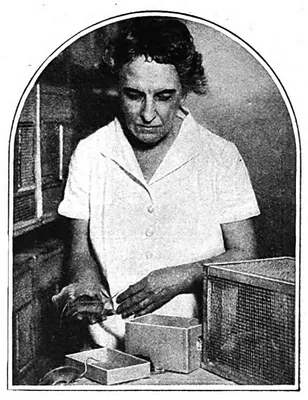
1913 WARTHIN, Aldred Scott (1866 – 1931)
Heredity with reference to carcinoma: As shown by the study of the cases examined in the pathological laboratory of the University of Michigan, 1895-1913.
"In 1895, a young seamstress of his [Warthin's] acquaintance told him about her family's long history of cancer deaths.[6] Intrigued, he researched her family's history, searching death records and administering quest…
GMN 9443 · https://historyofmedicine.com/id/11626
1928 SLYE, Maud (1879 – 1954)
Cancer and heredity.
By selective breeding over a period of 15 years, Slye produced generations of mice absolutely resistant to, or particularly susceptible to, cancer. She demonstrated that resistance is a Mendelian dominant and suscepti…
GMN 2652 · https://historyofmedicine.com/id/3307
1971 KNUDSON, JR., Alfred George (1922 – 2016)
Mutation and cancer: Statistical study of retinoblastoma.
In this paper Knudson first described his "two-hit hypothesis," also known as the "Knudson hypothesis," which explains the incidence of hereditary cancers, such as retinoblastoma. "Humans inherit two copies of every g…
GMN 13964 · https://historyofmedicine.com/id/16266
1976 VARMUS, Harold Eliot (1942 – ); BISHOP, John Michael (1936 – ); STEHELIN, Dominique (1943 – 2019); VOGT, Peter K. (1932 – )
DNA related to the transforming gene(s) of avian sarcoma viruses is present in normal avian DNA.
Discovery of the first “oncogene. In 1989 Varmus and Bishop shared the Nobel Prize for in Physiology or Medicine "for their discovery of the cellular origin of retroviral oncogenes."
GMN 2660.28 · https://historyofmedicine.com/id/3441
1986 ALBERT, Daniel Myron (1936 – ); DRYJA, Thaddeus P.; FRIEND, Stephen H.; BERNARDS, René (1953 – ); ROGELI, Snezna; WEINBERG, Robert A. (1942 – ); RAPAPORT, Joyce M.
A human DNA segment with properties of the gene that predisposes to retinoblastoma and osteosarcoma.
Isolation of the first human tumor suppressor gene. Order of authorship in the original publication: Friend, Bernards, Rogeli, Weinberg, Rapaport, Albert, Dryja.
GMN 13974 · https://historyofmedicine.com/id/16277
1990 KING, Mary-Claire (1946 – )
Linkage of early-onset familial breast cancer to Chromosome 17q21.
King showed that breast cancer can be inherited due to mutations in the Breast cancer type 1 susceptibility protein, a protein that in humans is encoded by the BRAC1 gene. BRCA1 is a human tumor suppressor gene (also …
GMN 13966 · https://historyofmedicine.com/id/16268
1994 SKOLNICK, Mark Henry (1946 – ); MIKI, Yoshio; SHATTUCK-EIDENS, Donna; ET AL
A strong candidate for the breast and ovarian cancer susceptibility gene BRCA1.
Discovery of the BRCA1 gene using the technique of restriction fragment length polymorphism (RFLP). (Thanks to Juan Weiss for this reference and its interpretation.)
GMN 14015 · https://historyofmedicine.com/id/16322
1994 STRATTON, Sir Michael Rudolf (1957 – ); WOOSTER, Richard; NEUHAUSEN, Susan L.; MANGION, Jonathan; ET AL
Location of a breast cancer susceptibility gene, BRACA2, to chromosome 13q12-13.
Stratton and colleagues discovered the BRCA2 gene. Oder of authorship in the original publication: Wooster, Neuhausen, Mangion....Stratton. (Thanks to Juan Weiss for this reference and its interpretation.)
GMN 14016 · https://historyofmedicine.com/id/16323