1868 ALLBUTT, Sir Thomas Clifford (1836 – 1925)
Case of cerebral disease in a syphilitic patient.
Syphilitic endarteritis of cerebral arteries described.
GMN 4778 · https://historyofmedicine.com/id/1496
1868 ORDENSTEIN, Leopold (1835 – 1902)
Sur la paralysie agitante et la sclérose en plaques généralisée.
In his doctoral thesis Ordenstein, a pupil of Charcot, first defined the clinical features of multiple schlerosis in detail, with pathologic confirmation, and distinguished the main symptoms and pathologic findings of…
GMN 13813 · https://historyofmedicine.com/id/16102
1869 BASTIAN, Henry Charlton (1837 – 1915)
On the various forms of loss of speech in cerebral disease.
Bastian’s first important paper on aphasia. His axiom “We think in words” explains his whole work on the subject. See also his later paper on pp. 470-92 of the same volume.
GMN 4622 · https://historyofmedicine.com/id/663
1869 CHARCOT, Jean Martin (1825 – 1893); JOFFROY, Alex (1844 – 1908)
Deux cas d’atrophie musculaire progressive avec lésions de la substance grise et des faisceaux antéro-latéraux de la moëlle épinière.
Description of the lesions of the spinal cord in muscular atrophy.
GMN 4740 · https://historyofmedicine.com/id/1321
1869 MÜNCHMEYER, Ernst (1846 – 1880)
Ueber Myositis ossificans progressiva.
Münchmeyer described a form of progressive ossifying myositis (“Münchmeyer’s disease”).
GMN 4741 · https://historyofmedicine.com/id/1324
1869 ALLBUTT, Sir Thomas Clifford (1836 – 1925)
Remarks on a case of locomotor ataxy with hydrarthrosis.
An early description of the joint symptoms in tabes dorsalis.
GMN 4779 · https://historyofmedicine.com/id/1506
1869 ROBERTSON, Douglas Moray Cooper Lamb Argyll (1837 – 1909)
On an interesting series of eye symptoms in a case of spinal disease, with remarks on the action of belladonna on the iris.
“Argyll Robertson pupil” first described. See also his later paper in the same journal, 1869, 15, 487-93. Reprinted in Med. Classics, 1937, 1, 851-76.
GMN 4540 · https://historyofmedicine.com/id/8902
1870 BRUNS, Paul von (1846 – 1916)
Das Rankenneurom.
Original description of plexiform neurofibroma.
GMN 4541 · https://historyofmedicine.com/id/402
1870 CHARCOT, Jean Martin (1825 – 1893); JOFFROY, Alex (1844 – 1908)
Une observation de paralysie infantile s’accompagnant d’une altération des cornes antérieures de la substance grise de la moëlle.
First demonstration of the atrophy of the anterior horns of the spinal cord in infantile paralysis, confirming earlier suggestions of von Heine and Duchenne.
GMN 4665 · https://historyofmedicine.com/id/801
1871 HAMMOND, William Alexander (1828 – 1900)
Treatise on diseases of the nervous system.
The first American treatise on neurology. The original description of athetosis, sometimes called “Hammond’s disease”, appears on pp. 654-62. During his tenure as Surgeon General of the Army during the U.S. Civil War,…
GMN 4542 · https://historyofmedicine.com/id/403
1871 –1888 BROCA, Pierre Paul (1824 – 1880)
Mémoires d’anthropologie. 5 vols.
Most often remembered for his contributions to neurology, Broca was also among the greatest of the French anthropologists. He originated modern craniometry and in that connection devised many craniometric and craniosc…
GMN 169 · https://historyofmedicine.com/id/3253
1871 –1872 PANCOAST, Joseph (1805 – 1882)
New operation for the relief of persistent facial neuralgia.
Pancoast devised the operative procedure of sectioning the second and third branches of the fifth pair of nerves as they emerge from the base of the brain. Reported by F. Woodbury.
GMN 4855 · https://historyofmedicine.com/id/5618
1872 MITCHELL, Silas Weir (1829 – 1914)
Clinical lecture on certain painful affections of the feet.
Mitchell suggested the name “erythromelalgia” for this condition, which is also known as “Weir Mitchell’s disease”. He records four earlier writers on the subject, the first being Graves in 1848. See also his paper in…
GMN 2706 · https://historyofmedicine.com/id/406
1872 –1887 CHARCOT, Jean Martin (1825 – 1893)
Leçons sur les maladies du système nerveux faites à La Salpêtrière.
An excellent idea of Charcot’s work is gained by perusal of his Leçons, dealing with his teaching on nervous disorders. In the second volume, pp. 1-72, is a classic account of the anomalies of tabes dorsalis. Charcot …
GMN 4546 · https://historyofmedicine.com/id/407
1872 HUNTINGTON, George (1850 – 1916)
On chorea.
The classic description by Huntington of the chronic degenerative hereditary type of chorea led to the eponym “Huntington’s chorea”. Earlier accounts of the disease were given by John Elliotson (Lancet, 1832, 1, 163),…
GMN 4699 · https://historyofmedicine.com/id/985
1872 KUSSMAUL, Adolf (1822 – 1902)
Zur Lehre von der Tetanie.
Important observations on gastric tetany were made by Kussmaul. He called attention to the convulsions sometimes accompanying dilatation of the stomach. He first mentioned “gastric tetany” in 1869 in his paper on gast…
GMN 4831 · https://historyofmedicine.com/id/1665
1872 DUCHENNE DE BOULOGNE, Guillaume Benjamin Armand (1806 – 1875)
De l’électrisation localisée et de son application à la pathologie et à la thérapeutique. 3me. éd.
Early description, page 357, of partial brachial plexus paralysis, upper type (“Duchenne-Erb palsy”: see No. 4548). An English translation of the 3rd ed., by H. Tibbitts, actually appeared London in 1871, one year bef…
GMN 4543 · https://historyofmedicine.com/id/8906
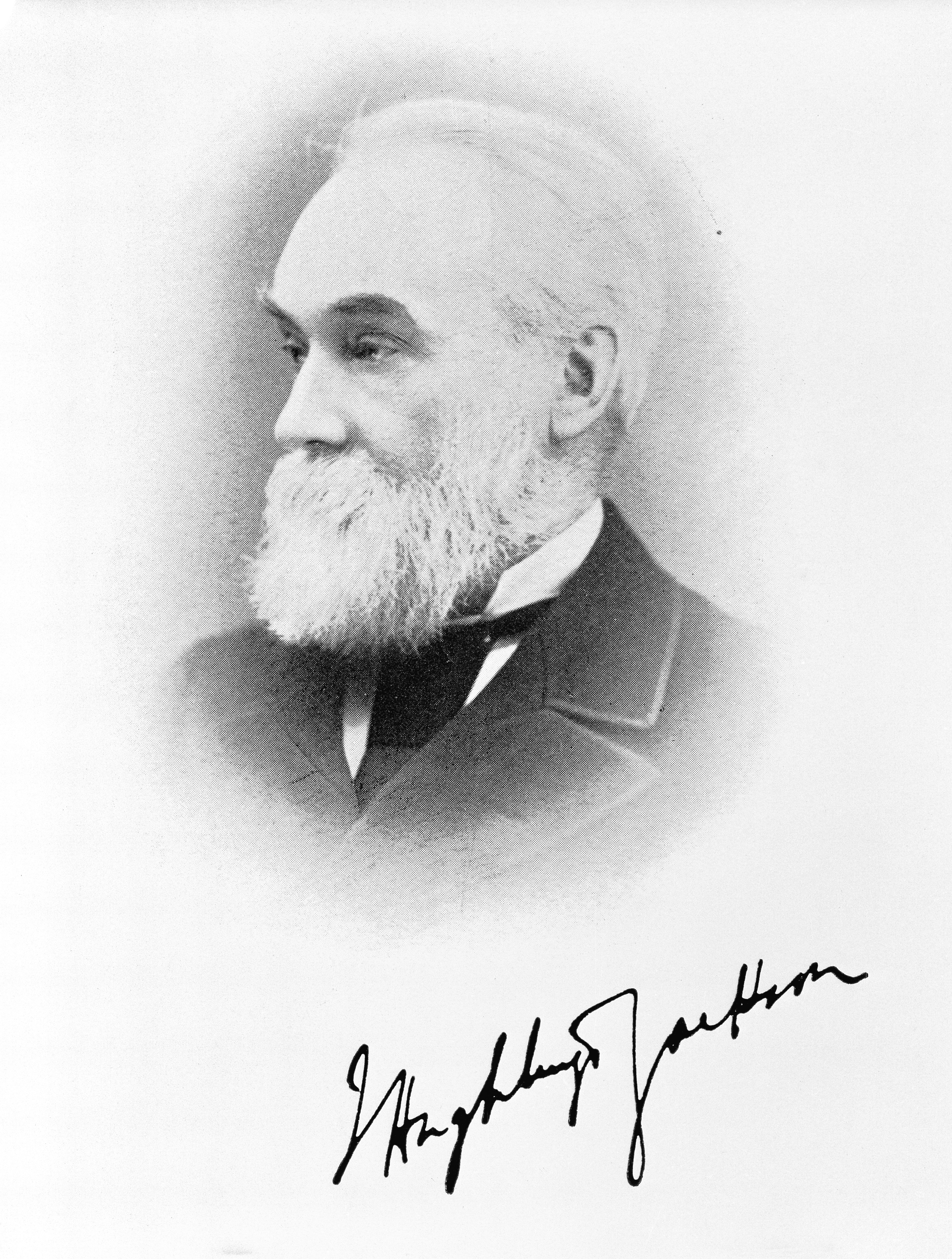
1872 JACKSON, John Hughlings (1835 – 1911)
On a case of paralysis of the tongue from haemorrhage in the medulla oblongata.
Jackson here described the syndrome consisting of paralysis of half the tongue, the same half of the palate, and of one vocal cord – “Jackson’s syndrome”.
GMN 4547 · https://historyofmedicine.com/id/8911
1873 LIVEING, Edward (1832 – 1919)
On megrim, sick-headache, and some allied disorders.
Liveing’s classic account of migraine showed the close association of this condition with tetany, asthma, and false angina pectoris, with epilepsy, and the alternation of all these conditions in the same subject or th…
GMN 2587 · https://historyofmedicine.com/id/409
1873 –1874 ERB, Wilhelm Heinrich (1840 – 1921)
Zur Lehre von der Tetanie nebst Bemerkungen über die Prufung der electrischen Erregbarkeit motorischer Nerven.
“Erb’s sign”.
GMN 4832 · https://historyofmedicine.com/id/3577
1873 –1877 ERB, Wilhelm Heinrich (1840 – 1921)
Ueber eine eigenthümliche Localisation von Lähmungen im Plexus brachialis.
“Erb’s palsy”, first described by Smellie in 1763 and later by Duchenne (No. 4543).
GMN 4548 · https://historyofmedicine.com/id/8913
1874 –1875 LEYDEN, Ernst Viktor von (1832 – 1910)
Klinik der Rückenmarks-Krankheiten.
One of Leyden’s best works. He was Professor of Medicine at Berlin, Königsberg, and Strassburg. In vol. 2, p. 65, of the above is given an account of “Leyden’s paralysis”, a form of hemiplegia probably first described…
GMN 4550 · https://historyofmedicine.com/id/410
1874 MITCHELL, Silas Weir (1829 – 1914)
Headaches, from heat-stroke, from fevers, after meningitis, from overuse of brain, from eyestrain.
Mitchell drew attention to the importance of eyestrain as a cause of headache.
GMN 4551 · https://historyofmedicine.com/id/411
1874 MITCHELL, Silas Weir (1829 – 1914)
Post-paralytic chorea.
First description.
GMN 4552 · https://historyofmedicine.com/id/412
1874 WERNICKE, Carl (1848 – 1905)
Der aphasische Symptomencomplex.
Sensory aphasia (“Wernicke’s aphasia”). Wernicke did important work on the localization of aphasia; he included in his book accounts of alexia and agraphia. English translation in Boston Studies in the Philosophy of S…
GMN 4623 · https://historyofmedicine.com/id/665
1874 CHARCOT, Jean Martin (1825 – 1893)
Des amyotrophies spinales chroniques.
Charcot differentiated between the ordinary (Aran–Duchenne) type of muscular atrophy and the rarer amyotrophic lateral sclerosis, (ALS), at one time called “Charcot’s disease,” but more frequently designated today as …
GMN 4742 · https://historyofmedicine.com/id/1326
1875 MITCHELL, Silas Weir (1829 – 1914)
On rest in the treatment of nervous disease.
First account of the “Weir Mitchell treatment”.
GMN 4553 · https://historyofmedicine.com/id/414
1875 ERB, Wilhelm Heinrich (1840 – 1921)
Ueber einen wenig bekannten spinalen Symptomencomplex.
“Erb–Charcot disease” (spastic spinal paralysis).
GMN 4556 · https://historyofmedicine.com/id/418
1875 GAYET, Alphonse-Charles (1833 – 1904)
Affection encéphalique (encéphalite diffuse probable) localisée aux étages supérieurs des pédoncules cérébraux et aux couches optiques.
First description of acute superior hemorrhagic polioencephalitis. Called also “Wernicke’s encephalopathy”, following the latter’s description in his Lehrbuch der Gehirnkrankheiten, Kassel, 1881, 2, 229-42.
GMN 4641 · https://historyofmedicine.com/id/710
1875 ERB, Wilhelm Heinrich (1840 – 1921)
Ueber acute Spinällahmung (Poliomyelitis anterior acuta) bei Erwachsenen und über verwandte spinale Erkrankungen.
Erb was first to use the term “acute anterior poliomyelitis”.
GMN 4665.1 · https://historyofmedicine.com/id/815
1875 –1876 LEYDEN, Ernst Viktor von (1832 – 1910)
Klinik der Rückenmarks-Krankheiten. Bd. 2, pt.2.
First description of myotonia congenita occurs on p. 550.
GMN 4743 · https://historyofmedicine.com/id/1332
1875 ERB, Wilhelm Heinrich (1840 – 1921)
Ueber Sehnenreflexe bei Gesunden und bei Rückenmarkskranken.
Knee-jerk first used as diagnostic measure in tabes dorsalis.
GMN 4780 · https://historyofmedicine.com/id/1511
1875 WESTPHAL, Carl Friedrich Otto (1833 – 1890)
Ueber einige durch mechanische Einwirkung auf Sehnen und Muskeln hervorgebrachte Bewegungs-Erscheinungen.
Westphal discovered the diagnostic value of the knee-jerk simultaneously with Erb.
GMN 4781 · https://historyofmedicine.com/id/1513
1875 JACKSON, John Hughlings (1835 – 1911)
Case of hemikinesis.
GMN 4817 · https://historyofmedicine.com/id/1615
1875 –1888 HUTCHINSON, Sir Jonathan (1828 – 1913)
Illustrations of clinical surgery. 2 vols.
Vol. 1 pp. 49-52: Hutchinson’s classic description of cheiropompholyx, dysidrosis (“Hutchinson’s disease”). The first description and illustration of sarcoidosis is on p. 42.
GMN 4067 · https://historyofmedicine.com/id/5464
1876 –1878 ERB, Wilhelm Heinrich (1840 – 1921)
Handbuch der Krankheiten des Nervensystems.
Erb was Professor of Neurology at Heidelberg. He gave the original descriptions of several nervous disorders, especially the muscular dystrophies, and was a pioneer in the use of electrotherapy.
GMN 4557 · https://historyofmedicine.com/id/419
1876 –1880 CHARCOT, Jean Martin (1825 – 1893)
Leçons sur les localisations dans les maladies du cerveau.
Charcot is especially notable for his important study of the localization of functions in diseases of the brain. Volume two is entitled Leçons sur les localisations dans les maladies du cerveau et de la moëlle épinièr…
GMN 4558 · https://historyofmedicine.com/id/421
1876 THOMSEN, Asmus Julius Thomas (1815 – 1896)
Tonische Krämpfe in willkürlich beweglichen Muskeln in Folge von ererbter psychischer Disposition (Ataxia muscularis?).
Thomsen suffered from muscle weakness and cramps, an issue that all his sons inherited. Realizing that this was a hereditary disease, Thomsen managed to trace the disease for six generations, and found over 20 cases o…
GMN 4744 · https://historyofmedicine.com/id/1336
1876 CHVOSTEK, František (1835 – 1884)
Beitrag zur Tetanie.
“Chvostek’s sign”, a reliable diagnostic sign in latent tetany in small children.
GMN 4833 · https://historyofmedicine.com/id/3583
1876 –1880 CHARCOT, Jean Martin (1825 – 1893); BOURNEVILLE, Désiré-Magloire (1840 – 1909); REGNARD, Paul-Marie-Léon (1850 – 1927)
Iconographie photographique de la Salpêtrière. Service de M. Charcot. 3 vols.
A photographic atlas devoted to cases of hysteria and epilepsy, with case histories; the third volume includes discussions of hypnotism, somnambulism and magnetism. Bourneville was Charcot’s assistant at the Salpêtriè…
GMN 4558.1 · https://historyofmedicine.com/id/8918
1877 MITCHELL, Silas Weir (1829 – 1914)
Fat and blood and how to make them.
Includes full account of Weir Mitchell’s rest cure for nervous disorders.
GMN 4554 · https://historyofmedicine.com/id/415
1877 MITCHELL, Silas Weir (1829 – 1914)
The relation of pain to weather, being a study of the natural history of a case of traumatic neuralgia.
First study of the subject.
GMN 4555 · https://historyofmedicine.com/id/417
1877 KUSSMAUL, Adolf (1822 – 1902)
Die Störungen der Sprache.
Kussmaul termed aphasia “word-blindness”. The book was issued as a supplement to vol. 12 of Ziemssen’s Handbuch der speciellen Pathologie und Therapie. English translation in Ziemssen’s Cyclopedia of the practice of m…
GMN 4624 · https://historyofmedicine.com/id/670
1877 WILKS, Sir Samuel (1824 – 1911)
On cerebritis, hysteria, and bulbar paralysis, as illustrative of arrest of function of the cerebro-spinal centres.
The case of “bulbar paralysis” (pp. 45-55) is believed to be the first definite record of myasthenia gravis.
GMN 4745 · https://historyofmedicine.com/id/1339
1877 CLOUSTON, Sir Thomas Smith (1841 – 1915)
A case of general paralysis at the age of sixteen.
Clouston, eminent English psychiatrist, was the first definitely to recognize the relationship between paresis and congenital syphilis and to report a case. This paper is also of interest as being the only recorded ca…
GMN 4799 · https://historyofmedicine.com/id/1556
1878 BERNHARDT, Martin (1844 – 1915)
Neuropathologische Beobachtungen.
Bernhardt drew attention to meralgia paraesthetica in the leg (“Bernhardt’s disease”) due to disease of the external cutaneous nerve of the thigh.
GMN 4559 · https://historyofmedicine.com/id/423
1879 NOTHNAGEL, Carl Wilhelm Hermann (1841 – 1905)
Topische Diagnostik der Gehirnkrankheiten.
On p. 220 is the description of unilateral oculomotor paralysis combined with cerebellar ataxia, “Nothnagel’s syndrome”.
GMN 4560 · https://historyofmedicine.com/id/424
1879 STURGE, William Allen (1850 – 1919)
A case of partial epilepsy, apparently due to a lesion of one of the vasomotor centres of the brain.
“Sturge–Weber syndrome” – association of a port-wine nevus in the skin of the face with a vascular abnormality of the meninges on the same side. See No. 4605.2.
GMN 4560.1 · https://historyofmedicine.com/id/426
1879 –1880 LEYDEN, Ernst Viktor von (1832 – 1910)
Ueber Poliomyelitis und Neuritis.
Leyden enjoyed a great reputation as a neurologist and his paper on poliomyelitis and neuritis is one of his best works. He was one of the founders of the journal in which it appeared.
GMN 4666 · https://historyofmedicine.com/id/817
1879 ERB, Wilhelm Heinrich (1840 – 1921)
Ueber einen eigenthümlichen bulbären (?) Symptomenkomplex.
Myasthenia gravis (“Erb-Goldflam disease”; see also No. 4757). A further paper on the subject by Erb appears in the above volume, pp. 325-50.
GMN 4746 · https://historyofmedicine.com/id/1341